Polygon ZK-EVM Upgrade: Costs, Security, & Developer Adoption
Polygon’s ZK-EVM upgrade is poised to revolutionize its ecosystem by significantly reducing transaction costs and bolstering network security, forecasting a substantial 20% surge in developer adoption by mid-2025.
The blockchain landscape is in a constant state of evolution, with innovations frequently emerging to address persistent challenges. Among these, the Polygon ZK-EVM Upgrade stands out as a pivotal development, promising to reshape how decentralized applications interact with the Ethereum network by significantly impacting transaction costs, bolstering network security, and projecting a substantial increase in developer adoption.
Understanding the ZK-EVM Revolution
The concept of Zero-Knowledge Ethereum Virtual Machine (ZK-EVM) represents a monumental leap in layer-2 scaling solutions for Ethereum. It combines the power of zero-knowledge proofs with the familiarity of the Ethereum Virtual Machine, creating an environment where transactions can be processed off-chain with cryptographic guarantees of correctness, then settled on the mainnet.
This technical synergy is designed to inherit Ethereum’s security while drastically improving scalability and reducing computational overhead. For Polygon, a leading layer-2 solution, integrating ZK-EVM is not just an incremental update but a foundational shift that promises to unlock new possibilities for decentralized applications (dApps) and their users.
The Core Principles of ZK-EVM
ZK-EVM operates on several key principles that collectively contribute to its efficiency and security. Understanding these principles is crucial to appreciating the full scope of Polygon’s upgrade.
- Zero-Knowledge Proofs: These cryptographic methods allow one party to prove to another that a statement is true, without revealing any information beyond the validity of the statement itself. In ZK-EVM, this means transaction validity can be proven without exposing the details of each individual transaction.
- EVM Equivalence: This ensures that the ZK-EVM environment behaves identically to the Ethereum Virtual Machine, allowing developers to easily migrate existing dApps or build new ones without significant code changes or learning new programming languages.
- Rollup Technology: ZK-EVMs typically employ rollup technology, bundling thousands of transactions into a single batch and generating a cryptographic proof for the entire batch. This proof is then submitted to the Ethereum mainnet, dramatically reducing the amount of data stored on-chain.
These principles work in concert to create a highly efficient and secure scaling solution. The ability to process transactions off-chain while maintaining compatibility with Ethereum’s extensive ecosystem is a game-changer for blockchain development.
In essence, the ZK-EVM revolution is about delivering a more performant and cost-effective blockchain experience without compromising the fundamental security assurances provided by Ethereum. Polygon’s adoption of this technology positions it at the forefront of this transformative movement.
Impact on Transaction Costs
One of the most immediate and tangible benefits of the Polygon ZK-EVM upgrade is its profound impact on transaction costs. High gas fees on the Ethereum mainnet have long been a barrier to entry for many users and a significant operational expense for dApps. ZK-EVM offers a compelling solution to this challenge.
By batching numerous transactions and submitting a single zero-knowledge proof to the Ethereum mainnet, the fixed cost of interacting with Ethereum is amortized across thousands of individual transactions. This significantly reduces the per-transaction cost for users on the Polygon network. This efficiency is not merely theoretical; it has been observed in other ZK-rollup implementations and is a core promise of ZK-EVM.
The Mechanism of Cost Reduction
The cost reduction mechanism within ZK-EVM is multi-faceted. Firstly, the data footprint on the Ethereum mainnet is drastically minimized. Instead of each transaction requiring its own block space, only a concise proof is needed. Secondly, the computational burden of verifying individual transactions is moved off-chain to specialized provers.
- Batch Processing: Thousands of transactions are grouped, and a single cryptographic proof is generated, reducing the number of mainnet interactions.
- Off-Chain Computation: The heavy lifting of transaction validation occurs off-chain, freeing up valuable Ethereum mainnet resources.
- Data Compression: Zero-knowledge proofs are highly efficient, compressing vast amounts of transaction data into a compact, verifiable format.
These factors combine to create an environment where users can execute transactions on Polygon at a fraction of the cost they would incur directly on the Ethereum mainnet. This affordability is crucial for fostering broader adoption of decentralized applications, especially microtransactions and high-frequency operations.
Ultimately, lower transaction costs translate into a more accessible and user-friendly blockchain experience. For Polygon, this means attracting a wider user base and enabling dApps that were previously economically unfeasible due to high gas fees.
Enhancing Network Security
Beyond cost efficiency, the Polygon ZK-EVM upgrade brings significant enhancements to network security. Unlike optimistic rollups, which rely on a challenge period for fraud detection, ZK-rollups like ZK-EVM provide instant cryptographic finality. This means that once a zero-knowledge proof is verified on the Ethereum mainnet, the transactions it represents are considered cryptographically valid and irreversible.
This inherent security model is a major advantage, as it eliminates the need for users to wait through a potentially lengthy challenge period before their funds can be withdrawn or their transactions are considered final. The security of the ZK-EVM is directly inherited from the underlying Ethereum mainnet, ensuring a robust and trustworthy environment.
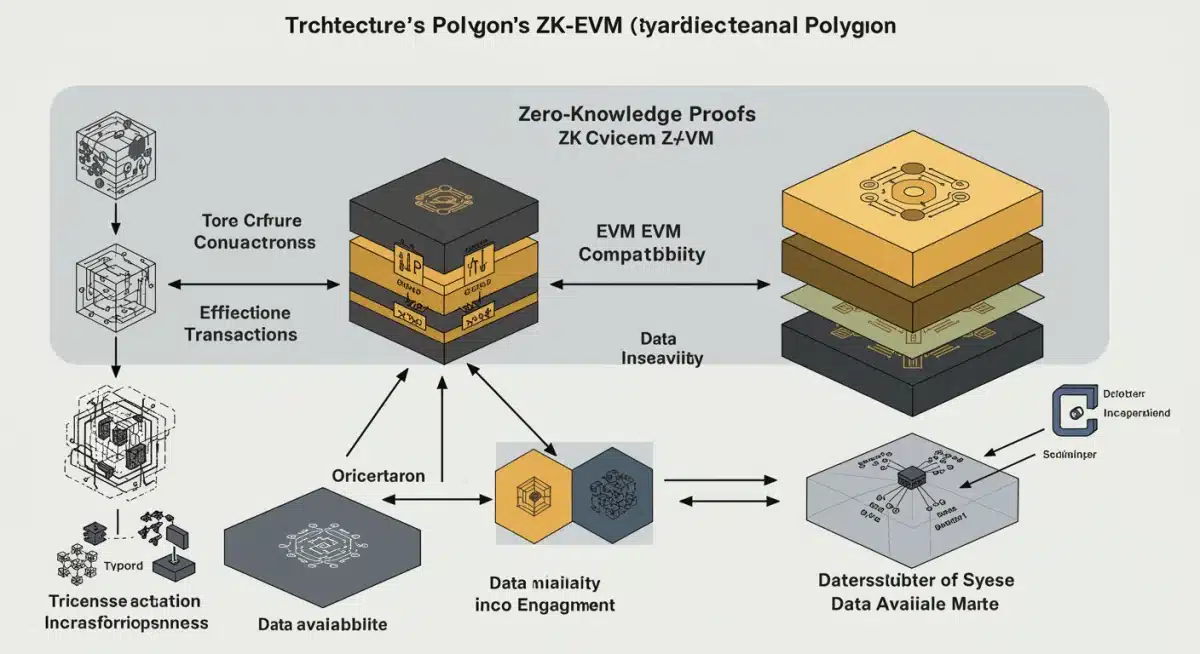
Cryptographic Guarantees and Fraud Prevention
The security of ZK-EVM hinges on sophisticated cryptographic techniques that make fraudulent transactions virtually impossible to commit undetected. Any attempt to submit an invalid proof would be immediately rejected by the mainnet smart contract.
- Mathematical Verification: Zero-knowledge proofs rely on complex mathematical algorithms that are incredibly difficult to tamper with.
- Ethereum Mainnet Security: The ZK-EVM inherits the robust security of the Ethereum blockchain, leveraging its decentralized consensus and vast network of validators.
- Instant Finality: Transactions are cryptographically proven valid, eliminating the need for dispute resolution periods common in other scaling solutions.
This robust security framework instills greater confidence in users and developers alike. Knowing that transactions are secured by immutable cryptographic proofs and backed by Ethereum’s security model reduces risks associated with off-chain computation. This enhanced security is a critical factor in attracting sensitive applications and enterprises to the Polygon ecosystem.
In conclusion, the ZK-EVM upgrade not only makes transactions cheaper but also significantly fortifies the security posture of the Polygon network, making it a more reliable and trustworthy platform for decentralized innovation.
Projecting Developer Adoption Growth
The combined benefits of reduced transaction costs and enhanced security are expected to be a powerful magnet for developers. The projection of a 20% increase in developer adoption by mid-2025 is not merely an optimistic estimate but a calculated outcome based on the fundamental improvements the ZK-EVM brings. Developers are constantly seeking platforms that offer efficiency, security, and ease of use, and Polygon’s ZK-EVM delivers on all these fronts.
The EVM compatibility of Polygon’s ZK-EVM is particularly attractive. It means that developers familiar with Ethereum’s ecosystem do not need to learn new programming languages or tools. They can leverage their existing knowledge and codebase, significantly lowering the barrier to entry for building and deploying dApps on Polygon.
Factors Driving Developer Interest
Several factors contribute to the anticipated surge in developer adoption. These elements address common pain points and offer compelling reasons for developers to choose Polygon’s ZK-EVM.
- EVM Compatibility: Seamless migration and deployment of existing Ethereum dApps without significant code changes.
- Lower Development Costs: Reduced gas fees make testing, deploying, and maintaining dApps more affordable for developers.
- Enhanced User Experience: Faster transaction finality and lower costs translate to a better experience for end-users, which in turn attracts more users to dApps built on Polygon.
- Robust Tooling and Ecosystem: Polygon already boasts a thriving developer community and a rich ecosystem of tools and resources, which will only be strengthened by the ZK-EVM.
The ability to build scalable, secure, and cost-effective dApps is a primary driver for developer choice. Polygon’s ZK-EVM upgrade directly addresses these needs, creating a highly attractive environment for innovation. The projected growth in developer adoption indicates a strong market response to these improvements, signaling a vibrant future for the Polygon ecosystem.
This increase in developer activity will lead to a richer variety of dApps, further enhancing the network’s utility and value proposition for users.
Challenges and Considerations for ZK-EVM Implementation
While the Polygon ZK-EVM upgrade promises substantial benefits, its implementation is not without challenges and important considerations. The complexity of zero-knowledge cryptography requires significant computational resources for proof generation, which can be a bottleneck.
Additionally, the nascent stage of ZK-EVM technology means that ongoing research and development are crucial to optimize performance and ensure long-term stability. Developers also need to be aware of the nuances involved in working with ZK-proofs, even with EVM compatibility, to fully leverage its capabilities.
Technical Hurdles and Optimization
The primary technical hurdle lies in the efficiency of proof generation. While ZK-proofs offer incredible security, generating them can be computationally intensive and time-consuming. Optimizing these processes is an ongoing area of research and development for the Polygon team.
- Proof Generation Speed: Improving the speed at which zero-knowledge proofs are generated without compromising security.
- Prover Decentralization: Ensuring that the provers (entities generating proofs) are sufficiently decentralized to prevent single points of failure or censorship.
- Audit and Security Reviews: Continuous auditing and security reviews are essential to identify and mitigate any potential vulnerabilities in the complex cryptographic codebase.
Furthermore, while the ZK-EVM aims for EVM equivalence, there might be subtle differences or edge cases that developers need to account for when migrating or building dApps. Thorough testing and documentation are paramount to ensure a smooth transition and reliable operation.
Despite these challenges, the commitment from Polygon and the broader blockchain community to advancing ZK-EVM technology suggests that these hurdles will be overcome. The long-term benefits of scalability and security far outweigh the initial complexities of implementation.
The Future Landscape: Polygon’s Strategic Position
With the ZK-EVM upgrade, Polygon is strategically positioning itself as a leading contender in the race for Ethereum scaling solutions. By offering a robust, secure, and cost-effective environment, it aims to attract a new wave of innovation and solidify its place as a critical infrastructure provider for the decentralized web.
The anticipated increase in developer adoption by mid-2025 is a testament to the market’s recognition of ZK-EVM’s potential. This influx of talent and projects will further decentralize and diversify the Polygon ecosystem, creating a virtuous cycle of growth and development.
Long-Term Vision and Ecosystem Growth
Polygon’s long-term vision extends beyond merely scaling Ethereum. It involves building a comprehensive ecosystem that supports a wide array of use cases, from DeFi and NFTs to enterprise solutions and gaming. The ZK-EVM is a cornerstone of this vision, providing the foundational technology to achieve these ambitious goals.
- Interoperability: Continued focus on seamless integration with other blockchain networks and layer-2 solutions.
- Community Empowerment: Fostering a strong, engaged community of developers and users who contribute to the network’s evolution.
- Sustainable Growth: Implementing economic models that ensure the long-term viability and sustainability of the Polygon network.
The ZK-EVM upgrade is not just a technical improvement; it’s a strategic move that enhances Polygon’s competitiveness and appeal. As the blockchain space matures, solutions that offer both performance and security will be paramount, and Polygon is clearly aiming to be at the forefront of this evolution. The future looks promising for Polygon, with the ZK-EVM upgrade serving as a catalyst for significant growth and innovation.
This strategic move ensures Polygon remains relevant and attractive in a rapidly evolving market, setting the stage for sustained expansion and increased utility.
| Key Aspect | Impact of ZK-EVM Upgrade |
|---|---|
| Transaction Costs | Significantly reduced by batching transactions and submitting concise zero-knowledge proofs to Ethereum. |
| Network Security | Enhanced through cryptographic guarantees and instant finality, inheriting Ethereum’s robust security model. |
| Developer Adoption | Projected 20% increase by mid-2025 due to EVM compatibility, lower costs, and improved user experience. |
| Scalability | Greatly improved by offloading computation and data storage from the Ethereum mainnet. |
Frequently Asked Questions
Polygon’s ZK-EVM upgrade is a layer-2 scaling solution for Ethereum that combines zero-knowledge proofs with EVM compatibility. It allows for off-chain transaction processing with cryptographic security, significantly reducing costs and improving scalability for decentralized applications.
It reduces costs by batching numerous transactions into a single proof submitted to the Ethereum mainnet. This amortizes the fixed cost across many transactions, making individual operations much cheaper than direct mainnet interactions.
ZK-EVM enhances security by providing instant cryptographic finality for transactions. It leverages zero-knowledge proofs to guarantee transaction validity without revealing details, inheriting Ethereum’s robust security model without reliance on challenge periods.
The projection stems from ZK-EVM’s EVM compatibility, which simplifies dApp migration and development, coupled with significantly lower transaction costs and enhanced security. These factors create an attractive environment for developers seeking efficient and reliable platforms.
Key challenges include optimizing the computational intensity and speed of zero-knowledge proof generation, ensuring prover decentralization, and continuous security audits. These technical hurdles require ongoing research and development efforts to overcome.
Conclusion
The Polygon ZK-EVM upgrade marks a significant milestone in the evolution of blockchain technology, particularly for the Ethereum ecosystem. By effectively addressing the critical issues of high transaction costs and scalability, while simultaneously bolstering network security through cryptographic assurances, Polygon is charting a course toward a more efficient and accessible decentralized future. The projected 20% increase in developer adoption by mid-2025 underscores the market’s confidence in this transformative technology, setting the stage for a period of accelerated innovation and ecosystem expansion within the Polygon network.