Reducing Impermanent Loss: 2025 DeFi Pool Guide

This article provides a comprehensive guide to reducing impermanent loss in US-compliant decentralized finance (DeFi) liquidity pools by 2025, offering actionable strategies for liquidity providers.
As the DeFi landscape continues to evolve, understanding and mitigating risks like reducing impermanent loss becomes paramount for liquidity providers. This guide offers a deep dive into effective strategies and tools to protect your investments in US-compliant DeFi pools by 2025.
Understanding Impermanent Loss in DeFi
Impermanent loss (IL) is a critical concept for anyone providing liquidity to decentralized exchanges (DEXs). It refers to the temporary loss of funds experienced by a liquidity provider due to price changes of the deposited assets. This loss is ‘impermanent’ because if the assets return to their original deposited prices, the loss disappears. However, if the prices diverge significantly, the loss can become permanent upon withdrawal, impacting overall returns.
The mechanics behind impermanent loss are tied to how automated market makers (AMMs) operate. When you provide liquidity, you typically deposit two assets in a specific ratio. If the price of one asset changes relative to the other, arbitrageurs will rebalance the pool, effectively selling the appreciating asset and buying the depreciating one. This rebalancing means that when you withdraw your liquidity, you might end up with a higher quantity of the underperforming asset and a lower quantity of the outperforming one, compared to simply holding the assets outside the pool.
The Core Mechanism of IL
Impermanent loss arises from the constant product formula (x * y = k) used by many AMMs. This formula ensures that the total value of the liquidity pool remains constant, but the quantities of each asset adjust based on price movements. For example, if you deposit Ether (ETH) and a stablecoin like USDC, and ETH’s price increases, arbitrageurs will add USDC and remove ETH from the pool to restore the balance, leaving you with less ETH than you would have had by just holding it.
- Price Divergence: The greater the price difference between the two assets since deposit, the higher the impermanent loss.
- Arbitrage Activity: Arbitrageurs play a crucial role in maintaining pool balance, but their actions contribute to IL for liquidity providers.
- Asset Volatility: Highly volatile asset pairs are more susceptible to significant impermanent loss.
Understanding these foundational aspects is the first step toward developing effective strategies for reducing impermanent loss. As DeFi matures, so do the tools and techniques available to mitigate this inherent risk, making informed participation increasingly viable.
Strategic Asset Selection for Lower IL
One of the most effective ways to begin reducing impermanent loss is through careful asset selection. Not all asset pairs in liquidity pools carry the same risk profile regarding price divergence. By strategically choosing assets, liquidity providers can significantly minimize their exposure to IL, enhancing the stability of their returns in DeFi.
Stablecoin-to-stablecoin pairs are often cited as the safest option for liquidity provision due to their minimal price fluctuation. Assets like USDC/USDT or DAI/USDT offer very low impermanent loss risk, making them ideal for capital preservation. While the yields might be lower compared to more volatile pairs, the predictability of returns and reduced risk of IL make them an attractive choice for conservative investors.
Volatile vs. Stable Pairs
When considering asset pairs, it’s crucial to weigh the potential for high returns against the risk of impermanent loss. Highly volatile pairs, such as emerging altcoins paired with ETH, can offer substantial trading fees and potential for capital appreciation, but they also come with a much higher IL risk. Conversely, stablecoin pairs, while offering lower fees, provide a more predictable and less volatile experience for liquidity providers.
- Stablecoin Pairs: Minimize IL due to pegged prices (e.g., USDC/DAI).
- Wrapped Assets: Pairs like wBTC/ETH can have lower IL than native altcoin/ETH pairs due to correlated price movements.
- Blue-Chip Crypto Pairs: ETH/BTC pairs might exhibit less IL than ETH/altcoin pairs due to their established market positions and often correlated movements.
In 2025, with increased regulatory scrutiny in the US, compliant platforms will likely emphasize transparency regarding IL risks. Choosing assets that align with your risk tolerance and investment goals is fundamental to successfully navigate DeFi and effectively work towards reducing impermanent loss.
Concentrated Liquidity and Active Management
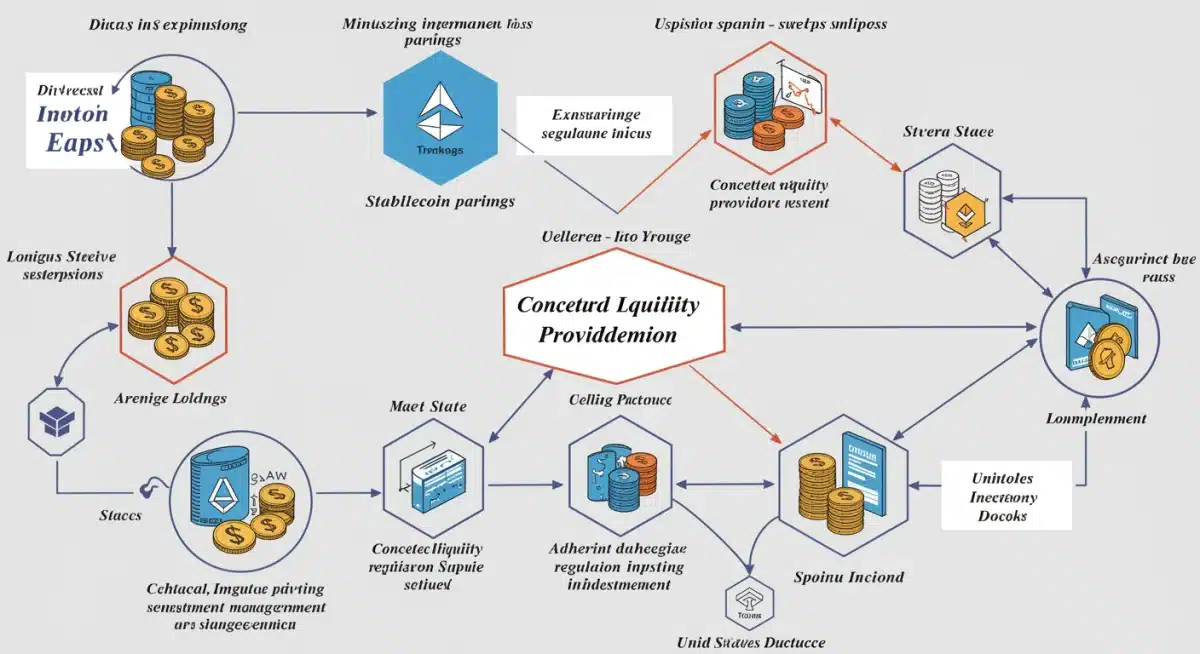
The advent of concentrated liquidity pools has revolutionized how liquidity providers approach risk and reward, offering a powerful mechanism for reducing impermanent loss. Unlike traditional AMMs where liquidity is spread across the entire price range, concentrated liquidity allows providers to allocate their capital within specific, narrower price ranges. This approach can significantly boost capital efficiency and fee generation, but it also introduces new complexities and risks.
Active management becomes crucial with concentrated liquidity. Providers must constantly monitor market conditions and adjust their price ranges to remain ‘in range’ and continue earning fees. If the price moves outside the designated range, the liquidity becomes inactive, and the provider is fully exposed to impermanent loss, effectively holding only the less performing asset.
Strategies for Concentrated Liquidity
Effective management of concentrated liquidity positions involves a dynamic approach. This includes setting appropriate price ranges, rebalancing positions, and understanding when to withdraw liquidity. Tools and analytics platforms are becoming increasingly sophisticated, offering insights into optimal range selection and potential IL exposure.
- Narrow Ranges for High Fees: Setting tighter ranges can maximize fee earnings when prices hover within that range.
- Wider Ranges for Lower Risk: Broader ranges reduce the frequency of needing to rebalance but also dilute fee earnings.
- Rebalancing: Actively adjusting price ranges or rebalancing asset ratios to stay within the active range and mitigate IL.
For US-compliant DeFi pools in 2025, understanding the nuances of concentrated liquidity and developing a robust active management strategy will be key to optimizing returns while diligently reducing impermanent loss. This requires a deeper engagement than simply depositing and forgetting.
Hedging Techniques to Counter Impermanent Loss
Beyond asset selection and active management, employing sophisticated hedging techniques can provide an additional layer of protection for reducing impermanent loss. Hedging involves using financial instruments to offset potential losses from an existing investment. In DeFi, this often translates to using derivatives or external positions to counteract the price divergence that causes IL.
One common hedging strategy involves short-selling one of the assets in the liquidity pair on a separate platform. For example, if you provide liquidity to an ETH/USDC pool and anticipate ETH’s price to rise, you might short ETH in an equivalent amount. If ETH’s price indeed rises, the impermanent loss in your liquidity pool would be offset by the gains from your short position, effectively neutralizing the market risk.
Derivative Instruments for Hedging
The DeFi ecosystem is rapidly developing, offering a broader range of derivative products that can be used for hedging. These include perpetual futures, options, and even structured products designed specifically to mitigate impermanent loss. However, these instruments come with their own risks and require a thorough understanding of their mechanics.
- Perpetual Futures: Shorting or longing futures contracts to hedge against price movements in your liquidity pool assets.
- Options: Purchasing put or call options to protect against downside or capture upside while mitigating IL.
- Delta-Neutral Strategies: Aiming to maintain a portfolio where overall price movements do not significantly impact the net value, often involving a combination of spot and derivative positions.
As US regulatory frameworks for DeFi mature by 2025, the availability and compliance of these hedging tools will become more defined. Liquidity providers seeking to maximize their capital efficiency and proactively work towards reducing impermanent loss should explore these advanced techniques, always prioritizing platform security and regulatory adherence.
US Regulatory Compliance and IL Mitigation
The regulatory landscape for DeFi in the United States is continuously evolving, and by 2025, compliance will be a central theme for all participants, including liquidity providers. Understanding how these regulations impact liquidity provision and, consequently, strategies for reducing impermanent loss, is crucial. Compliant platforms often prioritize user protection and transparency, which can indirectly aid in IL mitigation.
Regulatory clarity can bring stability to the market, potentially reducing extreme volatility in certain assets, which is a primary driver of impermanent loss. Furthermore, platforms that adhere to US regulations may offer more robust security measures and clearer terms of service, which can instill greater confidence in liquidity providers. This doesn’t directly prevent IL, but it creates a more predictable environment for implementing mitigation strategies.
Impact of Future Regulations
Upcoming regulations might influence the types of assets available in compliant pools, potentially favoring those with lower volatility or clearer legal definitions. This could naturally steer liquidity providers towards asset pairs that inherently carry less impermanent loss risk. Moreover, reporting requirements could lead to better data and analytics, empowering providers with more information to make informed decisions.
- KYC/AML Compliance: Platforms adhering to these standards may see increased institutional participation, potentially stabilizing liquidity.
- Asset Classification: Clearer classification of tokens could influence which assets are available in compliant pools, impacting IL profiles.
- Investor Protection: Regulations aimed at protecting investors might lead to features or disclosures that help users understand and manage IL.
Navigating US-compliant DeFi pools in 2025 will require a keen awareness of both market dynamics and regulatory shifts. By choosing platforms and strategies that align with these evolving standards, liquidity providers can create a more secure environment for their assets, thereby contributing significantly to reducing impermanent loss.
Advanced Tools and Analytics for IL Prediction
As DeFi matures, the ecosystem of tools and analytics designed to assist liquidity providers in reducing impermanent loss has become increasingly sophisticated. These platforms leverage data, algorithms, and predictive models to offer insights into potential IL exposure, optimal liquidity ranges, and even automated management strategies. For any serious liquidity provider in 2025, utilizing these advanced tools is no longer optional but essential.
These tools often provide real-time monitoring of liquidity positions, showing current IL, projected fees, and the overall performance of a pool. They can simulate different scenarios, helping providers understand how various price movements might affect their positions. This predictive capability is invaluable for making proactive decisions, such as adjusting liquidity ranges in concentrated pools or deciding when to withdraw assets.
Key Features of IL Analytics Platforms
Modern IL analytics platforms integrate a variety of features to give liquidity providers an edge. From detailed historical performance data to forward-looking projections, these tools aim to demystify impermanent loss and empower users to make data-driven decisions. As regulatory guidelines in the US become clearer, these tools will also likely incorporate compliance-related metrics.
- IL Calculators: Estimate potential impermanent loss based on asset price changes and pool composition.
- Yield Optimizers: Suggest optimal liquidity ranges and asset pairings for maximizing fee generation while minimizing IL.
- Portfolio Trackers: Provide a comprehensive overview of all liquidity positions, including real-time IL and profit/loss.
- Alert Systems: Notify users when their positions are outside optimal ranges or when significant price divergence occurs.
Leveraging these advanced tools will be a cornerstone for liquidity providers in US-compliant DeFi pools by 2025. They transform the complex challenge of reducing impermanent loss into a more manageable and strategic endeavor, enabling more efficient and profitable participation in the DeFi ecosystem.
| Key Strategy | Brief Description |
|---|---|
| Stablecoin Pairs | Minimize IL by pairing assets with minimal price fluctuation. |
| Concentrated Liquidity | Allocate capital within specific price ranges for higher efficiency, requiring active management. |
| Hedging Techniques | Use derivatives (futures, options) to offset potential losses from price divergence. |
| Advanced Analytics | Utilize tools and platforms for IL prediction and optimal range suggestions. |
Frequently Asked Questions
Impermanent loss is the temporary loss experienced by a liquidity provider when the price of deposited assets changes relative to each other. It becomes permanent if assets are withdrawn before prices return to their original ratios, essentially meaning you would have been better off just holding the assets.
Choosing less volatile or highly correlated asset pairs, such as stablecoin-to-stablecoin or blue-chip crypto pairs, significantly reduces the likelihood and magnitude of price divergence. This directly lowers the risk of impermanent loss compared to highly volatile or uncorrelated asset pairings.
While concentrated liquidity can boost capital efficiency and fee generation, it requires active management. If asset prices move out of the specified range, liquidity providers are fully exposed to IL and stop earning fees. It’s better for those willing to actively monitor and adjust their positions.
US regulations, by promoting market stability, transparency, and potentially influencing asset availability in compliant pools, can indirectly aid in IL mitigation. Compliant platforms often feature enhanced security and clearer terms, fostering a more predictable environment for liquidity providers.
Automated tools and analytics can significantly help in managing and predicting impermanent loss, but they cannot completely eliminate it. They provide insights for optimal strategies, alert to risks, and assist in rebalancing, but the fundamental risk of price divergence remains inherent in liquidity provision.
Conclusion
Reducing impermanent loss remains a central challenge and opportunity for liquidity providers in the rapidly evolving DeFi landscape. As we approach 2025, a multi-faceted approach combining strategic asset selection, astute active management in concentrated liquidity pools, sophisticated hedging techniques, and leveraging advanced analytics will be crucial. Furthermore, staying informed about US regulatory compliance will not only ensure safer participation but also potentially influence the stability and predictability of DeFi markets. By adopting these comprehensive strategies, liquidity providers can navigate the complexities of DeFi with greater confidence and optimize their returns.