US State Crypto Licensing: 5 Key Differences for National Operators

Understanding the nuances of US state-level crypto licensing is paramount for national operators, requiring a strategic approach to navigate diverse regulatory frameworks and ensure seamless compliance across jurisdictions.
For national operators in the burgeoning digital asset space, the regulatory landscape in the United States presents a unique tapestry of challenges. Successfully expanding across state lines hinges on a profound understanding of the disparate licensing requirements. This article delves into US state crypto licensing, highlighting five critical differences that demand careful attention, and offering practical solutions to help navigate this complex environment efficiently.
Understanding the patchwork: diverse regulatory frameworks
The United States does not have a unified federal licensing regime for cryptocurrency businesses, leading to a complex ‘patchwork’ of state-specific regulations. Each state maintains the authority to regulate financial services within its borders, and many have opted to extend these frameworks to digital asset activities. This decentralized approach creates significant hurdles for national operators seeking to offer services across multiple states, necessitating a granular understanding of each jurisdiction’s demands.
This regulatory fragmentation often stems from differing legislative interpretations of what constitutes a ‘money transmission’ or ‘financial service’ in the context of digital assets. Some states have enacted specific cryptocurrency laws, while others apply existing money transmitter laws, sometimes with varying degrees of clarity or modification. This lack of uniformity means that a compliance strategy effective in one state may be entirely insufficient or even contradictory in another.
The genesis of state-level oversight
The origins of state-level oversight for financial services date back centuries, predating even the concept of digital currencies. When cryptocurrencies emerged, states began grappling with how to fit these novel assets into existing legal structures. This often involved applying traditional money transmission laws, designed for fiat currency, to a technology that operates fundamentally differently.
- Historical precedent: State banking departments historically regulate money services businesses.
- Legal interpretation: Applying ‘money transmission’ definitions to crypto transactions.
- Emergent legislation: States developing specific crypto-focused statutes like New York’s BitLicense.
Impact on national expansion
For national operators, the fragmented regulatory environment translates into a significant burden. Each state’s unique requirements necessitate separate applications, varying fee structures, and distinct ongoing compliance obligations. This can lead to substantial legal costs, administrative overhead, and prolonged market entry timelines, making nationwide service delivery a formidable task.
The diverse regulatory frameworks underscore the need for a sophisticated compliance infrastructure that can adapt to the specific demands of each state. A one-size-fits-all approach is simply not viable, and attempting to implement one can lead to regulatory penalties, operational disruptions, and reputational damage. Therefore, a deep dive into each state’s particular requirements is a foundational step for any operator eyeing national reach.
Licensing requirements: beyond the basics
While many states require some form of money transmitter license for crypto businesses, the specific requirements attached to these licenses can vary dramatically. It’s not merely about obtaining a license; it’s about understanding the intricate details of what each state expects from applicants and licensees. These differences extend far beyond basic application forms, touching upon capital requirements, surety bonds, and operational controls.
Some states demand significant minimum net worth or liquid asset thresholds, designed to ensure the financial stability of the applicant. Others may require specific types of surety bonds, which act as a form of insurance to protect consumers in case of business failure or misconduct. These financial prerequisites alone can present a substantial barrier to entry for smaller or newer operators, disproportionately favoring well-capitalized entities.
Variations in capital and bond requirements
The financial robustness of a crypto business is often scrutinized through capital and surety bond requirements. These can differ by millions of dollars from one state to another. For instance, a state might demand a minimum net worth of $500,000 and a surety bond of $250,000, while a neighboring state could require a $1 million net worth and a $500,000 bond. These disparities necessitate careful financial planning and resource allocation for multi-state operations.
- Minimum net worth: States set varying thresholds for financial stability.
- Surety bond amounts: Protection for consumers, with amounts fluctuating significantly.
- Liquid asset mandates: Some states specify the proportion of assets that must be liquid.
Operational and technical standards
Beyond financial requirements, states also impose diverse operational and technical standards. These can include mandates for cybersecurity protocols, data privacy measures, anti-money laundering (AML) and know-your-customer (KYC) programs, and even specific technology audits. Ensuring compliance across all these fronts requires robust internal controls and a scalable technological infrastructure capable of meeting varied demands.
For national operators, harmonizing these operational requirements can be a significant undertaking. Developing a baseline standard that satisfies the most stringent state while remaining flexible enough to adapt to less demanding jurisdictions is a strategic imperative. This often involves investing in advanced compliance software and dedicated personnel to manage the complexities of multi-state operations.
Defining ‘virtual currency’ and regulated activities
One of the most fundamental differences across US states lies in how they define ‘virtual currency’ and, consequently, which activities fall under their regulatory purview. This definitional disparity is a critical factor for national operators, as it directly impacts whether their specific business model requires a license in a given state. Some states adopt broad definitions, encompassing a wide array of digital assets and services, while others take a more narrow approach.
For example, some states may regulate only specific types of cryptocurrencies, such as those deemed to have an exchange rate against fiat currency, while others might include utility tokens, stablecoins, or even NFTs. Similarly, the regulated activities can vary; some states might only focus on direct exchanges, while others extend oversight to custody services, lending platforms, or even decentralized finance (DeFi) protocols to varying degrees.
Broad vs. narrow interpretations
The spectrum of definitions for ‘virtual currency’ can be quite wide. New York’s BitLicense, for instance, has a broad scope, covering a wide range of activities involving digital assets. In contrast, other states might have more limited definitions, potentially exempting certain types of tokens or activities from their licensing requirements. This divergence creates a legal minefield for businesses operating across state lines.
National operators must conduct thorough legal analysis for each state where they intend to operate, ensuring their business model aligns with the local definition of virtual currency and regulated activities. Misinterpreting these definitions can lead to operating without a required license, resulting in severe penalties and legal repercussions.
Implications for business models
The varying definitions profoundly impact the viability and structure of different crypto business models. A company offering a niche service, such as a non-custodial wallet or a specific type of DeFi lending, might be regulated in one state but exempt in another. This necessitates a flexible and adaptive business strategy, potentially requiring different service offerings or operational adjustments based on state-specific regulations.
Understanding these nuances is not just about compliance; it’s also about strategic market entry. By identifying states with more favorable or clearer regulatory environments, operators can prioritize their expansion efforts, mitigating risk and optimizing resource allocation. Conversely, states with ambiguous or overly broad definitions may require a more cautious approach or even necessitate direct engagement with regulators for clarity.
Application processes and timelines
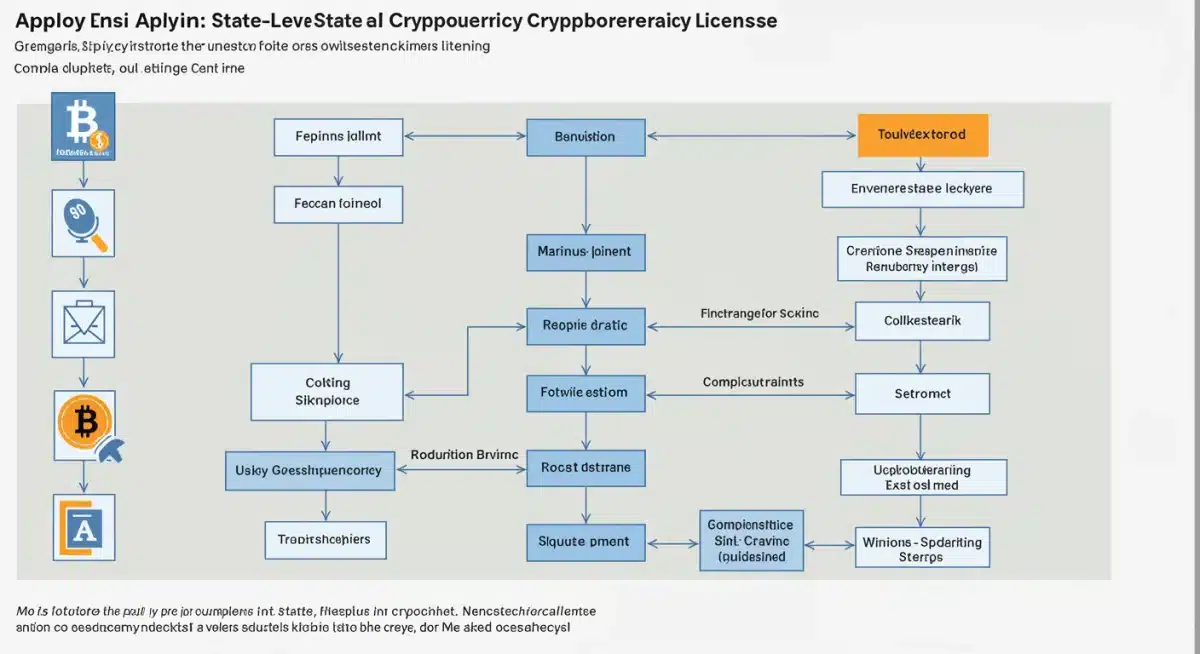
The bureaucratic hurdles involved in obtaining state crypto licenses are another significant point of divergence. The application processes, required documentation, and approval timelines can vary dramatically from one state to the next. This administrative complexity adds another layer of challenge for national operators, requiring meticulous planning and dedicated resources to manage multiple concurrent applications.
Some states employ streamlined online application portals, while others adhere to more traditional paper-based submissions. The documentation requested can range from basic corporate information and financial statements to detailed business plans, cybersecurity policies, and personal background checks for key personnel. The sheer volume and diversity of these requirements can overwhelm even experienced compliance teams.
Streamlined vs. arduous applications
The contrast between state application processes can be stark. Some states have made efforts to simplify their licensing procedures, recognizing the need to foster innovation. These might offer clearer guidelines, faster review times, and more intuitive online platforms. However, many states still maintain lengthy, opaque, and resource-intensive application processes, often requiring extensive legal and compliance support.
- Online portals: Some states offer digital application submissions.
- Paper-based forms: Traditional methods still prevalent in many jurisdictions.
- Documentation demands: Varies from basic to highly detailed operational and financial data.
Impact of varying approval timelines
Beyond the application itself, the time it takes for states to review and approve licenses can vary widely, from a few months to over a year. These unpredictable timelines can significantly impact a national operator’s market entry strategy and financial projections. Delays in one state can cascade, affecting launch plans across multiple jurisdictions and potentially hindering competitive advantage.
Effectively managing these varying timelines requires proactive engagement with state regulators, clear communication, and a well-organized approach to documentation. Operators often find it beneficial to stagger applications or prioritize states based on strategic importance and anticipated approval speed. This strategic sequencing helps to mitigate the risks associated with prolonged regulatory review periods and ensures a more predictable rollout of services.
Ongoing compliance and reporting obligations
Obtaining a license is only the first step; maintaining compliance with each state’s ongoing requirements is an equally complex and critical task. These obligations encompass a broad spectrum of activities, including regular financial reporting, consumer protection measures, cybersecurity audits, and anti-money laundering (AML) program reviews. The differences in these ongoing duties across states represent a significant operational challenge for national operators.
Some states may require monthly financial statements, while others demand quarterly or annual reports. The level of detail expected in these reports can also vary, with some jurisdictions seeking granular data on transaction volumes and customer demographics, and others focusing on broader financial health indicators. This divergence necessitates a robust and adaptable internal reporting infrastructure.
Reporting frequency and detail
The cadence and depth of reporting are key differentiators. A national operator must be prepared to submit various reports on different schedules, tailored to each state’s specific demands. This includes not only financial data but also information related to cybersecurity incidents, consumer complaints, and changes in corporate structure or ownership. Failure to adhere to these reporting deadlines or provide accurate information can lead to fines and license revocation.
To manage this complexity, many operators leverage compliance management software that centralizes reporting requirements and automates data collection. This technological approach helps ensure consistency and accuracy across multiple jurisdictions, reducing the risk of errors and omissions that could trigger regulatory scrutiny.
Evolving regulatory expectations
The crypto regulatory landscape is not static; it is constantly evolving. States frequently update their laws, issue new guidance, or introduce new requirements based on market developments and emerging risks. National operators must stay abreast of these changes in every state where they operate, adapting their compliance programs accordingly. This continuous monitoring and adaptation are crucial for long-term operational success.
Engaging with industry associations, subscribing to regulatory intelligence services, and maintaining open lines of communication with state regulators are vital practices for staying informed. A proactive approach to regulatory changes, rather than a reactive one, can help national operators anticipate new requirements and adjust their strategies before potential compliance gaps emerge, ensuring sustained adherence to all applicable laws.
Practical solutions for national operators
Navigating the intricate web of US state crypto licensing requires a strategic and multifaceted approach. For national operators, the key lies in developing scalable solutions that address the diverse regulatory demands without stifling innovation or incurring unsustainable costs. A well-thought-out strategy can transform regulatory hurdles into competitive advantages, fostering trust and enabling sustainable growth.
One primary solution involves leveraging technology to automate and streamline compliance processes. Implementing robust compliance software can help track state-specific requirements, manage license applications, monitor reporting deadlines, and ensure consistent adherence to AML/KYC protocols across all operational jurisdictions. This technological backbone is indispensable for efficiency and accuracy.
Centralized compliance infrastructure
Establishing a centralized compliance infrastructure is paramount. This involves creating a dedicated compliance team or department equipped with the expertise to interpret and implement diverse state regulations. This team should be responsible for developing standardized policies and procedures that can be adapted to specific state requirements, ensuring consistency while allowing for necessary localized adjustments.
- Dedicated compliance team: Experts in multi-state regulatory frameworks.
- Standardized operating procedures: Baseline policies adaptable to state specifics.
- Technology integration: Utilizing software for license management and reporting.
Strategic state prioritization
Given the complexity and cost associated with obtaining licenses in every state, national operators should consider a strategic prioritization approach. This involves identifying key markets based on business objectives, customer base, and regulatory clarity. By focusing initial efforts on states that are most strategically important or have more predictable regulatory environments, operators can manage resources effectively and build a strong compliance foundation before expanding further.
Furthermore, engaging with legal counsel specializing in cryptocurrency regulation is critical. These experts can provide invaluable guidance on interpreting state laws, navigating application processes, and developing robust compliance programs. Their insights can help mitigate risks, accelerate market entry, and ensure that national operators remain on the right side of the law as they expand their reach across the United States.
| Key Difference | Impact on National Operators |
|---|---|
| Regulatory Frameworks | Requires adapting compliance strategies to unique state laws. |
| Licensing Requirements | Varying capital, bond, and operational demands per state. |
| Definition of Virtual Currency | Determines if specific services require a license in each state. |
| Application Processes | Diverse documentation and unpredictable approval timelines. |
Frequently asked questions about crypto licensing
The fragmentation stems from the US federal system, where states retain significant authority over financial services. There’s no overarching federal crypto licensing framework, leading states to implement their own interpretations and regulations, often building upon existing money transmitter laws.
A ‘BitLicense’ is a specific regulatory framework for virtual currency businesses established by the New York State Department of Financial Services (NYDFS). It is required for any entity conducting virtual currency business activity involving New York residents or operations within the state.
Not necessarily. The requirement depends on the specific activities a business conducts and how each state defines ‘virtual currency’ and regulated services. Non-custodial wallets or certain DeFi protocols might be exempt in some states but regulated in others.
National operators can manage diverse reporting through a centralized compliance infrastructure, utilizing specialized software to track deadlines and automate data collection. Engaging legal and compliance experts is also crucial for interpreting and adhering to varying requirements.
Non-compliance can lead to significant penalties, including substantial fines, cease-and-desist orders, license revocation, and even criminal charges. It also carries reputational risks, damaging consumer trust and hindering future business opportunities in the burgeoning crypto sector.
Conclusion
Successfully navigating the complex and fragmented landscape of US state crypto licensing is not merely a legal requirement; it is a strategic imperative for national operators in the digital asset space. The five key differences – diverse regulatory frameworks, varied licensing requirements, disparate definitions of virtual currency, complex application processes, and evolving ongoing compliance obligations – collectively underscore the need for a meticulous and adaptable approach. By investing in robust compliance infrastructures, leveraging technology, and engaging expert legal counsel, businesses can transform these regulatory challenges into opportunities for sustainable growth and trusted market presence across the United States. The journey is arduous, but with careful planning and proactive engagement, national operators can thrive in this dynamic environment.