Leveraged DeFi Yield Strategies 2026: 25% APR on Compound V3

Leveraged DeFi Yield Strategies in 2026: Achieving 25% APR with Prudent Borrowing on Compound V3
The decentralized finance (DeFi) landscape continues its relentless evolution, offering innovative avenues for capital growth that were once unimaginable in traditional finance. As we look towards 2026, the pursuit of exceptional returns remains a primary driver for many participants. Among the most compelling opportunities are DeFi Yield Strategies that leverage borrowing protocols like Compound V3 to amplify returns. This comprehensive guide delves into how investors can aim for an ambitious 25% Annual Percentage Rate (APR) by strategically utilizing Compound V3, while also emphasizing the critical importance of prudent borrowing and robust risk management.
The promise of high APRs in DeFi is alluring, but it’s crucial to understand that such returns often come hand-in-hand with increased complexity and risk. This article is designed to equip you with the knowledge and tools necessary to navigate this sophisticated terrain, transforming potential pitfalls into profitable opportunities. We will explore the mechanics of Compound V3, delineate advanced leveraged yield farming techniques, and provide actionable insights into mitigating the inherent risks.
By 2026, the DeFi ecosystem is expected to be more mature, with improved infrastructure, enhanced security measures, and a broader array of financial primitives. However, market volatility and smart contract risks will persist, making a well-informed and cautious approach indispensable for anyone looking to engage in advanced DeFi Yield Strategies.
Understanding Compound V3: The Foundation for Leveraged Yield
Compound V3, also known as Compound III, represents a significant evolution in lending and borrowing protocols. Unlike its predecessors, which allowed users to borrow any asset against any collateral, Compound V3 focuses on a single borrowable asset per market (e.g., USDC or ETH), significantly streamlining the protocol and enhancing capital efficiency and security. This design makes it a potent platform for executing sophisticated DeFi Yield Strategies.
Key Features of Compound V3
- Single Borrowable Asset: Each Compound V3 market facilitates borrowing of a single asset (e.g., USDC, ETH) against a variety of approved collateral assets. This simplifies risk assessment and management for both the protocol and its users.
- Capital Efficiency: By isolating borrowable assets, Compound V3 can optimize interest rate models and liquidation mechanisms, leading to more efficient capital utilization.
- Enhanced Security: The simplified architecture reduces attack vectors and makes auditing more straightforward, contributing to a more secure environment for your assets.
- Collateral Management: Users deposit collateral assets (such as wETH, wstETH, cbETH, UNI, LINK, etc.) to borrow the target asset. The system automatically manages collateral factors and liquidation thresholds.
- COMP Rewards: As with previous versions, users can often earn COMP tokens as an incentive for participating in the protocol, which can further boost overall APRs. These rewards are a critical component when calculating the total yield for DeFi Yield Strategies.
The transition to Compound V3 has been driven by a desire for greater efficiency, security, and a more robust foundation for future DeFi innovation. For those looking to implement leveraged DeFi Yield Strategies, understanding these core features is paramount.
The Mechanics of Leveraged Yield Farming on Compound V3
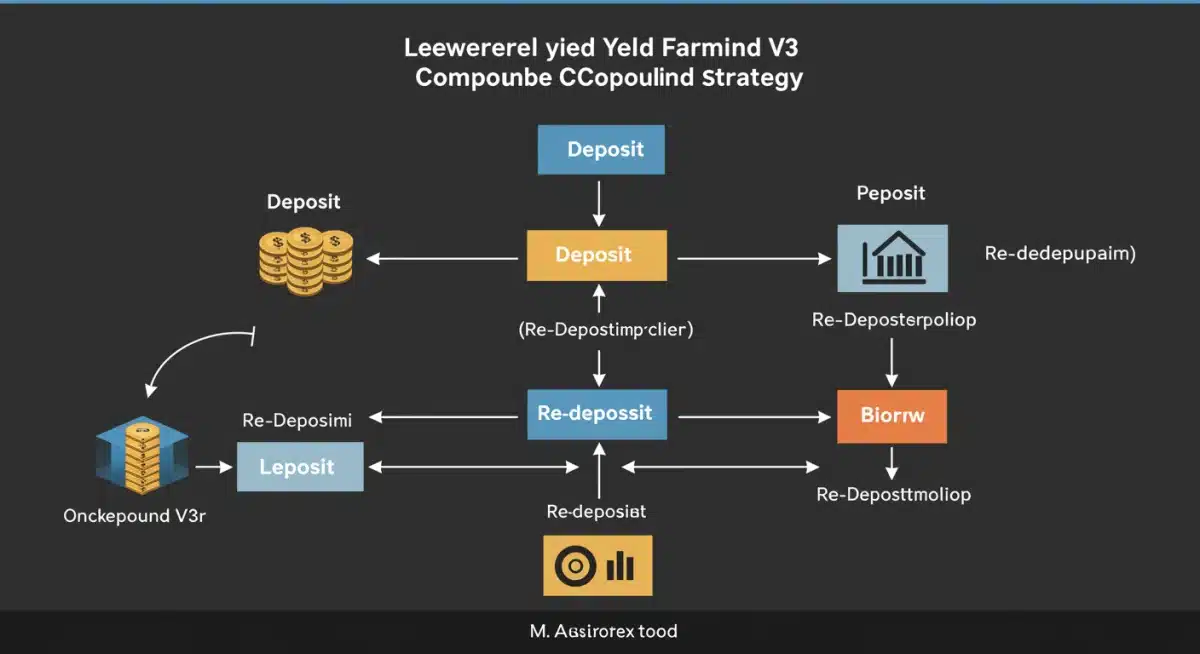
Achieving a 25% APR through leveraged DeFi Yield Strategies on Compound V3 involves a cyclical process of depositing collateral, borrowing, and redeploying the borrowed funds. The goal is to magnify the yield generated from underlying assets or liquidity provision by increasing your exposure.
Step-by-Step Leveraged Strategy:
- Initial Deposit: Deposit a stablecoin (e.g., USDC) or a liquid staking derivative (e.g., wstETH) as collateral into a Compound V3 market. This earns a supply APR.
- Borrow Against Collateral: Borrow the designated borrowable asset (e.g., USDC or ETH) against your deposited collateral. You will incur a borrow APR on this loan.
- Redeploy Borrowed Funds: The borrowed funds are then typically redeployed back into the same or another DeFi protocol to earn additional yield. For instance, if you borrowed USDC, you might use it to provide liquidity in a stablecoin pool on a decentralized exchange (DEX) or deposit it back into Compound V3 as collateral to borrow more.
- Iterate (Looping): This process can be repeated multiple times, creating a ‘loop’ where you continuously borrow against existing collateral and redeploy, thereby increasing your effective capital and potential returns. Each iteration amplifies both potential gains and risks.
The net APR is a function of the supply APR, borrow APR, and the APR generated from redeploying the borrowed funds, all multiplied by the leverage factor. Crucially, the COMP rewards earned from both supplying and borrowing also contribute significantly to the overall yield, often making otherwise marginal strategies highly profitable. These rewards are often the ‘alpha’ that pushes DeFi Yield Strategies into the higher APR ranges.
Example Scenario for 25% APR Target:
Imagine you deposit $10,000 in wstETH as collateral. Compound V3 allows you to borrow, say, 80% of its value in USDC. You borrow $8,000 USDC. You then take this $8,000 USDC and deposit it as collateral again, borrowing another portion, and so on. Simultaneously, you are earning staking rewards on your wstETH, supply interest on your deposited USDC, and potentially COMP rewards. The borrowed USDC can also be put to work in other high-yield stablecoin pools. The cumulative effect of these yields, amplified by leverage, is what drives the target 25% APR for sophisticated DeFi Yield Strategies.
Prudent Borrowing: The Cornerstone of Sustainable DeFi Yield
While the allure of high APRs is strong, the sustainability of any leveraged DeFi Yield Strategies hinges on prudent borrowing practices. Neglecting risk management can quickly turn promising gains into significant losses, especially in volatile markets.
Understanding Liquidation Risk
The primary risk in leveraged borrowing is liquidation. If the value of your collateral falls below a certain threshold relative to your borrowed amount, your collateral will be automatically sold by the protocol to repay your loan. This often incurs a penalty, resulting in a substantial loss of capital.
Key Prudent Borrowing Practices:
- Maintain a Healthy Collateral Ratio: Always borrow significantly less than the maximum allowed by the protocol. A common rule of thumb is to stay well below the liquidation threshold, typically aiming for a collateral ratio of 150-200% or higher, depending on market volatility and the specific assets used.
- Monitor Market Conditions: Keep a close eye on the price movements of your collateral assets and the borrowable asset. Sudden drops in collateral value or spikes in borrow rates can quickly erode your safety margin.
- Understand Interest Rate Volatility: Borrowing interest rates in DeFi protocols are dynamic and can fluctuate significantly based on supply and demand. A sudden increase in borrow rates can make your leveraged position unprofitable or push you closer to liquidation.
- Choose Stable Collateral: While higher-volatility assets might offer higher supply APRs or COMP rewards, using more stable assets (like stablecoins or highly liquid staked ETH) as primary collateral reduces liquidation risk.
- Diversify Your Strategy: Avoid putting all your capital into a single leveraged position. Diversifying across different protocols, assets, and strategies can help spread risk.
- Implement Stop-Loss Mechanisms (Manual or Automated): While not directly built into most DeFi protocols, consider setting mental or even automated stop-loss points where you manually de-leverage or exit a position if market conditions deteriorate.
- Factor in Gas Fees: Frequent adjustments to leveraged positions can incur significant gas fees on the Ethereum network. Factor these costs into your overall profitability calculations.
Prudent borrowing is not about avoiding risk entirely, but about understanding, quantifying, and managing it effectively. It’s the difference between a sustainable, high-yield strategy and a speculative gamble.
Optimizing Your Leveraged Position for 25% APR
Achieving a 25% APR with DeFi Yield Strategies on Compound V3 requires meticulous optimization and constant vigilance. This goes beyond simply looping; it involves understanding the nuances of interest rates, reward mechanisms, and market dynamics.
Strategies for Optimization:
- Maximize COMP Rewards: Actively track COMP distribution rates for different assets. Sometimes, supplying or borrowing a specific asset might yield disproportionately high COMP rewards, making it more attractive for leverage. These rewards are often the primary driver for achieving the target APR.
- Monitor Supply and Borrow APYs: Keep a close watch on the fluctuating supply and borrow APYs on Compound V3. The spread between supply and borrow rates significantly impacts your net yield. Look for opportunities where the supply APR + COMP rewards heavily outweigh the borrow APR.
- Strategic Asset Selection: Choose collateral assets that offer a good balance of stability, high collateral factors, and strong supply APYs (including COMP). Liquid staking derivatives (LSDs) like wstETH are popular choices due to their underlying staking yield and liquidity.
- External Yield Sources: The borrowed asset doesn’t necessarily have to be re-deposited into Compound V3. It can be deployed into other high-yield opportunities, such as concentrated liquidity pools on DEXs, other lending protocols, or stablecoin yield aggregators, provided the risk is assessed.
- Dynamic Rebalancing: Markets are constantly changing. Be prepared to dynamically rebalance your positions. This might involve adjusting your collateral ratio, swapping collateral assets, or even unwinding a portion of your leverage if conditions become unfavorable.
- Utilize Analytics Tools: Leverage DeFi analytics platforms (e.g., DefiLlama, DeBank) to track your positions, monitor liquidation thresholds, compare APYs across protocols, and stay informed about market trends.
The pursuit of 25% APR is an active management strategy, not a set-it-and-forget-it approach. It demands continuous engagement and adaptation to the ever-changing DeFi landscape.
Advanced Considerations and Risks for 2026
As we project into 2026, the complexity of DeFi Yield Strategies will likely increase, alongside new opportunities and risks. A forward-looking approach requires understanding these advanced considerations.
Smart Contract Risk
Despite advancements, smart contract vulnerabilities remain a persistent threat. Exploits, bugs, or economic attacks can lead to irreversible loss of funds. Always choose battle-tested protocols like Compound V3, which have undergone extensive audits, but acknowledge that no system is entirely immune.
Oracle Risk
DeFi protocols rely on external oracles to feed price data into their smart contracts. If an oracle is manipulated or provides incorrect data, it can lead to liquidations at unfair prices or other adverse outcomes for leveraged positions. Compound V3 uses robust oracle systems, but it’s a risk to be aware of.
Regulatory Landscape
The regulatory environment for DeFi is still evolving. Future regulations could impact the accessibility, profitability, or even legality of certain DeFi Yield Strategies. Staying informed about regulatory developments in major jurisdictions is crucial.
Market Volatility and Black Swan Events
Cryptocurrency markets are notoriously volatile. Sudden, extreme price movements (‘black swan events’) can rapidly trigger liquidations, even for positions with seemingly safe collateral ratios. Understanding your worst-case scenario and having contingency plans is vital.
Gas Fees and Network Congestion
While Ethereum’s transition to Proof-of-Stake and Layer 2 solutions aim to reduce gas fees, periods of high network congestion can still lead to increased transaction costs and delays. This can be particularly problematic when trying to quickly adjust or unwind leveraged positions.
Impermanent Loss (if applicable)
If your strategy involves providing liquidity to DEX pools with borrowed funds, you must also account for impermanent loss. While less direct for Compound V3’s core lending, it’s a critical consideration for any redeployment of borrowed assets into liquidity provision.
Building a Robust Risk Management Framework
To truly achieve sustainable high APRs with DeFi Yield Strategies, a comprehensive risk management framework is essential. This goes beyond just monitoring your collateral ratio.
Key Components of a Risk Management Framework:
- Define Your Risk Tolerance: Before entering any leveraged position, clearly define how much capital you are willing to risk and what level of drawdown you can psychologically handle.
- Stress Testing Your Position: Simulate worst-case scenarios. What happens if your collateral asset drops by 20%, 30%, or even 50%? At what price point does liquidation occur? Understand these thresholds intimately.
- Set Alerts and Notifications: Utilize tools that provide real-time alerts for price changes, collateral ratio changes, or significant shifts in borrow rates. Many DeFi dashboards offer this functionality.
- Maintain Emergency Funds: Always have unallocated stablecoins or liquid assets readily available to add collateral or repay a portion of your loan if your position approaches liquidation.
- Regular Review and Adjustment: Markets are dynamic. Regularly review your positions, the underlying protocols, and your overall strategy. Be prepared to adjust your leverage, collateral, or even exit positions if the risk-reward profile changes unfavorably.
- Understand Protocol Governance: For protocols like Compound, governance decisions can impact parameters like collateral factors, liquidation thresholds, and interest rate models. Staying abreast of governance proposals is part of advanced risk management.

A disciplined approach to risk management is the single most important factor in distinguishing successful, long-term participants in DeFi Yield Strategies from those who experience significant losses.
The Future of Leveraged Yield on Compound V3 in 2026
Looking ahead to 2026, Compound V3 and similar protocols are expected to continue innovating, potentially introducing new features that could further enhance or alter leveraged DeFi Yield Strategies.
Potential Developments:
- Improved Capital Efficiency: Further optimizations in interest rate models and collateral management could allow for even higher collateral factors without compromising security, potentially increasing leverage opportunities.
- Cross-Chain Capabilities: As multi-chain and cross-chain interoperability improves, we might see Compound V3 expanding its reach, allowing for more diverse collateral and borrowable assets from different blockchain ecosystems.
- Enhanced Automation: The rise of account abstraction and more sophisticated smart contract wallets could lead to automated risk management tools, such as automatically adding collateral or deleveraging based on predefined rules.
- Institutional Adoption: Increased institutional participation could bring more liquidity and potentially more stable, albeit possibly lower, baseline APYs. However, it could also introduce new competitive dynamics.
- Regulatory Clarity: While a risk, clearer regulatory guidelines could also bring more stability and confidence to the DeFi space, attracting a wider user base and potentially leading to more robust financial products.
The DeFi landscape is never static. Staying informed about these potential developments will be key to adapting your DeFi Yield Strategies and maintaining a competitive edge in 2026 and beyond.
Conclusion: Navigating the High-Stakes World of Leveraged DeFi Yield
Achieving a 25% APR through leveraged DeFi Yield Strategies on Compound V3 in 2026 is an ambitious yet attainable goal for sophisticated investors. It requires a deep understanding of the protocol’s mechanics, meticulous optimization of positions, and, most importantly, an unwavering commitment to prudent borrowing and robust risk management.
The journey into leveraged DeFi is not without its perils. Smart contract risks, oracle failures, market volatility, and regulatory uncertainty are ever-present. However, by carefully selecting assets, maintaining healthy collateral ratios, diligently monitoring market conditions, and being prepared to adapt, you can significantly mitigate these risks.
Compound V3’s streamlined architecture offers a powerful platform for these strategies, but the responsibility for success ultimately lies with the user. Treat your DeFi ventures with the same diligence and strategic planning as any other significant financial endeavor. With the right approach, the innovative potential of decentralized finance can indeed unlock substantial returns, positioning you at the forefront of the financial revolution in 2026.
Remember, the pursuit of high yield is a marathon, not a sprint. Continuous learning, adaptation, and a disciplined approach to risk will be your most valuable assets in the dynamic world of DeFi Yield Strategies.