Bitcoin as an Inflation Hedge: 2026 U.S. Perspective and Past Performance
Bitcoin as an Inflation Hedge: 2026 U.S. Perspective and Past Performance
In an era marked by unprecedented economic shifts and evolving financial landscapes, the quest for reliable stores of value has become more urgent than ever. As the U.S. economy navigates complex inflationary pressures, investors are constantly seeking assets that can preserve, if not grow, their purchasing power. Among the myriad options, Bitcoin, the world’s leading cryptocurrency, has emerged as a prominent, albeit controversial, candidate for an Bitcoin inflation hedge. But how effective is it truly? And what does the outlook for 2026 suggest regarding its role in mitigating the impact of U.S. inflation?
This comprehensive analysis delves deep into Bitcoin’s performance as an inflation hedge, particularly focusing on its effectiveness over the past 12 months and projecting its potential financial impact by 2026. We will explore the theoretical underpinnings of Bitcoin as a hedge, scrutinize its historical correlation with inflation metrics, and consider the various factors that could influence its future trajectory. Understanding these dynamics is crucial for investors looking to make informed decisions in a volatile economic climate.
Understanding Inflation and the Need for a Hedge
Inflation, at its core, is the rate at which the general level of prices for goods and services is rising, and consequently, the purchasing power of currency is falling. In the U.S., inflation is primarily measured by indices such as the Consumer Price Index (CPI) and the Personal Consumption Expenditures (PCE) price index. When inflation runs high, the dollars in your wallet or bank account buy less than they used to, eroding wealth over time. This erosion necessitates finding assets that can either maintain their value or appreciate at a rate greater than inflation, thus acting as an inflation hedge.
Historically, assets like gold, real estate, and commodities have been considered traditional inflation hedges. These assets tend to hold their value or even increase in price during inflationary periods because they are perceived as having intrinsic value or their supply is limited. However, the digital age has introduced new contenders, with Bitcoin being the most prominent. Its proponents argue that its decentralized nature, finite supply, and independence from traditional financial systems make it an ideal Bitcoin inflation hedge.
The U.S. has experienced significant inflationary pressures in recent years, driven by factors such as supply chain disruptions, expansive monetary policies, and geopolitical events. These pressures have heightened the demand for effective hedging strategies, pushing investors to consider alternative assets like Bitcoin. The question remains: can Bitcoin truly live up to the expectations as a modern-day inflation shield?
Bitcoin’s Theoretical Appeal as an Inflation Hedge
The argument for Bitcoin as an inflation hedge rests on several key characteristics:
- Scarcity: Perhaps the most compelling argument is Bitcoin’s fixed supply cap of 21 million coins. Unlike fiat currencies, which can be printed indefinitely by central banks, Bitcoin’s supply is mathematically limited. This scarcity, similar to gold, is often cited as a fundamental reason why it should retain value during periods of currency debasement.
- Decentralization: Bitcoin operates on a decentralized network, independent of government or financial institutions. This independence means its value is not directly influenced by the monetary policies or political decisions of any single nation, making it an attractive option for those wary of government-induced inflation.
- Divisibility and Portability: Bitcoin can be divided into very small units (satoshis) and transferred globally with relative ease and speed, offering a high degree of liquidity and utility that some traditional hedges lack.
- Global Adoption: As a global digital currency, Bitcoin’s value is determined by worldwide supply and demand dynamics, potentially insulating it from localized economic downturns or inflationary spikes in a single country.
These theoretical advantages paint a promising picture for Bitcoin’s role as an Bitcoin inflation hedge. However, theory often diverges from practice, especially in nascent and highly volatile markets like cryptocurrency. The real test lies in its actual performance against inflationary trends.
Evaluating Bitcoin’s Performance: The Past 12 Months
To assess Bitcoin’s effectiveness as an inflation hedge, we must look at its performance against U.S. inflation over a recent, relevant period. The past 12 months have been particularly instructive, characterized by fluctuating inflation rates and significant volatility in the cryptocurrency market. During this period, the U.S. experienced varying levels of CPI growth, from peaks to more moderate levels, providing a dynamic backdrop for evaluating Bitcoin’s resilience.
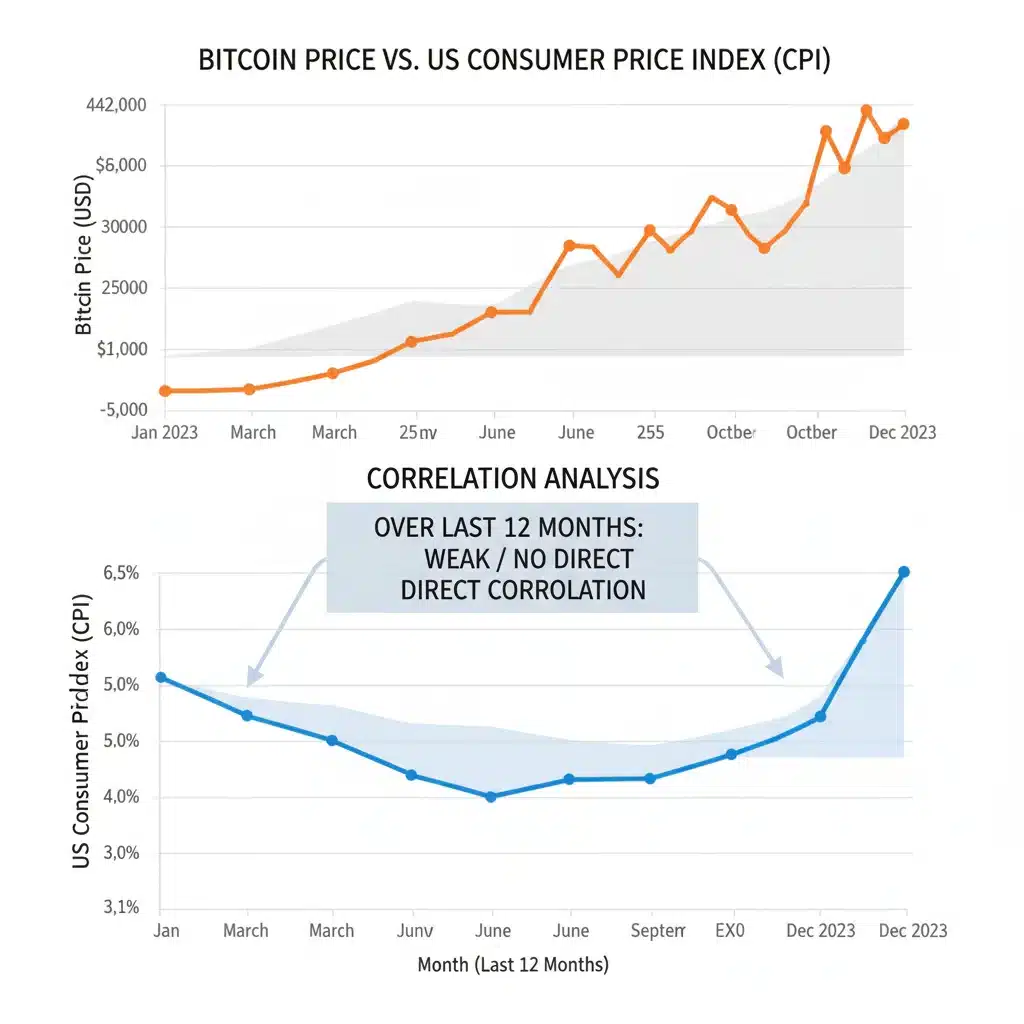
A direct correlation between Bitcoin’s price movements and U.S. inflation rates has been a subject of intense debate. Some analyses suggest that Bitcoin’s price often moves independently or even inversely to inflation in the short term, driven more by speculative sentiment, technological developments, and broader market liquidity than by a direct response to rising prices. For example, during periods of aggressive interest rate hikes by the Federal Reserve aimed at curbing inflation, risk-on assets like Bitcoin have often seen significant price dips, indicating a sensitivity to monetary tightening rather than acting as a direct hedge.
Conversely, there have been instances where Bitcoin has shown impressive gains during periods of high inflation, leading some to conclude that its hedging properties are indeed at play. However, attributing these gains solely to inflation hedging is challenging, given the multitude of factors influencing Bitcoin’s price, including institutional adoption, regulatory news, and macroeconomic sentiment.
One key observation from the past year is Bitcoin’s continued high volatility. While traditional hedges like gold tend to exhibit relative stability during inflationary periods, Bitcoin’s price swings can be dramatic. This volatility, while offering potential for high returns, also presents significant risks for investors seeking a stable store of value to combat inflation. An asset that can lose 20-30% of its value in a short span might not instill confidence as a reliable hedge, even if it eventually recovers or surpasses its previous highs.
Correlation vs. Causation: A Nuanced View
It’s crucial to distinguish between correlation and causation. While Bitcoin’s price might sometimes rise alongside inflation, it doesn’t necessarily mean inflation is the sole or primary driver. The crypto market is still relatively young and susceptible to speculative bubbles, ‘fear of missing out’ (FOMO) mentality, and rapid shifts in investor sentiment. These factors can often overshadow fundamental economic indicators like inflation.
Furthermore, Bitcoin’s correlation with the broader equity markets, particularly tech stocks, has been notable. When tech stocks face headwinds due to rising interest rates or economic uncertainty, Bitcoin often follows suit. This behavior suggests that, for now, Bitcoin is still largely perceived as a risk-on asset rather than a safe haven like gold, which typically performs well when other markets are struggling. This perception can hinder its effectiveness as a consistent Bitcoin inflation hedge.
Factors Influencing Bitcoin’s Future as an Inflation Hedge by 2026
Looking ahead to 2026, several factors will likely shape Bitcoin’s role as an inflation hedge:
1. Regulatory Environment
The regulatory landscape for cryptocurrencies is constantly evolving. Clear and favorable regulations could boost institutional adoption and bring more stability to the market, potentially strengthening Bitcoin’s appeal as a legitimate store of value. Conversely, overly restrictive regulations could dampen its growth and hinder its ability to act as an effective hedge.
2. Institutional Adoption
Increasing institutional interest and investment in Bitcoin, such as through spot Bitcoin ETFs, could provide a more stable demand base, reducing volatility and enhancing its credibility as a long-term asset. If more corporations and institutional investors allocate a portion of their portfolios to Bitcoin specifically for inflation hedging, its correlation with inflation might strengthen.
3. Macroeconomic Conditions
The global macroeconomic environment, including interest rate policies of central banks, geopolitical stability, and the overall health of traditional financial markets, will continue to play a significant role. If the U.S. experiences prolonged periods of high inflation coupled with economic stagnation, the demand for alternative hedges could surge, potentially benefiting Bitcoin. However, if central banks successfully curb inflation, the urgency for an inflation hedge might diminish.
4. Technological Advancements and Network Security
Ongoing developments in Bitcoin’s underlying technology, such as the Lightning Network for faster and cheaper transactions, could enhance its utility and adoption. Robust network security is also paramount to maintaining trust and preventing vulnerabilities that could undermine its value proposition.
5. Competition from Other Cryptocurrencies
While Bitcoin is the dominant cryptocurrency, emerging altcoins or new digital assets could present alternative hedging options. However, none currently rivals Bitcoin’s market capitalization, decentralization, or established network effect, making its position as the premier digital store of value relatively secure for the foreseeable future.
Projecting Bitcoin’s Effectiveness in 2026
By 2026, the narrative around Bitcoin as an inflation hedge could be more solidified or further complicated. If institutional adoption continues to grow, and regulatory clarity is achieved, Bitcoin might indeed exhibit more consistent hedging properties. Its fixed supply mechanism remains a strong theoretical foundation, and as traditional financial systems continue to grapple with inflationary pressures, the appeal of a decentralized, scarce asset could become even more pronounced.
However, investors must remain cognizant of its inherent volatility. While 2026 might see a more mature Bitcoin market, it is unlikely to shed its speculative nature entirely. Therefore, considering Bitcoin purely as a stable, predictable inflation hedge, akin to gold, might be premature. Instead, it could function as a high-growth, high-risk component of an inflation-hedging strategy, offering significant upside potential but also considerable downside risk.
The financial impact of holding Bitcoin as an inflation hedge by 2026 will heavily depend on the prevailing economic conditions and Bitcoin’s interaction with them. If inflation remains elevated globally, and fiat currencies continue to lose purchasing power, Bitcoin’s value proposition strengthens. Conversely, if inflation is brought under control and economic stability returns, its unique hedging properties might be less emphasized, and its price movements could be driven more by general market sentiment and technological adoption.

Integrating Bitcoin into an Inflation-Hedging Strategy
For investors considering Bitcoin as part of their inflation-hedging strategy, a diversified approach is key. Relying solely on Bitcoin might expose a portfolio to excessive volatility. Instead, it can be integrated alongside traditional hedges like real estate, commodities, and inflation-protected securities (TIPS) to create a more robust and balanced portfolio.
A small allocation to Bitcoin, commensurate with an investor’s risk tolerance, could provide exposure to its potential upside as a hedge against currency debasement, without subjecting the entire portfolio to its significant price swings. Furthermore, a long-term holding strategy (HODLing) might be more appropriate for those using Bitcoin as an inflation hedge, as it allows investors to ride out short-term volatility and benefit from its long-term scarcity-driven appreciation.
Regular rebalancing of the portfolio and staying informed about macroeconomic developments, regulatory changes, and Bitcoin’s own market dynamics will be crucial. The role of Bitcoin inflation hedge is not static; it evolves with the broader financial ecosystem.
Challenges and Risks of Using Bitcoin as an Inflation Hedge
Despite its potential, several challenges and risks are associated with using Bitcoin as an inflation hedge:
- High Volatility: As discussed, Bitcoin’s price can fluctuate wildly, making it a risky asset for short-term inflation hedging.
- Regulatory Uncertainty: The lack of a uniform global regulatory framework creates uncertainty and can impact market sentiment and institutional adoption.
- Market Manipulation: The cryptocurrency market is still susceptible to manipulation by large holders (whales) and speculative trading, which can distort its true value.
- Technological Risks: While robust, the underlying technology (blockchain) is not immune to potential vulnerabilities or unforeseen issues.
- Environmental Concerns: The energy consumption associated with Bitcoin mining raises environmental concerns, which could lead to regulatory backlash or impact its public perception.
- Liquidity Risks: While generally liquid, extreme market conditions could impact the ease of converting large amounts of Bitcoin to fiat currency without significant price impact.
These risks underscore the importance of due diligence and a cautious approach when considering Bitcoin for an inflation-hedging strategy. It is not a guaranteed solution but rather an asset with potential that comes with its own set of complexities.
Conclusion: Bitcoin’s Evolving Role in Inflation Hedging by 2026
Bitcoin’s journey as a potential Bitcoin inflation hedge is both fascinating and complex. Over the past 12 months, its performance against U.S. inflation has been mixed, often overshadowed by its inherent volatility and correlation with broader risk-on assets. While its theoretical attributes – scarcity, decentralization, and independence – make a strong case for its role as a hedge, its practical application has been less straightforward.
Looking towards 2026, Bitcoin’s effectiveness as an inflation hedge will likely depend on a confluence of factors: continued institutional adoption, clearer regulatory frameworks, and the prevailing global macroeconomic environment. If these factors align favorably, Bitcoin could mature into a more reliable component of an inflation-hedging strategy, albeit one that still carries higher risk than traditional assets.
For investors, the key lies in understanding Bitcoin’s unique characteristics and integrating it thoughtfully into a well-diversified portfolio. It may not be a perfect, one-to-one hedge against inflation, but its potential to preserve and grow purchasing power in an inflationary environment makes it an asset worth considering. As the financial world continues to evolve, Bitcoin’s role as a digital alternative to traditional stores of value will undoubtedly remain a focal point of discussion and investment strategy.
Ultimately, the decision to use Bitcoin as an inflation hedge should be based on individual risk tolerance, investment horizon, and a thorough understanding of both its potential rewards and inherent risks. The path to 2026 promises to be an interesting one for Bitcoin and its role in combating U.S. inflation.