Bitcoin Storage 2025: Hardware Wallets vs. Custodial Services
Choosing between hardware wallets and custodial services for Bitcoin storage in 2025 involves weighing self-sovereignty and robust security against convenience and professional management for U.S. investors.
As we advance into 2025, the landscape of digital asset management continues to evolve rapidly, presenting both opportunities and challenges for investors. For those holding Bitcoin, one of the most critical decisions revolves around how to securely store their assets. This article delves into Comparing Bitcoin Storage Solutions for 2025: Hardware Wallets vs. Custodial Services for U.S. Investors, examining the nuances, benefits, and risks associated with each approach to help you make an informed choice.
understanding the fundamentals: self-custody vs. third-party management
Before diving into the specifics of hardware wallets and custodial services, it’s crucial to grasp the foundational concepts of self-custody versus third-party management. Self-custody places the full responsibility of securing your private keys directly on you, granting unparalleled control over your Bitcoin. Conversely, third-party management, typically offered by custodial services, involves entrusting your private keys to a professional entity. This distinction forms the bedrock of every decision related to Bitcoin storage.
The choice between these two paradigms is not merely technical; it reflects an investor’s philosophy regarding asset ownership and risk tolerance. For some, the ethos of ‘not your keys, not your coin’ is paramount, driving them towards self-custody solutions. For others, the convenience and perceived security of professional management outweigh the desire for absolute control, especially given the complexities of managing digital assets securely.
the essence of private keys
At the heart of Bitcoin security are private keys, alphanumeric strings that prove ownership of your cryptocurrency. Losing these keys means losing access to your Bitcoin forever. Conversely, if someone else gains access to your private keys, they can transfer your Bitcoin without your permission.
- Self-custody: You hold the private keys directly, often on a device like a hardware wallet.
- Custodial services: The service provider holds your private keys on your behalf, acting as a custodian.
- Responsibility: With self-custody, you are solely responsible for key security; with custodial services, the provider bears this responsibility.
Understanding where your private keys reside is the primary differentiator when evaluating Bitcoin storage solutions. This fundamental concept influences everything from transaction speed to recovery options in case of loss or theft, making it the most significant factor in your storage strategy.
hardware wallets: the gold standard for self-custody
Hardware wallets represent the pinnacle of self-custody solutions, offering a robust defense against online threats. These physical devices are designed to keep your private keys offline, isolating them from internet-connected computers and potential malware. For U.S. investors prioritizing maximum control and security, hardware wallets are often the preferred choice, especially for significant Bitcoin holdings.
The operational principle of a hardware wallet is straightforward yet highly effective: private keys never leave the device. When you initiate a transaction, the transaction data is sent to the hardware wallet, which then signs it internally using your private key. Only the signed transaction, not the private key itself, is then broadcast to the Bitcoin network. This process ensures that even if your computer is compromised, your private keys remain secure.
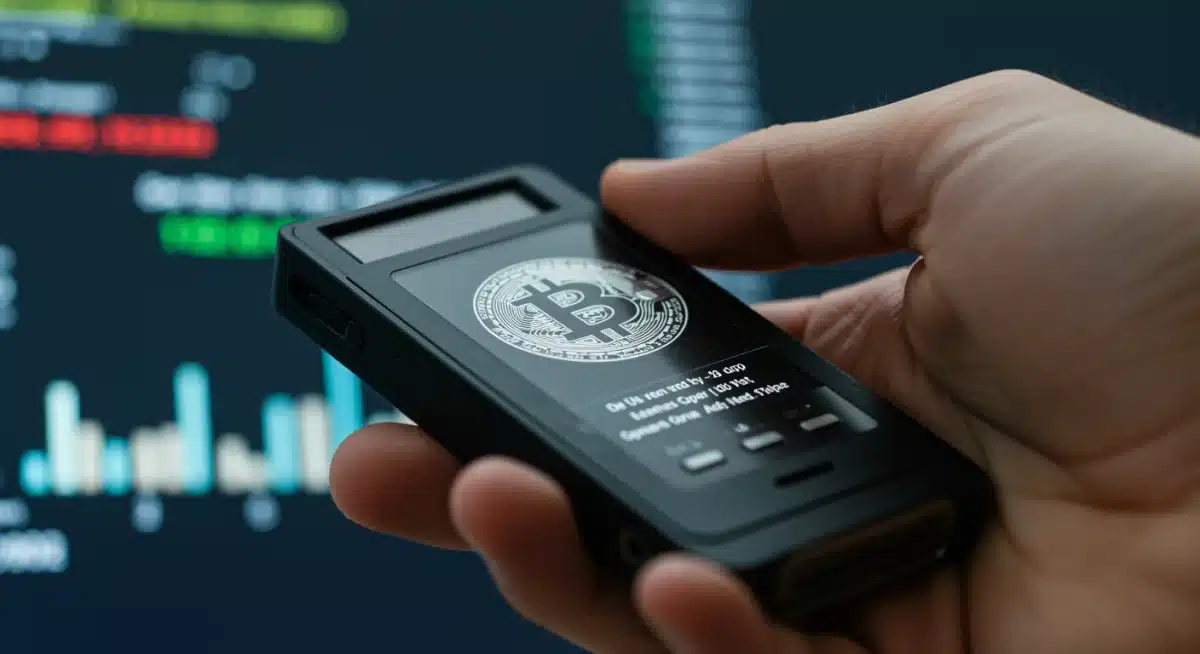
The market for hardware wallets has matured significantly by 2025, offering a variety of models from reputable manufacturers. These devices often come with intuitive interfaces and clear instructions, making them accessible even for those new to cryptocurrency. However, the onus of proper setup, backup, and ongoing security practices falls entirely on the user.
security features and considerations
Modern hardware wallets incorporate multiple layers of security to protect your assets. These features are designed to mitigate various attack vectors, from physical tampering to sophisticated software exploits.
- Offline key storage: Private keys are generated and stored in a secure element, completely isolated from internet access.
- PIN protection: A personal identification number (PIN) is required to access the device, preventing unauthorized physical access.
- Seed phrase backup: A recovery seed (typically 12 or 24 words) is provided during setup, allowing you to restore your wallet on a new device if the original is lost or damaged.
- Transaction confirmation: Transactions must be manually confirmed on the device’s screen, ensuring you approve every outgoing transfer.
While hardware wallets offer superior security, they demand a higher degree of personal responsibility. Misplacing your recovery seed, forgetting your PIN, or falling victim to sophisticated phishing scams targeting seed phrases can lead to irreversible loss. Therefore, diligent security practices are paramount for successful self-custody.
custodial services: convenience and accessibility
Custodial services, often provided by cryptocurrency exchanges or specialized custodians, offer an alternative to self-custody. For U.S. investors who prioritize ease of use, accessibility, and professional management, these services present a compelling option. Instead of managing private keys themselves, users entrust their Bitcoin to a third-party provider, much like traditional banks hold fiat currency.
The primary advantage of custodial services lies in their simplicity. Users typically create an account, deposit funds, and can then buy, sell, or transfer Bitcoin with relative ease through a web interface or mobile app. This eliminates the technical complexities associated with managing private keys, setting up hardware, and understanding blockchain intricacies. Custodial services are particularly attractive to new investors or those who trade frequently.
By 2025, many custodial platforms have enhanced their security protocols, obtained regulatory licenses, and offer insurance policies to protect client assets against certain risks. This institutionalization provides a layer of reassurance for users who might be apprehensive about the responsibilities of self-custody.
benefits and drawbacks of custodial solutions
While convenient, custodial services come with their own set of benefits and inherent risks that U.S. investors must carefully consider before committing their Bitcoin.
- Convenience: Easy access, simplified transactions, and often integrated trading features.
- Reduced personal responsibility: The custodian handles key management, security updates, and infrastructure.
- Insurance: Many regulated custodians offer insurance against certain types of loss, though coverage limits and exclusions apply.
- Regulatory compliance: Reputable custodians adhere to KYC/AML regulations, which can enhance trust but also involve personal data collection.
However, the fundamental drawback remains: you do not hold the private keys. This means you are dependent on the custodian’s security practices, operational integrity, and regulatory compliance. Past incidents of exchange hacks and insolvencies serve as stark reminders of the risks involved. While the industry has matured, the principle of counterparty risk persists.
security protocols and regulatory landscape in 2025
The year 2025 sees a more mature and regulated cryptocurrency ecosystem, particularly in the United States. This evolution significantly impacts both hardware wallet usage and custodial service offerings. Regulatory clarity has led to improved security standards across the board, but also introduces new considerations for investors.
For hardware wallets, the security emphasis remains on individual responsibility. Users must ensure they purchase devices from official channels to avoid tampering, protect their seed phrases meticulously, and use strong PINs. The regulatory framework primarily affects the manufacturing and distribution of these devices, ensuring product integrity and consumer protection.
Custodial services, on the other hand, are subject to increasingly stringent regulations. In the U.S., entities handling client funds must comply with various financial laws, including those related to anti-money laundering (AML), know your customer (KYC), and cybersecurity. This regulatory oversight aims to protect consumers and prevent illicit activities, contributing to a more secure environment for entrusted assets.
evolving threats and defenses
The digital threat landscape is constantly evolving, with new attack vectors emerging regularly. Both self-custody and custodial solutions must adapt to these challenges.
- Phishing and social engineering: Remain a significant threat, targeting users to reveal private keys or account credentials.
- Supply chain attacks: Malicious actors attempting to compromise hardware wallets during manufacturing or distribution.
- Exchange hacks: Although less frequent in 2025 due to enhanced security, large-scale breaches of custodial platforms remain a risk.
- Quantum computing: A long-term, theoretical threat to current cryptographic algorithms, prompting research into quantum-resistant solutions.
In response, hardware wallet manufacturers continuously update firmware and introduce new security features. Custodial services invest heavily in advanced cybersecurity infrastructure, multi-factor authentication, and cold storage solutions to minimize exposure to online threats. Regulatory bodies also play a crucial role in setting minimum security standards and conducting audits.
cost implications and accessibility for U.S. investors
Beyond security and control, the cost and accessibility of Bitcoin storage solutions are practical considerations for U.S. investors. These factors can significantly influence the choice, especially for those with varying investment sizes and technical proficiencies.
Hardware wallets typically involve an upfront purchase cost, ranging from $50 to several hundred dollars depending on the model and features. Once purchased, there are generally no ongoing fees for storing Bitcoin. The primary ‘cost’ is the time and effort invested in learning to use the device securely and maintaining proper backup procedures. For long-term holders, this one-time expense is often seen as a worthwhile investment in security.
Custodial services, while often free to set up an account, usually charge fees for various services. These can include trading fees (spreads or commissions), withdrawal fees, and sometimes even inactivity fees. While individual transactions might incur small charges, these can accumulate over time, especially for active traders. However, the convenience and ease of access can justify these costs for many users.
comparing financial aspects
A direct comparison of costs involves more than just explicit fees; it also includes the implicit costs of risk and time.
- Hardware wallet costs: One-time purchase fee, zero ongoing storage fees.
- Custodial service costs: Trading fees, withdrawal fees, potential premium service charges.
- Implicit cost of self-custody: Time spent learning, managing backups, and ensuring security.
- Implicit cost of custodial services: Opportunity cost of not having direct control, potential counterparty risk.
For small amounts of Bitcoin, the initial cost of a hardware wallet might seem disproportionately high, making custodial services more appealing initially. However, as holdings grow, the relative cost of a hardware wallet diminishes, and the security benefits become increasingly pronounced. Accessibility also plays a role; while hardware wallets require a degree of technical comfort, custodial services aim for maximum user-friendliness.
choosing the right solution: a personalized approach
The decision between a hardware wallet and a custodial service is not one-size-fits-all; it depends heavily on an individual U.S. investor’s specific needs, risk tolerance, and technical aptitude. There is no single ‘best’ solution, but rather the most appropriate one for your unique circumstances.
For investors with substantial Bitcoin holdings, or those deeply committed to the principles of decentralization and self-sovereignty, hardware wallets remain the superior choice. The enhanced security and complete control over private keys offer peace of mind that no third-party service can fully replicate. However, this choice demands a commitment to rigorous security practices and a thorough understanding of how to manage the device and its recovery seed.
Conversely, for newer investors, those with smaller amounts of Bitcoin, or individuals who prioritize convenience and integration with trading platforms, custodial services can be an excellent entry point. They simplify the process of buying, selling, and storing Bitcoin, reducing the technical barrier to entry. The key is to choose a reputable, regulated custodian with a strong track record of security and transparent fee structures.
hybrid strategies and future trends
Many experienced U.S. investors adopt a hybrid strategy, utilizing both types of solutions. This often involves keeping smaller amounts of Bitcoin on custodial exchanges for active trading or quick access, while transferring larger, long-term holdings to a hardware wallet for maximum security. This approach balances accessibility with robust protection.
- Small amounts for trading: Custodial services offer liquidity and ease of execution.
- Long-term holdings: Hardware wallets provide ultimate security and control.
- Diversification of risk: Spreading assets across different storage methods can mitigate single points of failure.
Looking ahead to 2026 and beyond, we can expect continued innovation in both hardware wallet technology and custodial service offerings. Increased regulatory clarity may lead to even more secure and user-friendly custodial solutions, while hardware wallets will likely incorporate advanced features like multi-signature capabilities and enhanced integration with DeFi protocols. The landscape will continue to evolve, offering even more sophisticated choices for Bitcoin investors.
| Key Aspect | Description |
|---|---|
| Private Key Ownership | Hardware wallets grant full self-custody; custodial services hold keys for you. |
| Security Model | Hardware wallets use offline storage; custodians rely on institutional-grade cybersecurity. |
| Accessibility & Convenience | Custodial services offer high convenience; hardware wallets require more technical effort. |
| Cost Structure | Hardware wallets have one-time costs; custodians often charge transaction and withdrawal fees. |
frequently asked questions about bitcoin storage
The primary advantage of a hardware wallet is its superior security through offline private key storage. This isolation from internet-connected devices significantly reduces the risk of online theft, making it highly secure for holding substantial amounts of Bitcoin, especially for long-term investors.
Yes, many custodial services for U.S. investors are increasingly safe in 2025 due to enhanced regulatory oversight and improved security protocols. Reputable platforms employ institutional-grade cybersecurity, cold storage, and sometimes insurance, offering a convenient and relatively secure option, though counterparty risk always exists.
If you lose your hardware wallet, you can recover your Bitcoin using your recovery seed phrase on a new compatible device. This 12 or 24-word phrase is crucial and must be stored securely offline. Without it, your Bitcoin would be permanently inaccessible, emphasizing the importance of proper backup.
Absolutely. A hybrid strategy is common among experienced investors. You can use a custodial service for smaller amounts of Bitcoin for trading or quick access, while securing larger, long-term holdings in a hardware wallet. This balances convenience with maximum security, diversifying your storage approach.
Hardware wallets typically involve a one-time purchase fee, with no ongoing storage costs. Custodial services, however, often charge transaction fees, withdrawal fees, and sometimes spread fees on trades. It’s essential to review the fee schedule of any custodial provider before committing your funds.
conclusion
The choice between hardware wallets and custodial services for Bitcoin Storage Solutions in 2025 ultimately boils down to a careful assessment of individual priorities for U.S. investors. While hardware wallets offer unparalleled security and self-sovereignty, demanding personal responsibility for private key management, custodial services provide convenience, accessibility, and professional oversight, albeit with inherent counterparty risk. As the digital asset landscape matures, a nuanced understanding of both options, and potentially a hybrid approach, will empower investors to secure their Bitcoin effectively and confidently navigate the evolving world of digital finance.