DeFi Arbitrage in January 2025: 4 Profitable Opportunities

Identifying and executing profitable DeFi Arbitrage 2025 strategies with over 10% spread requires a deep understanding of market inefficiencies and advanced tools, offering significant returns for those prepared to act quickly and precisely.
As we approach January 2025, the decentralized finance (DeFi) landscape continues to evolve, presenting both challenges and unprecedented opportunities. For astute traders, the pursuit of DeFi Arbitrage 2025 remains a compelling strategy to capitalize on market inefficiencies. This article delves into four distinct opportunities poised to offer over 10% profit spreads, providing a roadmap for those looking to maximize their returns in this dynamic environment.
Understanding DeFi Arbitrage in a Maturing Market
DeFi arbitrage, at its core, involves exploiting price discrepancies for the same asset across different decentralized exchanges (DEXs) or liquidity pools. While the underlying principle is simple, execution in the fast-paced DeFi world demands sophisticated tools and a keen eye for detail. As the market matures, these opportunities become more nuanced but no less lucrative.
The year 2025 is expected to bring increased institutional participation and regulatory clarity, which might reduce some of the most obvious arbitrage gaps. However, the inherent fragmentation of liquidity across numerous chains and protocols will continue to create conditions ripe for exploitation. Successful arbitragers will be those who can adapt to these changing dynamics, leveraging advanced analytics and automated systems.
The Mechanics of Decentralized Arbitrage
Decentralized arbitrage differs significantly from its centralized counterpart due to the nature of blockchain transactions. Instead of relying on order books, DeFi arbitrage often involves interacting with automated market makers (AMMs) and flash loans. Flash loans, in particular, have revolutionized the arbitrage game, allowing traders to borrow vast sums of capital without collateral, execute an arbitrage trade, and repay the loan within a single transaction.
- Flash Loans: Enable collateral-free borrowing for single-transaction arbitrage.
- AMMs: Automated Market Makers provide liquidity, but can also create price discrepancies.
- Gas Fees: A critical factor; high gas fees can erode potential profits.
- Slippage: Significant price impact on large trades in illiquid pools.
Understanding these elements is crucial for anyone looking to engage in DeFi Arbitrage 2025. The speed of execution, coupled with the ability to manage transaction costs, will determine the profitability of each venture. Opportunities with over 10% spread are rare and require swift action.
Opportunity 1: Cross-Chain Arbitrage in January 2025
The proliferation of Layer-2 solutions and interoperability protocols means that assets often exist on multiple blockchains, creating fertile ground for cross-chain arbitrage. As we enter January 2025, the liquidity bridges between Ethereum, Polygon, Avalanche, and other emerging chains are expected to be robust, yet still prone to temporary price imbalances.
This strategy involves identifying an asset priced lower on one chain’s DEX and higher on another. The arbitrager would then purchase the asset on the cheaper chain, bridge it to the more expensive chain, and sell it for a profit. The key challenge lies in the speed and cost of bridging assets, as well as the potential for price movements during the transfer period.
Leveraging Interoperability Protocols
Advanced interoperability protocols like Wormhole, LayerZero, and Chainlink’s CCIP will play a pivotal role in facilitating efficient cross-chain arbitrage. These technologies aim to reduce transaction times and costs, making multi-chain strategies more viable. Traders will need to monitor these bridges closely for optimal entry and exit points.
- Monitor Bridging Costs: High fees can negate profit margins.
- Assess Liquidity: Ensure sufficient liquidity on both sides of the trade.
- Automate Monitoring: Use bots to detect price differences instantly.
The potential for over 10% spread in January 2025 will likely arise from sudden surges in demand or large liquidations on a specific chain, creating temporary inefficiencies that can be capitalized on by quick-thinking arbitragers. Tools that provide real-time data across multiple chains will be indispensable.
Opportunity 2: Stablecoin Peg Arbitrage
Stablecoins are designed to maintain a 1:1 peg with fiat currencies, primarily the US dollar. However, market volatility, liquidity issues, or protocol-specific events can cause stablecoins to temporarily de-peg. These de-pegging events, while often short-lived, present excellent arbitrage opportunities, especially when the spread exceeds 10%.
In January 2025, with increasing regulatory scrutiny and potential macroeconomic shifts, stablecoin pegs might experience more frequent, albeit brief, fluctuations. An arbitrager would buy the de-pegged stablecoin when it trades below $1 and sell it when it returns to its peg, or swap it for another stablecoin that maintains its peg more closely.
Identifying De-Pegging Events
Monitoring major stablecoins like USDC, USDT, DAI, and newer algorithmic stablecoins will be crucial. Decentralized lending protocols, which often use stablecoins as collateral, can also be sources of de-pegging if large liquidations occur. Flash loans are particularly useful here, allowing traders to quickly acquire large amounts of the de-pegged asset to bring it back to its intended value.
- Watch for Liquidation Cascades: Can trigger sudden de-pegs.
- Analyze Stablecoin Reserves: Indicates the strength of the peg.
- Use On-Chain Data: Track large stablecoin movements for early signals.
The ability to react instantly to these de-pegging events will be paramount. Automated bots configured to execute trades within milliseconds of detecting a profitable spread will be the most effective for capturing these fleeting opportunities. The goal is to profit from the market’s natural corrective mechanisms.
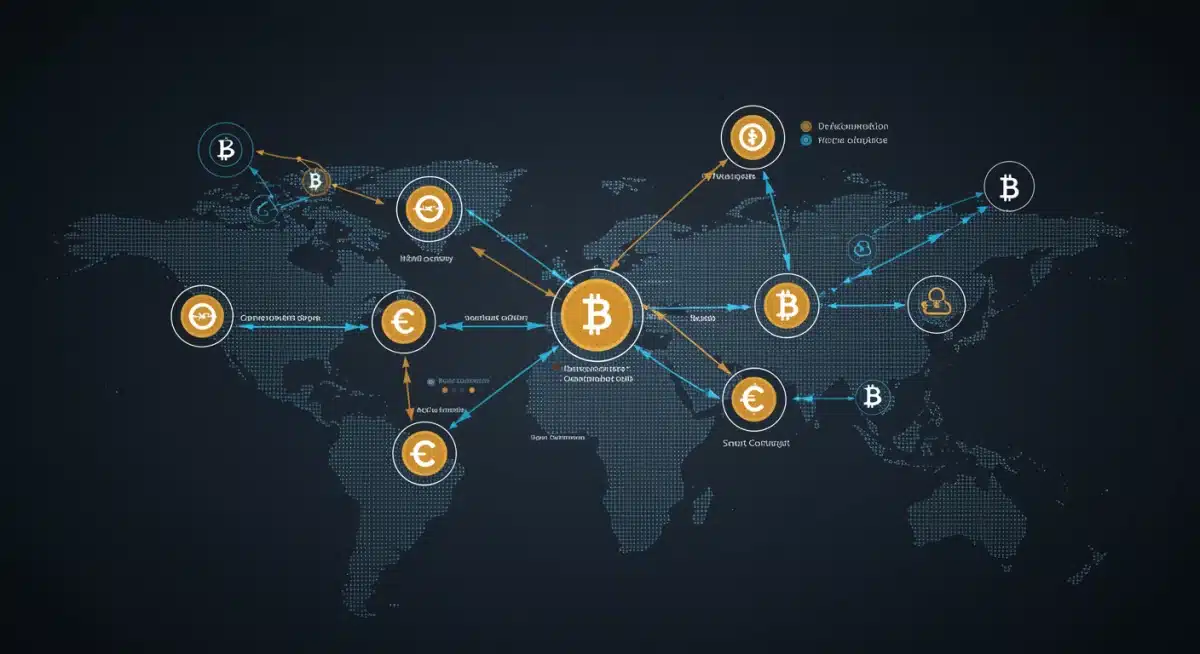
Opportunity 3: DEX-CEX Arbitrage (Decentralized to Centralized Exchange)
While DeFi primarily focuses on decentralized protocols, the interplay between DEXs and centralized exchanges (CEXs) still offers significant arbitrage potential. Price discrepancies can arise when a token is listed on a new CEX, experiences high trading volume on a DEX, or faces regulatory uncertainty that affects one platform more than another.
In January 2025, as more tokens launch on both types of platforms simultaneously, or as major news impacts one market before the other, an arbitrager could buy a token on a DEX where it’s cheaper and sell it on a CEX where it’s more expensive, or vice versa. This requires accounts on multiple exchanges and efficient capital management.
Managing Funds and Execution Speed
The primary challenge in DEX-CEX arbitrage is the time and cost associated with moving funds between different platforms. Transaction fees, withdrawal limits, and KYC procedures on CEXs can slow down execution. Therefore, pre-funding accounts on various exchanges with the necessary capital is often a prerequisite.
- Pre-fund Accounts: Have capital ready on both types of exchanges.
- Monitor Listing Announcements: New listings often create temporary disparities.
- Consider Regulatory Impact: Different regulations can affect prices on CEXs.
For spreads exceeding 10%, the arbitrager must be exceptionally fast. This often involves using API-driven trading bots to monitor prices across platforms and execute trades almost simultaneously. The risk of price movement during asset transfer between exchanges is a key factor to mitigate.
Opportunity 4: Yield Farming and Liquidation Arbitrage
Yield farming protocols, where users lend or stake crypto assets to earn rewards, can inadvertently create arbitrage opportunities. Specifically, liquidation events within lending protocols, when collateral falls below a certain threshold, can be highly profitable. Arbitragers can purchase liquidated assets at a discount and immediately sell them for profit.
January 2025 might see increased sophistication in these protocols, but also higher volatility in underlying asset prices, leading to more frequent liquidation events. Identifying these events and having the capital and tools to act on them quickly can yield substantial returns, often exceeding the 10% spread.
Automating Liquidation Monitoring
Successful liquidation arbitrage requires constant monitoring of lending protocols like Aave, Compound, and newer platforms. Bots are essential for scanning blockchain mempools for pending liquidation transactions and executing the purchase before others. Flash loans are again a powerful tool here, allowing arbitragers to acquire the necessary funds for liquidation without pre-existing capital.
- Scan Mempools: Identify pending liquidation transactions.
- Understand Protocol Mechanics: Know the liquidation thresholds and penalties.
- Utilize Flash Loans: Execute large liquidations rapidly.
This strategy requires a deep technical understanding of smart contracts and the ability to deploy sophisticated bots. The competition is fierce, but the rewards for those who can execute flawlessly can be very significant. The ability to calculate optimal gas prices to ensure transaction inclusion is also paramount.
Tools and Strategies for Maximizing Profitability
Executing DeFi Arbitrage 2025 with over 10% spread is not for the faint of heart or the ill-prepared. It demands a suite of advanced tools and well-honed strategies. Manual trading is rarely fast enough to capture these fleeting opportunities. Automation is key, as is a robust understanding of blockchain mechanics.
Traders should invest in developing or acquiring sophisticated arbitrage bots that can monitor multiple DEXs and chains simultaneously, calculate profit margins, and execute trades with minimal latency. These bots often integrate with flash loan providers and can manage gas fees dynamically to ensure transactions are processed quickly.
Essential Tools for Arbitrageurs
- Arbitrage Bots: Automated software for detection and execution.
- On-Chain Data Analytics: Platforms like Dune Analytics, Nansen, or custom scripts for real-time insights.
- Flash Loan Integrations: Access to platforms like Aave or Compound for collateral-free capital.
- Multi-Chain Monitoring: Tools that track prices and liquidity across various blockchains.
Beyond tools, a solid risk management strategy is vital. While flash loans mitigate capital risk, smart contract exploits, network congestion, and unexpected price movements can still lead to losses. Thorough testing of arbitrage strategies in simulated environments is highly recommended before deploying real capital.
Risks and Considerations for DeFi Arbitrage in 2025
While the allure of over 10% spreads is strong, DeFi Arbitrage 2025 is not without its risks. The decentralized nature of these markets introduces unique challenges that traditional finance traders might not encounter. Understanding and mitigating these risks is crucial for long-term success.
One primary risk is smart contract vulnerability. Arbitrage often involves interacting with multiple smart contracts, and a bug or exploit in any of them could lead to significant financial loss. Another major consideration is network congestion and fluctuating gas fees, especially on high-traffic blockchains like Ethereum. High gas costs can quickly erode profit margins, turning a seemingly profitable trade into a loss.
Mitigating Common Arbitrage Risks
- Smart Contract Audits: Only interact with audited and reputable protocols.
- Gas Price Management: Implement dynamic gas fee adjustments in bots.
- Slippage Control: Set appropriate slippage tolerances to avoid unexpected losses.
- Front-Running: Be aware of and protect against MEV (Maximal Extractable Value) attacks.
The competitive nature of arbitrage also means that opportunities are often short-lived and quickly exploited by other bots. This race to execute demands extreme efficiency and speed. Continuous learning and adaptation to new market conditions and technological advancements will be key to staying ahead in this competitive field.
| Opportunity Type | Brief Description |
|---|---|
| Cross-Chain Arbitrage | Exploiting price differences for the same asset across different blockchain networks. |
| Stablecoin Peg Arbitrage | Profiting from temporary de-pegging of stablecoins from their intended fiat value. |
| DEX-CEX Arbitrage | Capitalizing on price disparities between decentralized and centralized exchanges. |
| Yield Farming Liquidation | Purchasing liquidated assets at a discount from lending protocols and reselling for profit. |
Frequently Asked Questions About DeFi Arbitrage in 2025
The primary factor for successful DeFi arbitrage in 2025 is execution speed, largely facilitated by automated trading bots. Rapid detection of price discrepancies and near-instantaneous transaction execution are crucial to capture fleeting opportunities before other market participants.
Flash loans are instrumental as they allow traders to borrow large sums of capital without collateral, execute an arbitrage trade (buy low, sell high), and repay the loan within a single blockchain transaction. This eliminates the need for significant upfront capital.
Key risks include smart contract vulnerabilities, high and volatile gas fees that can erase profits, network congestion leading to failed transactions, and intense competition from other arbitrageurs and MEV bots, which can front-run trades.
While theoretically possible, achieving over 10% spreads often requires advanced technical skills, knowledge of blockchain mechanics, and access to sophisticated tools like custom bots. Beginners might find simpler, lower-spread opportunities more accessible initially.
Cross-chain arbitrage is expected to be profitable due to the continued fragmentation of liquidity across multiple blockchains and evolving interoperability solutions. Temporary price discrepancies between chains, especially during high volatility or large asset transfers, create opportunities.
Conclusion
The landscape of DeFi Arbitrage 2025 promises continued opportunities for those equipped with the right knowledge, tools, and strategic foresight. While the market matures and inefficiencies become more subtle, the potential for significant profit spreads, particularly those exceeding 10%, remains a powerful incentive. From cross-chain imbalances to stablecoin de-pegs, and the dynamic interplay between DEXs and CEXs, the decentralized finance ecosystem offers a rich hunting ground for arbitragers. Success hinges on a blend of technological prowess, real-time data analysis, and meticulous risk management, ensuring that only the most prepared traders can truly capitalize on these high-reward scenarios.