DeFi Insurance Protocols 2026: 90% Coverage Against Exploits
By 2026, DeFi insurance protocols are poised to offer unprecedented protection, with up to 90% coverage against smart contract exploits, significantly bolstering security for digital assets and fostering greater trust in decentralized finance.
The landscape of decentralized finance (DeFi) is rapidly evolving, and with its growth comes an increasing need for robust security measures. By 2026, DeFi insurance protocols 2026 are projected to revolutionize how digital assets are protected, offering up to 90% coverage against smart contract exploits. This significant advancement aims to instill greater confidence among investors and users, paving the way for wider adoption of DeFi applications.
The Evolution of DeFi Insurance: A 2026 Perspective
The early days of DeFi were marked by rapid innovation but also by significant vulnerabilities, particularly in smart contract security. As the ecosystem matured, the demand for reliable protection against these risks grew exponentially. Fast forward to 2026, and DeFi insurance has transformed from a niche concept into a cornerstone of decentralized finance infrastructure.
This evolution is driven by several factors, including the increasing sophistication of attack vectors and the growing institutional interest in DeFi. Protocols have learned from past incidents, integrating advanced risk assessment models and oracle networks to provide more accurate and timely coverage. The goal is no longer just to recover losses but to proactively mitigate risks, making the DeFi space more resilient.
From Basic Protection to Comprehensive Coverage
Initial DeFi insurance offerings were often limited in scope, focusing on specific types of exploits or offering minimal coverage. However, the market quickly recognized the need for more comprehensive solutions.
- Expanded Coverage Types: Insurance now extends beyond simple smart contract bugs to cover oracle manipulation, economic exploits, and even certain forms of governance attacks.
- Dynamic Premiums: Premiums are no longer static but adjust based on real-time risk assessments, protocol audit scores, and market volatility, ensuring fairness and sustainability.
- Cross-Chain Protection: With the rise of multi-chain ecosystems, insurance protocols now offer coverage for assets bridged across different blockchains, a critical development for interconnected DeFi.
The progression towards more sophisticated insurance models reflects a broader maturing of the DeFi industry, where security and user protection are paramount. This shift ensures that investors can participate in decentralized finance with a significantly reduced exposure to catastrophic losses.
Understanding Smart Contract Exploits and Their Impact
Smart contract exploits have historically been the Achilles’ heel of the DeFi ecosystem, leading to billions in lost funds and eroding user trust. These vulnerabilities can arise from various sources, including coding errors, design flaws, and external attacks targeting associated protocols like oracles or bridges.
The financial and reputational damage from a single exploit can be immense, not only for the affected protocol but for the broader DeFi community. This makes understanding and mitigating these risks a top priority for developers and users alike. Insurance protocols directly address this by creating a financial safety net.
Common Types of Smart Contract Vulnerabilities
While smart contracts are designed to be immutable and self-executing, they are not immune to flaws. Several common types of exploits have plagued the DeFi space:
- Reentrancy Attacks: Where an attacker repeatedly withdraws funds from a contract before its balance can be updated.
- Flash Loan Attacks: Utilizing uncollateralized loans to manipulate asset prices on decentralized exchanges and profit from arbitrage.
- Logic Errors: Bugs in the contract’s code that allow unintended actions, such as unauthorized withdrawals or asset minting.
- Oracle Manipulation: Feeding incorrect price data to a smart contract, leading to skewed valuations and potential exploits.
In 2026, advanced auditing tools and AI-driven security analyses have significantly reduced the prevalence of known vulnerabilities. However, new attack vectors continuously emerge, underscoring the ongoing need for adaptive insurance solutions.
The impact of these exploits extends beyond immediate financial loss, often causing a ripple effect across interconnected protocols and damaging investor confidence. Effective insurance acts as a crucial buffer, restoring faith and providing a mechanism for recovery.
How DeFi Insurance Protocols Achieve 90% Coverage in 2026
Achieving 90% coverage against smart contract exploits in 2026 is a testament to the advancements in decentralized risk management and capital efficiency. This high level of protection is not merely an aspiration but a realized capability, built upon innovative economic models and technological improvements.
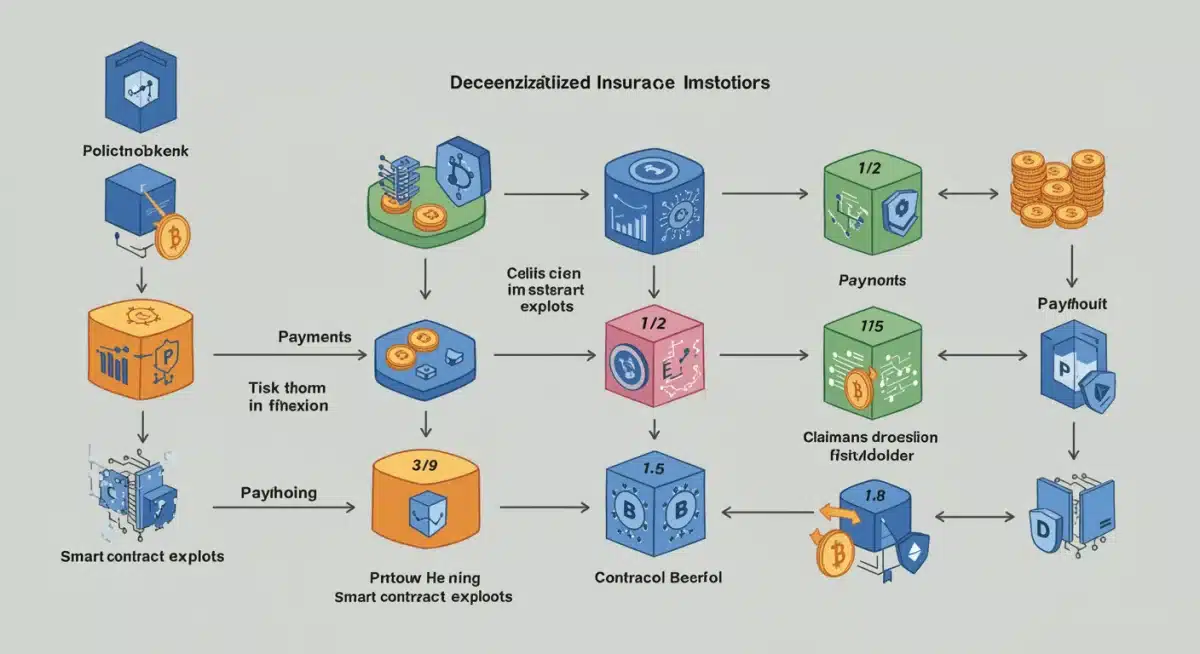
The mechanisms involve intricate risk pooling, sophisticated underwriting, and rapid claims processing, all operating on transparent and auditable blockchain infrastructure. These protocols leverage collective capital to absorb losses, distributing risk across a wide base of participants.
Key Mechanisms for High Coverage
Several critical components enable DeFi insurance protocols to offer such extensive coverage:
- Massive Capital Pools: Protocols incentivize users to stake capital, which forms the basis of the insurance fund. The sheer volume of staked assets allows for significant payouts even in large-scale exploits.
- Advanced Risk Assessment Oracles: Real-time data feeds and AI-powered analytics continuously evaluate protocol security, identifying potential vulnerabilities before they are exploited and adjusting coverage terms accordingly.
- Decentralized Claims Assessment: Claims are assessed by a decentralized network of token holders or expert committees, ensuring impartiality and transparency, which speeds up the payout process.
- Reinsurance Layers: Integration with traditional insurance markets or other DeFi insurance protocols creates reinsurance layers, further diversifying risk and boosting capital efficiency.
The synergy of these elements allows for a robust and scalable insurance framework. The ability to dynamically price risk and quickly process claims, combined with substantial capital reserves, positions these protocols to offer industry-leading coverage levels.
Ultimately, the success of 90% coverage lies in the continuous innovation and adaptation of these protocols to the ever-changing threat landscape of decentralized finance, ensuring that policyholders are adequately protected.
Benefits for Digital Asset Holders and the Broader DeFi Ecosystem
The advent of highly effective DeFi insurance protocols, offering 90% coverage, brings a multitude of benefits that extend far beyond individual asset holders, fostering a more stable and attractive decentralized finance ecosystem. This elevated level of security is a game-changer for mainstream adoption.
For individuals, it provides peace of mind, allowing them to engage with DeFi applications without the constant fear of losing their investments to unforeseen exploits. For the ecosystem, it builds trust, attracts new capital, and encourages innovation by reducing systemic risk.
Enhanced Trust and Adoption
One of the most significant benefits is the substantial boost in trust. Historically, the volatility and security concerns of crypto assets deterred many potential investors. With reliable insurance, this barrier is significantly lowered.
- Increased Investor Confidence: Knowing that a significant portion of their assets is protected encourages more users to participate in yield farming, lending, and other DeFi activities.
- Institutional Participation: Large institutional investors, who are typically highly risk-averse, are more likely to allocate capital to DeFi when robust insurance mechanisms are in place, driving further market maturity.
- Reduced Systemic Risk: By covering losses from exploits, insurance protocols prevent contagion, where a single protocol failure could trigger a cascade of liquidations and instability across the entire ecosystem.
This newfound confidence translates directly into increased liquidity and a more vibrant, resilient DeFi market. The ability to mitigate the financial consequences of smart contract exploits makes DeFi a more viable and attractive alternative to traditional finance.
The broader ecosystem benefits from this stability, allowing developers to focus on innovation rather than constantly battling the reputational damage from security incidents. This creates a virtuous cycle of growth and enhanced security.
Challenges and Future Outlook for DeFi Insurance in 2026
While DeFi insurance protocols have made remarkable strides by 2026, offering impressive coverage levels, they are not without their challenges. The dynamic nature of blockchain technology and the evolving tactics of malicious actors demand continuous innovation and adaptation from insurance providers.
The future outlook, however, remains overwhelmingly positive, with ongoing research and development focused on addressing current limitations and expanding the scope of protection. The industry is committed to making DeFi as secure as traditional financial systems, if not more so.
Overcoming Remaining Hurdles
Despite the advancements, several key areas require ongoing attention and improvement:
- Oracle Dependency: The reliance on external data feeds for risk assessment and claims verification introduces a potential single point of failure, necessitating robust, decentralized oracle solutions.
- Regulatory Clarity: The lack of clear global regulatory frameworks for DeFi insurance creates uncertainty and can hinder widespread adoption and integration with traditional finance.
- Scalability of Capital: While capital pools are substantial, ensuring sufficient liquidity to cover multiple large-scale exploits simultaneously remains a challenge that requires innovative capital formation strategies.
- Complex Exploit Vectors: As smart contracts become more intricate, identifying and insuring against novel, complex exploit vectors requires highly specialized expertise and AI-driven analysis.
Addressing these challenges will involve collaborative efforts between protocol developers, security auditors, legal experts, and the wider DeFi community. The emphasis will be on creating more resilient, autonomous, and legally sound insurance mechanisms.
The future of DeFi insurance in 2026 is characterized by a drive towards greater automation, predictive risk modeling, and seamless integration with other DeFi primitives, ultimately aiming for near-absolute protection for digital assets.
Integrating DeFi Insurance into Your 2026 Digital Asset Strategy
For any serious digital asset holder in 2026, integrating DeFi insurance into their investment strategy is no longer optional but a fundamental component of responsible portfolio management. With 90% coverage against smart contract exploits becoming the norm, ignoring these protections is an unnecessary risk.
The process of acquiring and managing DeFi insurance has also become significantly more user-friendly, allowing even novice users to secure their investments with relative ease. It’s about proactive risk management in a decentralized world.
Practical Steps for Securing Your Assets
Implementing DeFi insurance into your strategy involves a few straightforward steps:
- Assess Your Risk Exposure: Identify which DeFi protocols you interact with and the specific types of risks they present (e.g., lending platforms, yield aggregators, DEXs).
- Research Insurance Providers: Evaluate different DeFi insurance protocols based on their coverage scope, capital reserves, claims history, and community governance model. Protocols like Nexus Mutual, InsurAce, and Etherisc continue to be prominent players.
- Understand Policy Terms: Carefully read the policy documents to understand what is covered, what exclusions apply, and the claims process. Pay attention to the payout limits and any deductible clauses.
- Purchase Coverage: Acquire coverage for your specific assets or protocol interactions. Many platforms offer flexible policy durations and premium structures.
- Monitor and Adapt: The DeFi landscape changes rapidly. Regularly review your insurance policies and adjust them as your portfolio or the protocols you use evolve.
By taking these steps, digital asset holders can significantly enhance the security of their investments, transforming potential liabilities into manageable risks. This strategic integration of insurance allows for more confident participation in the burgeoning DeFi economy.
Ultimately, DeFi insurance in 2026 empowers users, fostering a more secure and sustainable environment for everyone involved in decentralized finance, making it an indispensable tool for protecting your digital wealth.
| Key Aspect | Brief Description |
|---|---|
| 90% Coverage Target | DeFi insurance protocols in 2026 aim to cover up to 90% of losses from smart contract exploits. |
| Advanced Risk Models | Utilizing AI and real-time data for dynamic premium adjustments and proactive vulnerability detection. |
| Decentralized Claims | Community-driven assessment and rapid payout processes ensure transparency and efficiency. |
| Enhanced Trust | Robust insurance fosters greater investor confidence and encourages broader institutional adoption of DeFi. |
Frequently Asked Questions About DeFi Insurance in 2026
In 2026, DeFi insurance protocols provide comprehensive coverage against a range of exploits, including smart contract bugs, reentrancy attacks, flash loan manipulations, oracle failures, and certain governance attacks. Policies are designed to protect against both technical vulnerabilities and economic exploits that can lead to asset loss.
The 90% coverage level is achieved through massive, diversified capital pools, advanced AI-driven risk assessment models, and efficient decentralized claims processing. Reinsurance layers from both traditional and crypto markets also play a crucial role in bolstering capital reserves and distributing risk effectively across the ecosystem.
By 2026, premiums for DeFi insurance have become more dynamic and competitive. They are typically based on the protocol’s audit history, smart contract complexity, and real-time market volatility. While high-risk protocols might have higher premiums, many established protocols offer affordable rates, making insurance accessible to average users.
The claims process in 2026 is largely decentralized and streamlined. Policyholders submit a claim, which is then reviewed by a decentralized community of token holders or expert committees. This ensures impartiality and transparency. Payouts are typically automated or executed swiftly once a consensus on the validity of the claim is reached.
DeFi insurance significantly enhances ecosystem security by providing a financial safety net against exploits, which boosts user confidence and attracts more capital. It also incentivizes protocols to maintain high security standards to lower their insurance costs. This reduces systemic risk, fostering a more stable and resilient decentralized financial environment.
Conclusion
The evolution of DeFi insurance protocols by 2026 marks a pivotal moment for the decentralized finance industry. With the capability to offer up to 90% coverage against smart contract exploits, these protocols have transformed the risk landscape, making DeFi a significantly more secure and appealing investment avenue. This enhanced protection not only safeguards individual digital assets but also builds foundational trust, paving the way for broader institutional adoption and sustained innovation within the decentralized economy. Integrating DeFi insurance is now an essential practice for anyone navigating the complexities of digital finance.