Advanced DeFi Options Trading: Strategies for US Users

Advanced DeFi options trading offers US users robust tools to hedge against market volatility and optimize returns, with strategies like covered calls, protective puts, and iron condors becoming increasingly vital by Q2 2025.
The landscape of decentralized finance (DeFi) is rapidly evolving, presenting sophisticated opportunities for savvy investors. For US users, understanding and implementing DeFi options trading strategies is becoming crucial for effective risk management and portfolio optimization, especially as the market matures towards Q2 2025. This article explores advanced techniques that can empower you to navigate the volatile crypto markets with greater confidence and potentially enhanced returns.
Understanding DeFi Options: A Primer for US Users
DeFi options are financial derivatives built on decentralized protocols, allowing users to trade the right, but not the obligation, to buy or sell an underlying asset at a predetermined price (strike price) on or before a specific date (expiration). Unlike traditional finance, DeFi options operate without intermediaries, leveraging smart contracts for transparency and censorship resistance. This section lays the groundwork for understanding how these instruments function within the US regulatory context.
The core appeal of DeFi options for US users lies in their potential to enhance capital efficiency and provide flexible hedging mechanisms against the inherent volatility of digital assets. As the regulatory environment in the United States continues to clarify, understanding the nuances of these decentralized instruments becomes paramount for compliance and strategic advantage.
Key components of DeFi options
- Underlying Asset: The cryptocurrency or token on which the option is based (e.g., ETH, WBTC).
- Strike Price: The price at which the underlying asset can be bought or sold.
- Expiration Date: The date when the option contract ceases to be valid.
- Premium: The cost paid by the option buyer to the option seller.
Navigating DeFi options requires a solid grasp of these fundamentals, especially when considering the decentralized nature of their execution. The absence of a centralized clearinghouse means that counterparty risk is managed through collateralization and smart contract logic, a critical difference from traditional options markets.
In conclusion, DeFi options offer a powerful suite of tools for US users, but their effective utilization demands a clear understanding of their mechanics and the underlying decentralized infrastructure. This foundational knowledge is essential before delving into more complex trading strategies.
Strategy 1: Covered Calls for Income Generation
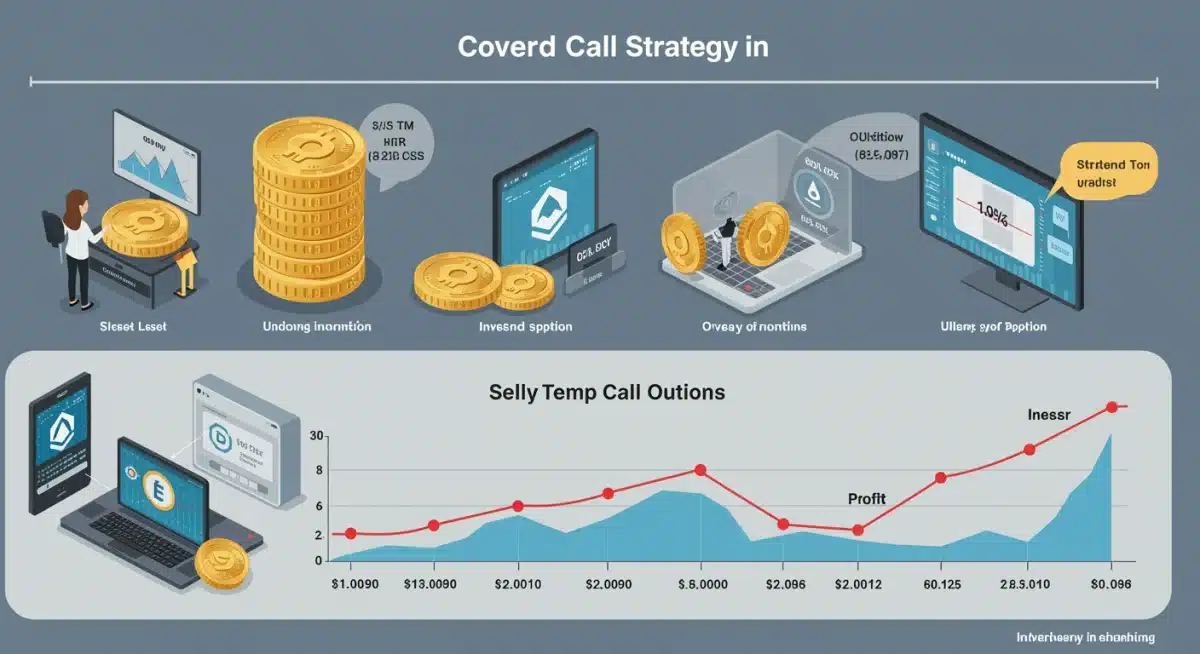
The covered call strategy is a popular choice for investors holding a long position in an underlying asset and seeking to generate additional income. In the DeFi space, this involves owning a cryptocurrency (e.g., Ethereum) and simultaneously selling call options on that same asset. The ‘covered’ aspect means that if the option is exercised, you already own the asset to deliver, thus limiting your risk.
For US users, implementing covered calls in DeFi protocols can be a compelling way to earn yield on existing crypto holdings, especially in relatively stable market conditions or when anticipating moderate price appreciation. This strategy allows you to capitalize on time decay, where the value of the option premium erodes as the expiration date approaches.
How covered calls work in DeFi
When you sell a covered call, you receive a premium upfront. If the price of the underlying asset stays below the strike price until expiration, the option expires worthless, and you keep the premium as profit, while retaining your underlying asset. If the price rises above the strike price, the option holder may exercise their right to buy your asset at the strike price, meaning you sell your asset at a profit, but forgo any further upside beyond the strike price.
- Generate Income: Earn premiums from selling call options.
- Lower Cost Basis: Premiums received effectively reduce the average purchase price of your underlying asset.
- Limited Upside: You cap your potential profit if the asset price surges significantly above the strike.
- Reduced Downside: The premium offers a small buffer against price drops.
Consider a scenario where you hold 10 ETH and believe its price will remain stable or rise only slightly. You could sell a call option with a strike price slightly above the current market price, expiring in a month. If ETH stays below the strike, you pocket the premium. If it goes above, you might sell your ETH at a profit, but miss out on further gains.
In conclusion, covered calls provide a conservative yet effective strategy for US DeFi users to generate recurring income and slightly cushion against minor price declines. It’s particularly suitable for long-term holders comfortable with potentially capping their maximum upside in exchange for immediate yield.
Strategy 2: Protective Puts for Downside Protection
Protective puts are akin to insurance policies for your cryptocurrency holdings. This strategy involves buying a put option on an asset you already own. If the market price of your asset falls below the strike price of the put option, you have the right to sell your asset at the higher strike price, thereby limiting your potential losses. For US users concerned about significant market downturns, this can be an invaluable hedging tool.
The primary objective of a protective put is capital preservation. While it incurs a cost (the premium paid for the put option), this cost is viewed as an insurance premium against adverse price movements. As the DeFi market matures and regulatory clarity increases by Q2 2025, tools that offer robust downside protection will become increasingly vital for institutional and retail investors alike.
Implementing protective puts in DeFi
Imagine you hold a substantial amount of a specific token, say SOL, and you’re concerned about a potential market correction. You could purchase a put option with a strike price slightly below the current market price. If SOL’s price tanks, your put option gains value, allowing you to sell your SOL at the agreed-upon strike price, mitigating severe losses. If SOL’s price rises or stays stable, the put option expires worthless, and your only loss is the premium paid.
- Downside Protection: Limits potential losses on your cryptocurrency holdings.
- Peace of Mind: Provides security against sudden market crashes.
- Cost of Insurance: Requires paying a premium, which reduces potential gains.
- Retain Upside: Unlike covered calls, protective puts allow you to fully participate in any upward price movement of your asset.
This strategy is particularly relevant for US users who have significant exposure to single assets or a concentrated portfolio. It enables them to remain invested in their preferred assets while safeguarding against unforeseen market volatility without having to sell their holdings outright. The cost of the premium should be weighed against the potential for catastrophic losses.
In summary, protective puts are an essential risk management tool for US users in the DeFi space, offering crucial downside protection while preserving the potential for upside participation. It’s a strategic move for those who prioritize capital preservation in volatile markets.
Strategy 3: Iron Condors for Range-Bound Markets
The iron condor is a more advanced, neutral options strategy designed to profit from an asset trading within a specific price range. It involves selling both a call spread and a put spread with the same expiration date. Specifically, it’s constructed by selling an out-of-the-money (OTM) call option and buying a further OTM call option, while simultaneously selling an OTM put option and buying a further OTM put option. This strategy is ideal for US users who anticipate low volatility or range-bound price action in a particular DeFi asset.
Iron condors offer a way to generate income in sideways markets, which are common in crypto after periods of high volatility. The profit potential is limited to the net premium received, and losses are also capped. This makes it an attractive strategy for sophisticated US traders looking for defined risk and reward scenarios as the DeFi market matures by Q2 2025.
Constructing an iron condor in DeFi
An iron condor consists of four options contracts: a sell put, a buy put, a sell call, and a buy call. All options have the same expiration date. The profitable range is defined by the two sold options (the inner strikes), and the maximum loss is limited by the purchased options (the outer strikes).
- Defined Risk and Reward: Maximum profit and loss are known at the outset.
- Income Generation: Profits from collecting premiums on both sides of the trade.
- Suitable for Sideways Markets: Benefits from low volatility and time decay.
- Complex Structure: Requires careful management and understanding of multiple legs.
For example, if you expect an asset like LINK to trade between $15 and $25, you might sell a $16 put and buy a $14 put, while also selling a $24 call and buying a $26 call. If LINK remains within the $16-$24 range at expiration, you profit from the premiums collected. If it breaks out of this range, your losses are capped by the purchased options.
The complexity of an iron condor means it’s generally recommended for experienced traders. However, for US users with a strong understanding of options and market dynamics, it provides a powerful tool for profiting from stable market conditions, offering a balanced approach to risk and reward.
Ultimately, the iron condor strategy allows US users to capitalize on market neutrality, providing a sophisticated method for generating income when significant price movements are not anticipated. Its defined risk profile makes it a valuable addition to an advanced DeFi options trading toolkit.
Regulatory Landscape and Compliance for US Users
Operating within the DeFi space as a US user necessitates a keen awareness of the evolving regulatory landscape. While decentralization offers certain freedoms, regulatory bodies like the SEC and CFTC are increasingly scrutinizing crypto activities, including decentralized finance and options trading. By Q2 2025, it is anticipated that further clarity and potentially stricter guidelines will be in place, impacting how US users engage with DeFi options.
Compliance is not just about avoiding penalties; it’s about building a sustainable and secure financial future in the digital realm. Understanding your obligations regarding taxes, reporting, and permissible activities is crucial for any US investor participating in advanced DeFi options trading.
Navigating US regulations
The classification of crypto assets and derivatives remains a complex area. Options on cryptocurrencies could be viewed as securities or commodities, each falling under different regulatory frameworks. US users must stay informed about these classifications and how they apply to the specific DeFi protocols and options contracts they engage with.
- Tax Implications: Understand capital gains taxes on profits from options trading and the potential for wash sale rules.
- KYC/AML: While DeFi protocols are permissionless, the on-ramps and off-ramps (fiat-to-crypto exchanges) often require Know Your Customer (KYC) and Anti-Money Laundering (AML) compliance.
- Jurisdictional Risks: Be aware that some DeFi protocols may restrict US users due to regulatory uncertainties, or impose specific requirements.
- Reporting Requirements: Keep meticulous records of all trades for tax reporting purposes, including premiums received, premiums paid, and profits/losses from exercise or assignment.
Engaging with legal and tax professionals specializing in cryptocurrency is highly advisable for US users involved in advanced DeFi options. This proactive approach ensures compliance and helps optimize tax strategies, preventing potential issues down the line.
In conclusion, while the allure of DeFi options is strong, US users must approach this space with a thorough understanding of the regulatory environment. Proactive compliance and professional guidance are key to safely and effectively leveraging these advanced financial instruments.
Risks and Considerations in DeFi Options Trading
While advanced DeFi options trading offers significant opportunities for hedging and income generation, it also comes with a unique set of risks that US users must carefully consider. Understanding these risks is not just about avoiding losses, but about making informed decisions that align with your risk tolerance and financial goals. The decentralized nature of these instruments introduces complexities not always present in traditional finance.
As the DeFi ecosystem evolves towards Q2 2025, new risks may emerge, and existing ones may become more pronounced. A proactive and cautious approach to risk management is therefore paramount for anyone engaging in these sophisticated financial activities.
Mitigating common DeFi options risks
The inherent volatility of cryptocurrencies is perhaps the most obvious risk. Rapid price swings can quickly turn a profitable options position into a losing one, or vice versa. Beyond market volatility, there are specific risks tied to the decentralized infrastructure.
- Smart Contract Risk: Bugs or vulnerabilities in the underlying smart contracts could lead to loss of funds or unexpected execution.
- Liquidation Risk: If collateralized positions are used, sudden market movements can trigger liquidations, especially with volatile assets.
- Impermanent Loss: While more common in liquidity providing, understanding its potential impact if options are combined with other DeFi strategies is important.
- Oracle Risk: DeFi protocols often rely on external data feeds (oracles) for pricing. Malfunctions or manipulation of these oracles can impact option payouts.
- Gas Fees: Transaction costs on some blockchains can be high, impacting the profitability of frequent options trades, especially for smaller positions.
Beyond these technical risks, there’s also the challenge of liquidity. Some DeFi options markets might not be as deep or liquid as their centralized counterparts, potentially leading to wider bid-ask spreads and difficulty in entering or exiting positions at desired prices. US users should conduct thorough due diligence on the specific DeFi options protocols they choose, evaluating their security audits, community support, and overall track record.
In conclusion, a comprehensive understanding of the risks associated with DeFi options trading is non-negotiable. By acknowledging and actively working to mitigate these factors, US users can navigate the complex landscape more effectively and protect their investments.
Future Outlook: DeFi Options in Q2 2025
Looking ahead to Q2 2025, the landscape of DeFi options trading for US users is poised for significant transformation and growth. We anticipate a period of increased institutional adoption, further regulatory clarity, and the emergence of more sophisticated and user-friendly protocols. These developments will likely enhance the accessibility and utility of DeFi options, making them an even more integral part of advanced crypto investment strategies.
The continuous innovation within the DeFi space means that new features, improved liquidity mechanisms, and better risk management tools are constantly being developed. For US users, staying ahead of these trends will be key to leveraging the full potential of decentralized options for hedging and yield generation.
Anticipated developments and opportunities
As the market matures, we can expect to see enhanced cross-chain interoperability, allowing for more seamless trading of options across different blockchain networks. This will expand the range of underlying assets available for options trading and potentially increase liquidity.
- Enhanced User Interfaces: Protocols will likely feature more intuitive and robust interfaces, lowering the barrier to entry for complex strategies.
- Institutional Participation: Increased regulatory clarity will likely attract more institutional capital, boosting liquidity and market depth.
- New Product Offerings: Expect to see a wider array of options products, including exotic options and structured products tailored for DeFi.
- Improved Capital Efficiency: Innovations in collateral management and margin systems will allow for more efficient use of capital.
- Decentralized Identity (DID): Integration of DID solutions could facilitate compliance without sacrificing the core tenets of decentralization.
The integration of advanced analytics and AI-driven tools will also empower US users to make more informed decisions, identify optimal entry and exit points, and better manage their risk exposures. Education will play a critical role, with resources becoming more comprehensive to guide users through the intricacies of DeFi options.
In conclusion, Q2 2025 holds immense promise for DeFi options trading. US users who embrace continuous learning and adapt to the evolving environment will be well-positioned to capitalize on these advanced strategies, effectively hedging risk and optimizing their portfolios in the decentralized future.
| Strategy Type | Primary Use Case |
|---|---|
| Covered Calls | Generate income on long-held assets. |
| Protective Puts | Hedge against significant downside risk. |
| Iron Condors | Profit from range-bound, low-volatility markets. |
| Regulatory Compliance | Essential for US users to avoid legal and tax issues. |
Frequently Asked Questions About DeFi Options Trading
DeFi options offer greater transparency, censorship resistance, and often lower fees due to the absence of intermediaries. They leverage smart contracts for automatic execution, reducing counterparty risk and providing 24/7 market access without traditional market hours.
US regulations are still evolving, leading to potential uncertainties regarding asset classification and tax implications. It’s crucial to stay informed about CFTC and SEC guidelines. Some protocols may restrict US access, and tax reporting is mandatory for all profits and losses.
An iron condor is considered an advanced strategy due to its multi-leg structure and the need for accurate market predictions. Beginners should first master simpler strategies like covered calls or protective puts before attempting complex neutral strategies to minimize risk.
Key risks include smart contract vulnerabilities, high gas fees, oracle manipulation, and illiquidity in certain markets. Additionally, the inherent volatility of crypto assets can lead to rapid and significant changes in option values, requiring careful risk management.
By Q2 2025, hedging with DeFi options will be more streamlined. Strategies like protective puts can safeguard against downturns, while covered calls generate income. Combining these with a clear understanding of market trends and regulatory developments will optimize your hedging strategy.
Conclusion
The journey into advanced DeFi options trading for US users by Q2 2025 presents both exciting opportunities and significant responsibilities. By mastering strategies like covered calls, protective puts, and iron condors, investors can build robust portfolios capable of navigating the inherent volatility of the crypto market. However, success hinges not only on strategic acumen but also on a diligent commitment to understanding the evolving regulatory landscape, mitigating technical risks, and continuously adapting to market innovations. For those prepared to embrace these complexities, DeFi options offer powerful tools to hedge risk, generate income, and ultimately thrive in the decentralized financial future.