Liquid Staking 2026: Achieve 12%+ APY on Leading Protocols

Maximizing Yield with Liquid Staking in 2026: A Guide to 12%+ APY on Leading Protocols
The cryptocurrency landscape is ever-evolving, and as we push further into 2026, the quest for sustainable and high-yield passive income streams remains a top priority for investors. Among the myriad of decentralized finance (DeFi) innovations, liquid staking has emerged as a particularly potent strategy, offering an attractive blend of yield generation and liquidity. This comprehensive guide will delve into the intricacies of liquid staking, focusing on how you can potentially achieve a remarkable 12%+ APY on leading protocols by 2026. We’ll explore the underlying mechanics, the benefits, the inherent risks, and advanced strategies to optimize your returns.
The concept of staking has been a cornerstone of proof-of-stake (PoS) blockchains, allowing participants to earn rewards by locking up their cryptocurrency to support network operations. However, traditional staking often comes with a significant drawback: illiquidity. Once your assets are staked, they are typically locked for a certain period, making them inaccessible for other investment opportunities or immediate use. This is where liquid staking revolutionizes the game.
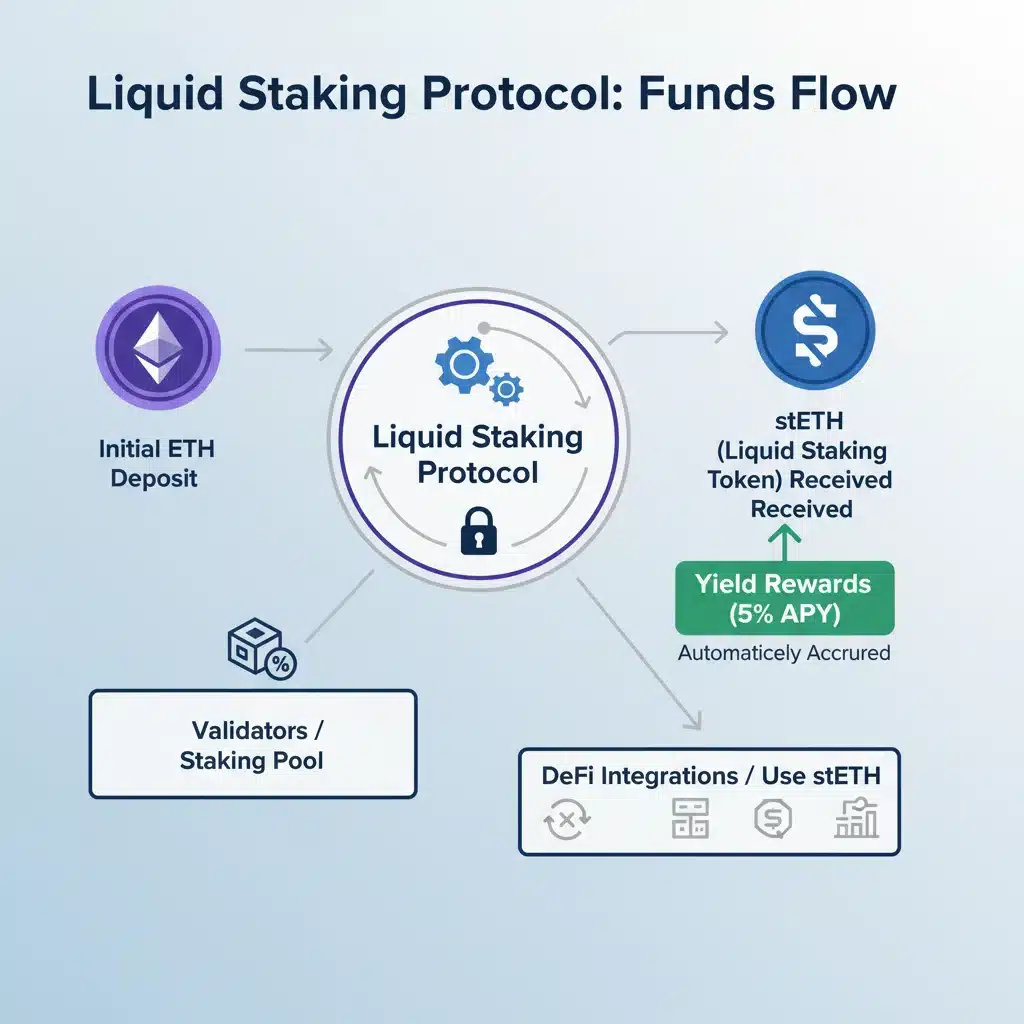
Liquid staking protocols address this liquidity challenge by issuing a tokenized representation of your staked assets. For instance, when you stake Ethereum (ETH) through a liquid staking platform, you receive a liquid staking token (LST) like stETH (from Lido) or rETH (from Rocket Pool). These LSTs are fully transferable, can be traded, used as collateral in other DeFi protocols, or even lent out, all while your original staked ETH continues to accrue staking rewards. This dual benefit of earning staking rewards and maintaining liquidity makes liquid staking an incredibly powerful tool for maximizing your capital efficiency.
As we project into 2026, the maturity of these protocols, coupled with the increasing adoption of PoS blockchains and potential network upgrades, is expected to create an environment where a 12%+ APY becomes not just a possibility, but a tangible goal for informed investors. The market is constantly optimizing, and competition among protocols drives innovation, often leading to more attractive yield opportunities for users.
Our journey through this guide will cover the fundamental principles of liquid staking, dissect the leading protocols that are likely to offer the most promising returns, and equip you with the knowledge to navigate this exciting, yet complex, corner of the DeFi world. Whether you are a seasoned DeFi enthusiast or new to the space, understanding liquid staking is crucial for anyone looking to optimize their crypto portfolio for the coming years.
Understanding the Core Mechanics of Liquid Staking for High APY
To truly appreciate the potential for a 12%+ liquid staking APY, it’s essential to grasp the underlying mechanics of how these protocols operate. At its heart, liquid staking involves delegating your native blockchain assets (like ETH) to a staking pool managed by a decentralized protocol. Instead of directly locking your assets on the blockchain, you deposit them into the protocol’s smart contracts.
Upon depositing, the protocol issues you an equivalent amount of a liquid staking token (LST). This LST represents your staked principal plus any accrued staking rewards. The value of the LST typically appreciates over time relative to the underlying asset, reflecting the continuous accumulation of staking rewards. For example, 1 stETH might initially be equivalent to 1 ETH, but over time, due to accumulated rewards, it could be worth 1.05 ETH, 1.10 ETH, and so on. This appreciation is one of the primary drivers of your liquid staking APY.
The protocols then take your deposited assets and stake them with professional validators on the underlying blockchain. These validators perform the crucial task of verifying transactions and securing the network, for which they receive block rewards and transaction fees. A portion of these rewards is passed back to the liquid stakers, forming the basis of their yield.
What differentiates liquid staking from traditional staking is the utility of the LST. Unlike locked staked assets, LSTs are fungible and can be used across the broader DeFi ecosystem. This opens up a world of possibilities for generating additional yield, a concept often referred to as ‘yield stacking’ or ‘re-hypothecation’. You can:
- Trade LSTs on decentralized exchanges (DEXs): Providing immediate liquidity for your staked assets.
- Use LSTs as collateral for loans: Borrowing stablecoins or other assets against your staked position without unstaking.
- Provide liquidity to LST/ETH or LST/stablecoin pools: Earning trading fees and additional liquidity mining rewards.
- Lend LSTs on money markets: Earning interest from borrowers.
By leveraging these additional opportunities, investors can significantly amplify their overall liquid staking APY, pushing it into the desirable 12%+ range. This multi-layered approach to yield generation is a key factor in the attractiveness and potential profitability of liquid staking in 2026.
Leading Protocols for Maximizing Liquid Staking APY in 2026
As we look towards 2026, several liquid staking protocols stand out as potential leaders for achieving a high liquid staking APY. Each offers unique features, security models, and integration opportunities within the broader DeFi ecosystem. Understanding these differences is crucial for making informed investment decisions.
Lido Finance (Lido)
Lido remains the undisputed giant in the liquid staking space, particularly for Ethereum. It allows users to stake ETH and receive stETH in return. Lido’s dominance stems from its early mover advantage, robust security audits, and widespread integration across numerous DeFi platforms. The sheer liquidity of stETH makes it a highly versatile asset for yield stacking strategies.
- Expected APY Drivers: Base Ethereum staking rewards, deep liquidity pools for stETH, and potential for high yield farming opportunities with stETH on various DEXs and lending platforms.
- Advantages: High liquidity, broad DeFi integration, strong community support, and a proven track record.
- Considerations: Centralization concerns due to its large market share, smart contract risk.
Rocket Pool (rETH)
Rocket Pool offers a more decentralized approach to Ethereum liquid staking. It allows anyone to run a node with a lower ETH bond (16 ETH instead of 32 ETH for a solo staker), making staking more accessible. Users can stake ETH and receive rETH, which is an interest-bearing token that accrues value over time.
- Expected APY Drivers: Base Ethereum staking rewards, rewards from mini-pool operators, and growing DeFi integrations for rETH.
- Advantages: Higher decentralization, lower barrier to entry for node operators, strong focus on security and community.
- Considerations: Potentially less liquidity for rETH compared to stETH, though this is rapidly improving.
Frax Ether (frxETH)
Frax Finance, known for its algorithmic stablecoin, has also entered the liquid staking arena with Frax Ether (frxETH). This protocol introduces a unique two-token model: frxETH (the liquid staking token) and sfrxETH (an ERC-4626 compliant token that automatically compounds staking rewards). This design allows for different yield optimization strategies.
- Expected APY Drivers: Ethereum staking rewards, potential for higher yields through sfrxETH’s auto-compounding mechanism, and integration within the Frax ecosystem.
- Advantages: Innovative token design, strong backing by the Frax ecosystem, potential for competitive yields.
- Considerations: Newer protocol compared to Lido/Rocket Pool, requiring careful evaluation of its growth and stability.
Other Promising Protocols (e.g., EigenLayer, Swell, Mantle)
Beyond Ethereum, other PoS blockchains are also developing robust liquid staking solutions. Protocols like Swell Network (swETH) are gaining traction, while innovations like EigenLayer’s restaking primitives are poised to revolutionize the entire staking landscape. EigenLayer allows stakers to ‘re-stake’ their already staked ETH (or LSTs) to secure other decentralized services, effectively earning additional rewards on top of their base staking yield. This concept, known as ‘restaking,’ is a significant driver for potentially reaching and exceeding the 12%+ liquid staking APY in 2026.
As these protocols mature and integrate further into the DeFi ecosystem, they will offer diverse avenues for maximizing your liquid staking APY. Diversification across multiple reputable protocols can also help mitigate protocol-specific risks.
Strategies for Achieving 12%+ Liquid Staking APY
Simply holding liquid staking tokens will earn you the base staking APY, which is typically in the 3-5% range for Ethereum. To push your liquid staking APY beyond the 12% mark, you need to employ more advanced, yet accessible, yield-stacking strategies. These strategies leverage the fungibility of LSTs within the broader DeFi ecosystem.
1. Providing Liquidity in LST Pools
One of the most common and effective ways to boost your liquid staking APY is to provide liquidity to LST trading pairs on decentralized exchanges (DEXs). For example, providing liquidity to an stETH/ETH pool on Curve Finance or Uniswap. As a liquidity provider (LP), you earn a share of the trading fees generated by swaps within that pool. Many protocols also offer additional liquidity mining rewards (in their native token or other incentives) to LPs, further increasing your yield.
- Example: Depositing stETH and ETH into a Curve pool. You earn trading fees and potentially CRV or other incentive tokens, which can be sold or re-invested.
- Risk: Impermanent loss, especially if the peg between the LST and its underlying asset breaks significantly. However, for stable LSTs like stETH, this risk is generally lower.
2. Lending LSTs on Money Markets
Lending protocols like Aave and Compound allow you to deposit your LSTs as collateral or lend them out to earn interest. If you lend your LSTs, you earn interest from borrowers. If you use them as collateral, you can borrow other assets (like stablecoins) to deploy into other yield-generating strategies, effectively leveraging your position.
- Example: Depositing stETH on Aave to earn lending interest, or using it as collateral to borrow USDC, which can then be farmed elsewhere.
- Risk: Liquidation risk if you borrow against your LSTs and the value of your collateral drops significantly. Smart contract risk of the lending protocol.
3. Yield Farming with LSTs
Many newer DeFi protocols and yield aggregators offer specific farms or vaults designed for LSTs. These often involve complex strategies under the hood, such as providing liquidity to multiple pools, leveraging positions, or participating in specific protocol incentive programs. Yield aggregators like Yearn Finance or Convex Finance can automate these processes, optimizing for the highest possible APY.
- Example: Depositing stETH into a Yearn vault that automatically deploys it into the most profitable yield farming strategy.
- Risk: Increased smart contract risk due to multiple protocol interactions, potential for de-pegging, and the inherent volatility of farm tokens.
4. Restaking with Protocols like EigenLayer
As mentioned earlier, restaking is a cutting-edge strategy that is expected to gain significant traction by 2026. Protocols like EigenLayer allow you to ‘re-stake’ your liquid staked ETH (e.g., stETH, rETH) to secure additional decentralized services (called AVSs – Actively Validated Services). In return, you earn additional rewards for securing these services, effectively layering yields on top of your base liquid staking APY.
- Example: Staking ETH on Lido to get stETH, then depositing stETH into EigenLayer to secure an AVS, earning both ETH staking rewards and AVS rewards.
- Risk: Increased slashing risk if the AVS you secure has performance issues or malicious behavior, as your re-staked LSTs could be penalized. Newer technology with inherent smart contract risks.
5. Combining Strategies (Layering Yields)
The most sophisticated investors will often combine several of these strategies to create highly optimized, multi-layered yield positions. For instance, you could stake ETH for stETH, provide stETH/ETH liquidity, then use the LP tokens as collateral to borrow stablecoins, which are then used in another yield farm. This layering can significantly amplify your liquid staking APY, but also proportionally increases complexity and risk.
Achieving a 12%+ liquid staking APY requires active management, continuous monitoring of market conditions, and a deep understanding of the protocols involved. Always conduct thorough due diligence and start with smaller amounts to familiarize yourself with the mechanics before committing significant capital.
Risks and Considerations for High Liquid Staking APY
While the prospect of a 12%+ liquid staking APY is highly attractive, it’s crucial to approach these strategies with a clear understanding of the associated risks. The decentralized nature of DeFi, coupled with the inherent complexities of yield stacking, introduces several potential pitfalls that can impact your capital and returns.
1. Smart Contract Risk
Every liquid staking protocol and every DeFi platform you interact with relies on smart contracts. A bug, vulnerability, or exploit in these contracts could lead to the loss of your funds. Even well-audited protocols can have undiscovered flaws. This is arguably the most significant risk in DeFi, and diversification across multiple protocols can help mitigate its impact.
- Mitigation: Choose reputable protocols with a long track record, multiple audits from well-known firms, and bug bounty programs. Consider protocols with insurance options, if available.
2. De-pegging Risk of Liquid Staking Tokens (LSTs)
LSTs are designed to maintain a close peg to their underlying asset (e.g., stETH to ETH). However, during periods of extreme market stress or due to protocol-specific issues, this peg can temporarily break, causing the LST to trade at a discount. If you need to sell your LST during a de-peg, you could incur losses. This risk is particularly relevant if you’re using your LSTs as collateral for loans, as a significant de-peg could trigger liquidation.
- Mitigation: Understand the factors that can cause a de-peg (e.g., redemption mechanism issues, market sentiment). Monitor the LST’s peg closely. Diversify your LST holdings.
3. Impermanent Loss (for Liquidity Providers)
If you’re providing liquidity to LST trading pairs (e.g., stETH/ETH), you’re exposed to impermanent loss. This occurs when the price ratio of the assets in your liquidity pool changes. If one asset significantly outperforms or underperforms the other, you might end up with less total value than if you had simply held the assets separately. While LSTs are designed to be relatively stable against their underlying asset, minor fluctuations can still lead to impermanent loss.
- Mitigation: Choose stable pools with low volatility between the assets (like stETH/ETH pools). Understand the mechanics of impermanent loss and its potential impact on your strategy.
4. Liquidation Risk (for Borrowers)
If you’re using LSTs as collateral to borrow other assets, you face liquidation risk. Should the value of your LST collateral drop (e.g., due to a de-peg or overall market downturn) and your loan-to-value (LTV) ratio exceed a certain threshold, your collateral will be automatically sold to repay the loan. This can result in significant losses.
- Mitigation: Maintain a healthy collateralization ratio, well above the liquidation threshold. Use stop-loss orders or automated liquidation management tools if available. Monitor your positions diligently.
5. Slashing Risk (for Stakers and Restakers)
When you stake assets, there’s always a risk that the validator you’ve delegated to might perform maliciously or poorly (e.g., downtime, double-signing transactions). In such cases, a portion of your staked assets (and the validator’s own stake) can be ‘slashed’ as a penalty. Protocols like Lido and Rocket Pool have mechanisms to mitigate this risk by distributing stakes across multiple professional validators, but the risk is never entirely eliminated, especially with advanced restaking strategies.
- Mitigation: Choose reputable liquid staking protocols with strong validator networks and robust slashing insurance or mitigation funds. Understand the slashing conditions for any restaking activities.
6. Regulatory Risk
The regulatory landscape for cryptocurrencies and DeFi is still evolving. New regulations could impact the operation of liquid staking protocols, the tax treatment of staking rewards, or the legality of certain yield-generating strategies. This uncertainty can introduce unforeseen challenges.
- Mitigation: Stay informed about regulatory developments in your jurisdiction. Consult with legal and tax professionals regarding your specific situation.
7. Market Volatility and Interest Rate Fluctuations
The APYs offered in DeFi are highly dynamic and can fluctuate significantly based on market demand, protocol incentives, and overall market conditions. A 12%+ liquid staking APY might be achievable under certain conditions but could decrease if incentives are reduced or market sentiment changes. The underlying asset’s price volatility also impacts the USD value of your returns.
- Mitigation: Do not rely solely on advertised APYs; understand their components. Monitor market trends and be prepared to adjust your strategies.
By carefully considering and planning for these risks, you can make more informed decisions and increase your chances of successfully achieving and sustaining a high liquid staking APY in 2026.
The Future of Liquid Staking and APY Potential in 2026
The trajectory of liquid staking towards 2026 is poised for significant innovation and growth, solidifying its role as a cornerstone of the DeFi ecosystem. Several key trends and technological advancements are likely to contribute to the sustained high APY potential, potentially making 12%+ a more common and attainable target for sophisticated investors.
Continued Ethereum Evolution (Dencun and Beyond)
Ethereum’s ongoing development, particularly with upgrades like Dencun and future iterations focusing on scalability and efficiency, will further enhance the stability and profitability of staking. As the network becomes more robust and transaction costs potentially decrease, the underlying value proposition of staking ETH will strengthen. Furthermore, the finalization of withdrawals has de-risked staking considerably, making it more attractive to a broader audience.
Rise of Restaking and AVSs
Protocols like EigenLayer, with their ‘restaking’ primitive, represent a paradigm shift. By allowing stakers to repurpose their already staked ETH (or LSTs) to secure additional decentralized services (Actively Validated Services or AVSs), they introduce a new layer of yield generation. As more AVSs launch and demand for their security grows, the rewards for restakers could significantly amplify overall liquid staking APY. This layering of security and rewards is a major driver for pushing APYs beyond traditional staking rates.
Cross-Chain Liquid Staking
While Ethereum liquid staking dominates, the concept is expanding rapidly to other PoS blockchains. As interoperability solutions improve, we might see more seamless cross-chain liquid staking, allowing users to stake assets on one chain and use their LSTs across multiple ecosystems. This expansion will diversify yield opportunities and potentially introduce new arbitraging strategies to boost APY.
Increased Institutional Adoption
As regulatory clarity emerges and the infrastructure for institutional participation matures, more traditional financial entities are expected to enter the liquid staking space. Their demand for secure, high-yield products could further legitimize the sector, increase liquidity, and potentially drive up APYs through increased competition for staking services and the development of more sophisticated financial products built on LSTs.
Innovation in Yield Aggregation and Automation
The DeFi ecosystem is constantly innovating with yield aggregators and automated strategies. By 2026, we can expect even more sophisticated platforms that abstract away the complexities of yield stacking, making it easier for users to optimize their liquid staking APY. These platforms will leverage advanced algorithms to dynamically allocate LSTs to the most profitable pools, lending protocols, or restaking opportunities, maximizing returns while attempting to manage risk.
Enhanced Security Measures and Insurance
As the market matures, so too will the security infrastructure. We can anticipate more robust smart contract auditing practices, on-chain insurance protocols, and slashing mitigation funds becoming standard. These advancements will help reduce the inherent risks associated with DeFi, making liquid staking a safer and more appealing option for a wider range of investors.
The combination of these factors suggests that 2026 will be a pivotal year for liquid staking. While a 12%+ liquid staking APY will likely still require active strategy and risk management, the underlying technological advancements and market maturation indicate a strong potential for sustained high yields. Investors who stay informed, adapt to new innovations, and carefully manage their risks will be best positioned to capitalize on these opportunities.
Step-by-Step Guide to Getting Started with Liquid Staking
Ready to dive into the world of liquid staking and aim for that 12%+ liquid staking APY? Here’s a simplified step-by-step guide to help you get started. Remember, due diligence is paramount, and this guide serves as a general overview.
Step 1: Choose Your Blockchain and Assets
While Ethereum is the most prominent for liquid staking, other PoS blockchains also offer opportunities. For 12%+ APY, Ethereum’s ecosystem (with its vast DeFi landscape) is currently the most promising. Decide which asset you want to stake (e.g., ETH).
Step 2: Select a Liquid Staking Protocol
Based on your risk tolerance, decentralization preferences, and desired LST utility, choose a reputable liquid staking protocol. Lido, Rocket Pool, and Frax Ether are excellent starting points for Ethereum.
- Consider: TVL (Total Value Locked), audit history, community reputation, LST liquidity, and integration with other DeFi platforms.
Step 3: Acquire the Native Asset
Ensure you hold the native asset (e.g., ETH) in a compatible non-custodial wallet (e.g., MetaMask, Ledger). You can acquire ETH from centralized exchanges (Coinbase, Binance) or decentralized exchanges (Uniswap).
Step 4: Connect Your Wallet to the Protocol
Navigate to the chosen liquid staking protocol’s website and connect your Web3 wallet. Ensure you are on the correct and official website to avoid phishing scams.
Step 5: Deposit Your Assets and Receive LSTs
Follow the protocol’s instructions to deposit your native assets. The protocol will then mint and send the corresponding amount of LSTs (e.g., stETH, rETH, frxETH) to your wallet. You will incur transaction fees (gas fees) for this process.
Step 6: Monitor Your Base Staking Rewards
Once you have your LSTs, your staked assets are now earning base staking rewards. You can typically monitor these rewards through the protocol’s dashboard or by observing the appreciation of your LST’s value relative to the underlying asset.
Step 7: Implement Yield-Stacking Strategies (to reach 12%+ APY)
This is where you move beyond base staking to achieve higher APYs. Based on the strategies discussed earlier (LP-ing, lending, yield farming, restaking), choose one or more to deploy your LSTs.
- Example: If you choose to provide liquidity, go to a DEX like Curve or Uniswap, find an appropriate LST pool (e.g., stETH/ETH), and deposit your LSTs (and potentially an equivalent amount of ETH).
- Always: Understand the specific risks of each strategy before deploying funds. Start with smaller amounts to get comfortable.
Step 8: Monitor and Manage Your Positions
DeFi is dynamic. Regularly monitor your positions, APY, collateralization ratios (if borrowing), and market conditions. Be prepared to adjust your strategies as incentives change or new opportunities arise. Use portfolio trackers to keep an overview of all your assets and yields.
Step 9: Understand How to Unstake/Redeem
Familiarize yourself with the process of unstaking your assets from the liquid staking protocol and withdrawing your funds from any yield-stacking positions. Some protocols have waiting periods for unstaking (e.g., Ethereum’s withdrawal queue), and others offer instant redemption via liquidity pools (though this might involve a small fee or slippage).
By following these steps and continuously educating yourself, you can confidently navigate the liquid staking landscape and work towards achieving your desired 12%+ liquid staking APY in 2026.
Conclusion: The Bright Future of Liquid Staking for High APY
As we’ve explored, liquid staking is far more than just a mechanism to earn passive income; it’s a revolutionary financial primitive that unlocks unparalleled capital efficiency within the decentralized economy. The ability to earn staking rewards while simultaneously utilizing your staked assets across a myriad of DeFi applications creates a powerful synergy for yield generation. By 2026, the potential to achieve a 12%+ liquid staking APY is not merely a speculative dream but a tangible goal for informed and strategic investors.
The maturation of leading protocols like Lido, Rocket Pool, and Frax Ether, coupled with the groundbreaking innovations in restaking through platforms like EigenLayer, will continue to expand the avenues for yield optimization. As the Ethereum network evolves and other Proof-of-Stake blockchains gain traction, the ecosystem supporting liquid staking will become even more robust and diverse. This growth will foster deeper liquidity, broader integration, and more sophisticated yield-stacking opportunities, making high APYs increasingly accessible.
However, it is paramount to reiterate that with enhanced returns come inherent risks. Smart contract vulnerabilities, de-pegging events, impermanent loss, liquidation risks, and regulatory uncertainties are all factors that demand careful consideration and proactive management. Successful engagement with liquid staking, especially when aiming for ambitious targets like 12%+ APY, necessitates a commitment to continuous learning, diligent monitoring, and a disciplined approach to risk assessment.
For those willing to navigate its complexities, liquid staking offers a compelling pathway to maximize crypto asset yields. It empowers investors to participate actively in network security while maintaining the flexibility to engage with the dynamic world of DeFi. As we move into 2026 and beyond, liquid staking will undoubtedly remain at the forefront of passive income generation in the crypto space, rewarding those who master its art with significant financial opportunities.
Embrace the future of decentralized finance. Understand the mechanics, choose your protocols wisely, implement smart yield strategies, and always prioritize risk management. The journey to a 12%+ liquid staking APY in 2026 is an exciting one, full of potential for those ready to seize it.