Layer-2 Altcoins: Arbitrum & Optimism Cut Ethereum Fees

Arbitrum and Optimism, prominent layer-2 altcoins, are revolutionizing the Ethereum network by reducing gas fees by up to 90% and attracting over 5 million new users by 2025, significantly boosting scalability and adoption.
The digital finance landscape is undergoing a profound transformation, and at its heart lies the persistent challenge of scalability on foundational blockchains. For years, Ethereum, the bedrock of decentralized finance (DeFi) and NFTs, has grappled with high transaction fees and network congestion. However, a new era is dawning with the emergence of layer-2 altcoins, particularly Arbitrum and Optimism, which are not just alleviating these issues but fundamentally reshaping the user experience. These innovative solutions are dramatically reducing gas fees, often by as much as 90%, and are projected to onboard over 5 million new users by 2025, signaling a pivotal shift in how we interact with decentralized applications.
Understanding the Ethereum Scalability Dilemma
Ethereum’s success as a foundational blockchain has, paradoxically, become its greatest challenge. As more users and applications flocked to the network, transaction volumes surged, leading to exorbitant gas fees and slow confirmation times. This bottleneck has hindered mainstream adoption and made many DeFi activities economically unfeasible for smaller participants. The core issue stems from Ethereum’s architectural design, which prioritizes decentralization and security, but at the cost of throughput.
The demand for block space on Ethereum’s mainnet often outstrips supply, driving up the cost of every transaction. This situation has created a barrier to entry for many potential users and developers, pushing them to seek alternative, faster, and cheaper blockchain environments. The need for a robust scaling solution became apparent, leading to intense innovation within the Ethereum ecosystem itself.
The inherent limitations of Layer-1
- High Gas Fees: Network congestion directly translates to increased transaction costs, making simple operations expensive.
- Slow Transaction Speeds: Limited block space and processing capacity result in longer wait times for transaction confirmation.
- Limited Throughput: Ethereum’s mainnet can only process a finite number of transactions per second, hindering mass adoption.
The inherent limitations of a monolithic blockchain like Ethereum’s layer-1 necessitate external scaling solutions. While Ethereum 2.0 (now the Merge and subsequent upgrades) aims to address some of these issues long-term, immediate and effective solutions were needed to sustain growth and retain users within the ecosystem. This urgency paved the way for layer-2 technologies to flourish.
The Emergence of Layer-2 Solutions: A Game Changer
Layer-2 solutions operate on top of the Ethereum mainnet, processing transactions off-chain while still leveraging Ethereum’s security. This approach dramatically increases transaction throughput and reduces costs. Instead of every single transaction being processed and verified directly on the mainnet, layer-2 networks bundle multiple transactions together, process them efficiently, and then submit a single, compressed proof to the Ethereum mainnet. This significantly offloads the burden from the base layer.
The concept of layer-2 scaling isn’t new, but the maturity and adoption of specific implementations like Arbitrum and Optimism have reached a critical mass. These platforms provide a user experience that is remarkably similar to interacting with Ethereum directly, but with the added benefits of speed and affordability. This seamless integration is crucial for attracting both developers and end-users.
How Layer-2s enhance efficiency
- Transaction Batching: Multiple transactions are grouped and processed together, reducing individual mainnet interactions.
- Reduced Data Footprint: Only a summary or proof of transactions is submitted to Ethereum, saving block space.
- Specialized Execution Environments: Layer-2s are optimized for transaction execution, leading to faster processing.
These architectural advantages allow layer-2s to handle thousands of transactions per second, a stark contrast to Ethereum’s current capacity. This enhanced efficiency is not just a technical achievement; it has profound implications for the accessibility and utility of decentralized applications, opening up new possibilities for innovation that were previously constrained by high costs.
Arbitrum: Leading the Charge in Scalability
Arbitrum has rapidly established itself as a frontrunner among layer-2 scaling solutions for Ethereum. Utilizing optimistic rollups, Arbitrum processes transactions off-chain and then posts a compressed version of the transaction data to the Ethereum mainnet. The ‘optimistic’ part refers to the assumption that all transactions are valid by default. A dispute window allows anyone to challenge a transaction if they suspect fraud, backed by cryptographic proofs. This mechanism ensures security while maintaining high efficiency.
The platform boasts a robust ecosystem, hosting a wide array of DeFi protocols, NFT marketplaces, and decentralized applications. Developers are drawn to Arbitrum due to its EVM (Ethereum Virtual Machine) compatibility, which allows for easy migration of existing Ethereum dApps without significant code changes. This compatibility significantly lowers the barrier to entry for projects seeking to scale.
Key features driving Arbitrum’s growth
- EVM Compatibility: Seamless deployment of existing Ethereum smart contracts.
- Fraud Proofs: A robust security mechanism allowing for dispute resolution.
- Thriving Ecosystem: A diverse range of dApps, liquidity, and user activity.
Arbitrum’s focus on developer-friendliness and a secure, high-performance environment has been instrumental in its rapid adoption. The platform’s ability to offer significantly lower gas fees and faster transaction finality has made it an attractive alternative for users frustrated with Ethereum’s mainnet limitations, contributing significantly to the overall growth of layer-2 altcoins.
Optimism: Simplifying the Layer-2 Experience
Optimism, another prominent optimistic rollup, shares many similarities with Arbitrum but distinguishes itself through its philosophy of simplicity and strong alignment with Ethereum’s core development principles. Optimism also uses optimistic rollups to scale Ethereum, offering substantial reductions in gas fees and improvements in transaction speed. Its commitment to being a public good and its close ties to the Ethereum Foundation resonate with many in the community.
One of Optimism’s key innovations is its Bedrock upgrade, which further improved performance, reduced transaction costs, and enhanced compatibility. The platform aims to be as close to Ethereum as possible, ensuring a smooth transition for developers and users. This dedication to simplicity and shared infrastructure fosters a sense of unity within the broader Ethereum ecosystem, making it a compelling choice for projects.
Optimism’s approach to scalability
- Bedrock Upgrade: Enhancements for improved performance and cost efficiency.
- Public Good Focus: Strong emphasis on contributing to the broader Ethereum ecosystem.
- Developer Tooling: Comprehensive tools and documentation for easy dApp deployment.
Optimism’s user-friendly interface and commitment to open-source development have cultivated a loyal user base. The platform’s ability to provide an efficient and cost-effective environment for decentralized applications has solidified its position as a major player in the layer-2 space, attracting significant investment and user migration from the Ethereum mainnet.
Impact on Ethereum Gas Fees and User Acquisition
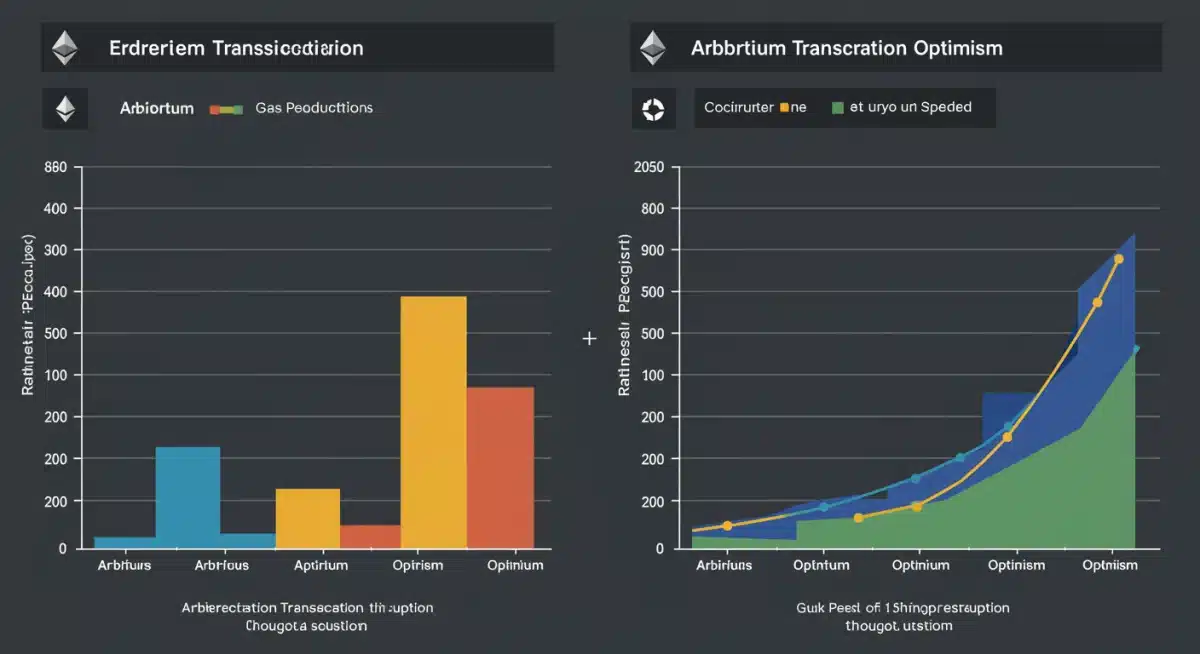
The most immediate and tangible benefit of Arbitrum and Optimism has been the dramatic reduction in Ethereum gas fees. Users can now perform transactions, swap tokens, and interact with dApps for a fraction of the cost they would incur on the mainnet. This cost efficiency democratizes access to DeFi, allowing a wider range of users to participate without being priced out by high fees. The average transaction cost on these layer-2 networks can be 10x to 100x cheaper than on Ethereum layer-1.
This affordability directly translates into increased user acquisition. By removing the financial barrier, Arbitrum and Optimism have opened the floodgates for new users, including those with smaller capital who previously found Ethereum too expensive. The projected onboarding of over 5 million new users by 2025 is a testament to the power of these scaling solutions in expanding the reach of decentralized technologies. This growth isn’t just about numbers; it’s about fostering a more inclusive and accessible digital economy.
Real-world implications of fee reduction
- Expanded DeFi Participation: More users can engage in staking, lending, and yield farming.
- Affordable NFT Transactions: Minting and trading NFTs become more accessible.
- New Use Cases: Enables micro-transactions and other applications previously unfeasible due to cost.
The impact of reduced gas fees extends beyond individual transactions. It fosters a more vibrant and dynamic ecosystem where developers can experiment with new applications and business models without worrying about prohibitive operational costs for their users. This virtuous cycle of lower fees, increased users, and greater innovation is a defining characteristic of the current layer-2 landscape.
The Future Landscape: Interoperability and Continued Growth
As Arbitrum and Optimism continue to mature, the focus is shifting towards enhanced interoperability and further technological advancements. The vision for the future involves a multi-chain ecosystem where assets and data can seamlessly flow between different layer-2 networks and the Ethereum mainnet. Projects like cross-chain bridges are crucial for achieving this seamless experience, allowing users to transfer their funds efficiently between different scaling solutions.
The competition and collaboration between various layer-2 projects are driving innovation at an unprecedented pace. While optimistic rollups currently dominate, other scaling solutions like ZK-rollups are also gaining traction, promising even greater security and efficiency in the long run. The continued development of these technologies will further solidify Ethereum’s position as the leading smart contract platform, capable of handling global-scale decentralized applications.
Challenges and opportunities ahead
- Bridge Security: Ensuring the robust security of cross-chain asset transfers.
- User Education: Guiding new users through the complexities of layer-2 ecosystems.
- Technological Convergence: Integrating different layer-2 solutions for a unified user experience.
The journey of layer-2 altcoins is far from over. As the technology evolves, we can expect even more sophisticated scaling solutions, improved user interfaces, and greater integration with traditional financial systems. The projected growth in user numbers is just the beginning of a broader trend towards a more efficient, accessible, and decentralized internet, largely powered by the innovations spearheaded by Arbitrum and Optimism.
| Key Aspect | Brief Description |
|---|---|
| Gas Fee Reduction | Arbitrum and Optimism cut Ethereum transaction costs by up to 90%, making DeFi accessible. |
| User Growth | Projected to attract over 5 million new users by 2025 due to enhanced scalability. |
| Optimistic Rollups | Technology used by both to process transactions off-chain, leveraging Ethereum’s security. |
| Ecosystem Expansion | Both platforms host diverse DeFi protocols and dApps, fostering innovation. |
Frequently asked questions about layer-2 altcoins
Layer-2 altcoins are scaling solutions built on top of the Ethereum blockchain to reduce congestion and lower transaction fees. They are crucial because they enable Ethereum to handle more transactions efficiently, making decentralized applications more accessible and affordable for a broader user base.
Arbitrum and Optimism use optimistic rollups, which bundle multiple transactions off-chain and submit a single, compressed proof to the Ethereum mainnet. This significantly reduces the amount of data processed on layer-1, leading to gas fee reductions often exceeding 90% compared to mainnet costs.
While both use optimistic rollups, Arbitrum offers a slightly more flexible execution environment and has a larger ecosystem by some metrics. Optimism prioritizes simplicity, strong alignment with Ethereum’s core development, and has a modular design with its Bedrock upgrade. Both are EVM-compatible.
Layer-2 solutions derive their security from the underlying Ethereum mainnet. Optimistic rollups rely on a ‘fraud proof’ mechanism, where anyone can challenge an invalid transaction within a dispute window. This ensures that even though transactions are processed off-chain, the integrity of the network is maintained by Ethereum’s robust security.
By significantly lowering costs and increasing transaction speeds, layer-2 altcoins are expected to drive massive DeFi adoption. Projections suggest over 5 million new users could join by 2025, enabling more diverse applications and making decentralized finance accessible to a much broader global audience, fostering innovation and inclusion.
Conclusion
The rise of layer-2 altcoins like Arbitrum and Optimism marks a critical inflection point for the Ethereum ecosystem and the broader decentralized finance landscape. By successfully tackling the long-standing challenges of high gas fees and network congestion, these innovative solutions have not only revitalized user engagement but also paved the way for unprecedented growth. Their ability to cut transaction costs by up to 90% and attract millions of new users underscores their pivotal role in shaping a more scalable, accessible, and efficient future for blockchain technology. As these platforms evolve, their continued development and increasing interoperability will undoubtedly cement Ethereum’s position as the leading smart contract platform, driving forward the vision of a truly decentralized internet.