Yield Farming Stablecoins: Top US Protocols 6%+ APY
Yield farming stablecoins allows US investors to earn passive income, typically above traditional savings rates, by providing liquidity to decentralized finance protocols, minimizing volatility risk.
In the dynamic world of decentralized finance (DeFi), earning passive income has become a significant draw. Among the myriad strategies, yield farming stablecoins stands out as a compelling option for those seeking attractive returns with reduced volatility. This article will delve into how US-accessible protocols are offering over 6% annual percentage yield (APY) this quarter, providing a strategic pathway for investors.
Understanding Yield Farming with Stablecoins
Yield farming is a DeFi strategy where participants lend or stake their cryptocurrency assets to generate high returns or rewards in the form of additional cryptocurrency. When applied to stablecoins, this strategy aims to mitigate the extreme price fluctuations often associated with other cryptocurrencies, offering a more predictable income stream. Stablecoins, pegged to traditional assets like the US dollar, provide a crucial bridge between the volatile crypto market and the stability of fiat currencies.
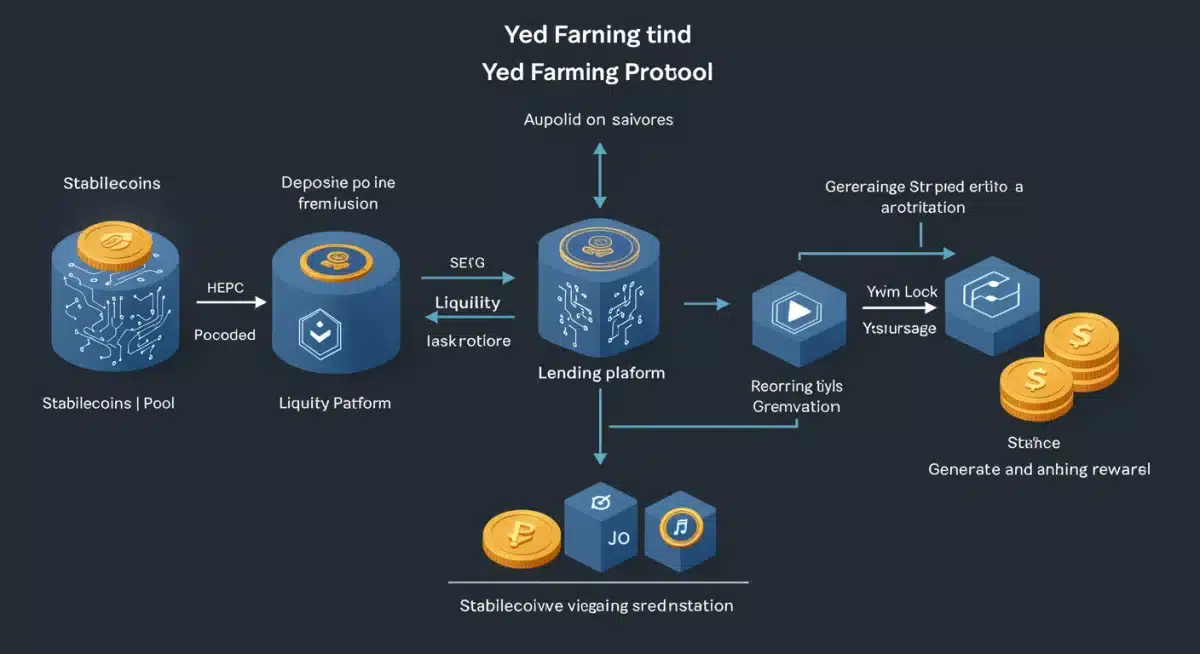
The core principle involves depositing stablecoins into liquidity pools on decentralized exchanges (DEXs) or lending platforms. These platforms then use the pooled assets to facilitate trades, loans, or other financial services, and in return, liquidity providers earn a share of the fees or newly minted tokens. The appeal for US investors lies in the potential for higher APYs compared to conventional banking products, all while maintaining exposure to an asset designed to hold its value.
How Stablecoin Yield Farming Works
Stablecoin yield farming operates on the backbone of smart contracts and decentralized protocols. Users contribute their stablecoins, such as USDC, USDT, or DAI, into specific pools. These pools are essential for the functioning of DeFi, enabling various financial activities without intermediaries. The rewards are typically distributed based on the amount of liquidity provided and the duration of the stake. Understanding the mechanics is key to safely navigating this space.
- Liquidity Provision: Depositing stablecoins into a pool to enable trading or lending.
- Earning Rewards: Receiving a share of transaction fees, interest from loans, or native protocol tokens.
- Automated Market Makers (AMMs): Protocols that use mathematical formulas to price assets in a liquidity pool.
- Risk Management: Assessing smart contract risks, impermanent loss (though less relevant for stablecoins), and platform security.
In essence, participants become integral to the DeFi ecosystem, facilitating its operations and being rewarded for their contribution. This symbiotic relationship drives the innovation and growth within decentralized finance, making yield farming a central component of its infrastructure.
Benefits and Risks for US Investors
For US investors, yield farming stablecoins presents an intriguing opportunity to diversify investment portfolios and potentially earn substantial passive income. The primary benefit is the relatively stable nature of the underlying asset. Unlike volatile cryptocurrencies, stablecoins aim to maintain a 1:1 peg with the US dollar, significantly reducing the risk of capital depreciation due to market swings. This stability makes the high APYs more attractive, as the gains are less likely to be offset by a sudden drop in the asset’s value.
Moreover, the transparency inherent in blockchain technology allows investors to audit smart contracts and observe transaction flows, fostering a degree of trust not always present in traditional financial systems. The accessibility of these protocols, often requiring only an internet connection and a crypto wallet, broadens participation beyond institutional investors.
However, yield farming is not without its risks. Smart contract vulnerabilities are a significant concern; a coding error or malicious exploit could lead to the loss of deposited funds. Regulatory uncertainty in the US also poses a challenge, with evolving guidelines potentially impacting the legality and operational frameworks of these protocols. While stablecoins are designed for stability, they are not entirely immune to de-pegging events, where their value temporarily deviates from their intended peg. Furthermore, custodial risks exist if platforms hold user funds, and the complexity of some strategies can be daunting for newcomers.
Mitigating Common Yield Farming Risks
To navigate these risks effectively, due diligence is paramount. Investors should thoroughly research protocols, examining their security audits, community reputation, and team experience. Opting for established and well-vetted platforms can significantly reduce the risk of smart contract exploits. Diversifying stablecoin holdings across multiple protocols and types of stablecoins can also help mitigate the impact of a single platform failure or de-pegging event. Staying informed about regulatory developments is also crucial for US-based participants.
- Smart Contract Audits: Verify that protocols have undergone reputable third-party security audits.
- Platform Reputation: Choose well-established protocols with a proven track record.
- Diversification: Spread investments across different stablecoins and platforms.
- Regulatory Awareness: Stay updated on US regulations concerning stablecoins and DeFi.
By understanding both the opportunities and the inherent risks, US investors can approach stablecoin yield farming with a more informed and strategic mindset, balancing potential rewards with necessary precautions.
Top 5 US-Accessible Protocols for Stablecoin Yield Farming
Identifying reliable and high-performing protocols is crucial for successful yield farming stablecoins. This quarter, several platforms stand out for their competitive APYs and accessibility to US investors. These protocols offer robust infrastructure, strong security measures, and a variety of stablecoin pools designed to generate consistent returns. Each platform has unique characteristics, catering to different risk appetites and investment preferences.
When evaluating these platforms, factors such as liquidity, transaction fees, audit history, and community support play a significant role. The protocols listed below have demonstrated a commitment to security and transparency, making them viable options for US users looking to engage in stablecoin yield farming. It is important to note that APYs can fluctuate, so continuous monitoring is advised.
Aave: A Leading Decentralized Lending Protocol
Aave is a decentralized non-custodial liquidity protocol where users can participate as depositors or borrowers. Depositors provide liquidity to earn a passive income, while borrowers are able to borrow in an overcollateralized fashion. For stablecoin yield farming, Aave often provides attractive APYs on popular stablecoins like USDC and DAI. Its strong market presence and continuous innovation make it a staple in the DeFi lending space.
- APY Range: Typically 6-10% on stablecoins, varying with market demand.
- Security: Multiple audits, bug bounty programs, and a strong community governance.
- Accessibility: Widely accessible in the US, with clear documentation.
Curve Finance: Optimized for Stablecoin Swaps
Curve Finance is an exchange liquidity pool on Ethereum designed for extremely efficient stablecoin trading. It allows users to swap stablecoins with low slippage and fees, making it ideal for liquidity providers who want to earn trading fees and CRV tokens. Curve’s unique algorithm is specifically optimized for stablecoins, leading to high capital efficiency and competitive APYs for its stablecoin pools.
- APY Range: Often 7-12% on various stablecoin pools, including rewards.
- Security: Highly audited, battle-tested protocol with significant TVL (Total Value Locked).
- Accessibility: Available to US users, though understanding its mechanics can be more complex.
Compound Finance: Pioneer in Decentralized Lending
Compound is another pioneering decentralized lending protocol that enables users to earn interest on their cryptocurrencies by supplying them to the protocol. Borrowers can take out loans by providing collateral. Compound supports a range of assets, including major stablecoins, offering competitive interest rates for liquidity providers. Its long-standing reputation and robust risk management framework make it a trusted choice.
- APY Range: Generally 6-9% on stablecoins, influenced by supply and demand.
- Security: Regular audits and a transparent governance model.
- Accessibility: Broadly available for US investors seeking a reliable lending platform.
Yearn.finance: Automated Yield Optimization
Yearn.finance is an aggregator service for DeFi investors, utilizing automation to maximize profits from yield farming. It automatically moves user funds between various protocols to find the highest yields available. For stablecoins, Yearn’s ‘Vaults’ are particularly popular, abstracting away much of the complexity of manual yield farming and optimizing returns across multiple platforms. This ‘set and forget’ approach appeals to many.
- APY Range: Can exceed 8-15% through optimized strategies across protocols.
- Security: Undergoes audits, but the complexity of aggregation introduces unique risks.
- Accessibility: Available for US users, offering a simplified approach to complex strategies.
Balancer: Flexible Liquidity Provision
Balancer is an automated portfolio manager, liquidity provider, and DEX. Unlike traditional AMMs, Balancer allows for custom liquidity pools with up to eight tokens and varying weights. This flexibility can lead to unique yield farming opportunities for stablecoins, especially in pools paired with other low-volatility assets. LPs earn trading fees and BAL tokens, providing a diversified revenue stream.
- APY Range: Varies significantly based on pool composition, often 6-10% for stablecoin pairs.
- Security: Audited protocol with a focus on smart contract safety.
- Accessibility: Open to US investors, offering advanced liquidity provision options.
These protocols represent some of the most promising avenues for US investors to engage in yield farming stablecoins. Each offers a unique blend of features, risks, and reward structures, making it essential to conduct thorough research before committing capital.
Strategies for Maximizing Stablecoin Yields
To truly excel in yield farming stablecoins, a strategic approach is essential. Simply depositing funds might yield some returns, but optimized strategies can significantly enhance profitability while managing risks. This involves understanding various techniques, from selecting the right stablecoin pairs to actively managing positions and leveraging advanced tools. The goal is to maximize the APY without exposing capital to undue risk.
One fundamental strategy is to diversify across multiple protocols and stablecoins. Relying on a single platform or a single stablecoin can concentrate risk. By spreading investments, one can mitigate the impact of a single protocol exploit or a de-pegging event. Furthermore, regularly monitoring APY rates across different platforms is crucial, as these can fluctuate based on market demand, liquidity, and governance decisions. Flexibility to move funds to higher-yielding opportunities is a key advantage.
Leveraging Automated Yield Optimizers
Platforms like Yearn.finance, as mentioned earlier, exemplify automated yield optimization. These platforms automatically rebalance portfolios and move funds between various protocols to capture the highest available yields. For investors who lack the time or expertise for constant manual management, these optimizers can be invaluable. However, it’s important to understand the fees associated with these services and the smart contract risks inherent in their complex strategies.
- Automated Rebalancing: Algorithms shift funds to maximize APY.
- Reduced Management: Less manual effort required from the investor.
- Increased Complexity: Potential for higher smart contract risk due to interconnected protocols.
Understanding Impermanent Loss and Its Mitigation
While less prevalent with stablecoin pairs, understanding impermanent loss is still important. Impermanent loss occurs when the price of your deposited assets changes compared to when you deposited them. In stablecoin-to-stablecoin pools, this risk is significantly minimized due to their pegged nature. However, if a stablecoin de-pegs, even temporarily, impermanent loss can occur. Choosing highly liquid and reputable stablecoins reduces this risk.
Another strategy involves participating in governance. Many DeFi protocols reward active participants with additional tokens, which can further boost overall yields. Engaging in community discussions and voting on proposals not only contributes to the protocol’s health but also provides an additional revenue stream. Ultimately, a blend of informed decision-making, continuous monitoring, and strategic diversification forms the bedrock of successful stablecoin yield farming.
Navigating Regulatory Landscapes in the US
The regulatory environment for cryptocurrency and DeFi in the United States is complex and continuously evolving, posing unique challenges for US investors participating in yield farming stablecoins. Unlike traditional financial products, stablecoins and their associated yield farming activities do not yet fit neatly into existing regulatory frameworks. This ambiguity can lead to uncertainty regarding taxation, compliance, and the long-term viability of certain protocols within US borders.
Currently, various governmental bodies, including the SEC, CFTC, and Treasury Department, are exploring how to classify and regulate digital assets. Stablecoins, in particular, have drawn significant attention due to their potential to disrupt traditional banking and payment systems. Proposed legislations and ongoing discussions suggest a future where stablecoins might be subject to stricter oversight, potentially impacting their issuance, circulation, and the platforms that utilize them for yield generation.
Tax Implications of Yield Farming
For US investors, understanding the tax implications of yield farming is paramount. The IRS generally views cryptocurrencies as property, meaning that any gains derived from yield farming—whether through earned interest, liquidity provider rewards, or governance tokens—are typically considered taxable income. This income can be taxed as ordinary income at the time it’s received, and subsequent sales of these earned tokens could be subject to capital gains tax.
- Income Tax: Rewards from yield farming are usually taxed as ordinary income.
- Capital Gains Tax: Selling or exchanging earned tokens can trigger capital gains or losses.
- Record Keeping: Meticulous records of all transactions are essential for accurate tax reporting.
Future Regulatory Outlook
The future regulatory landscape for stablecoins and yield farming in the US is likely to become clearer, albeit potentially more restrictive. Lawmakers are grappling with how to balance innovation with consumer protection and financial stability. This could involve licensing requirements for stablecoin issuers, increased reporting obligations for DeFi protocols, and clearer guidance on what constitutes a security in the crypto space. Investors should remain vigilant and proactively adapt their strategies to comply with new regulations as they emerge.
Staying informed through reputable news sources, legal experts, and community discussions can help US investors navigate this intricate environment. While the potential for high returns in stablecoin yield farming is attractive, understanding and adhering to the regulatory framework is crucial for long-term success and avoiding potential legal or financial penalties.
The Future of Stablecoin Yield Farming
The landscape of yield farming stablecoins is constantly evolving, driven by technological advancements, regulatory shifts, and market dynamics. Looking ahead, several key trends are likely to shape the future of this investment strategy, particularly for US-based participants. Continued innovation in protocol design, enhanced security features, and a clearer regulatory framework are all expected to play significant roles.
One major trend is the increasing institutional interest in DeFi. As more traditional financial institutions explore the crypto space, their participation could bring greater liquidity, stability, and legitimacy to stablecoin yield farming. This influx of institutional capital might also lead to the development of more sophisticated and compliant products tailored for larger investors, potentially increasing overall market efficiency and reducing some existing risks.
Technological Advancements and Cross-Chain Solutions
Technological advancements will continue to enhance the efficiency and accessibility of yield farming. Layer 2 scaling solutions, for example, are reducing transaction costs and increasing speeds on networks like Ethereum, making yield farming more economical for a wider range of investors. Cross-chain interoperability is another area of rapid development, allowing stablecoins and other assets to move seamlessly between different blockchains, unlocking new yield opportunities across diverse ecosystems.
- Layer 2 Scaling: Reduces gas fees and speeds up transactions, making farming more cost-effective.
- Cross-Chain Bridges: Enables asset movement across blockchains, expanding yield opportunities.
- Enhanced Security: Continuous improvements in smart contract auditing and protocol resilience.
Evolving Regulatory Clarity and Investor Protection
While regulatory uncertainty remains a challenge, there is a growing consensus among policymakers about the need for clearer guidelines. This could lead to a more defined legal status for stablecoins and yield farming activities, which, while potentially imposing stricter controls, could also foster greater investor confidence and protection. A well-regulated environment might attract even more participants, both retail and institutional, by reducing perceived risks.
The future of stablecoin yield farming is likely to be characterized by greater maturity and integration into the broader financial system. As protocols become more robust and user-friendly, and as regulatory clarity improves, the strategy could become an even more accessible and attractive option for US investors seeking stable, high-yield passive income streams in the digital economy. Continuous adaptation and informed decision-making will be key to thriving in this evolving landscape.
Choosing the Right Protocol for You
Selecting the optimal protocol for yield farming stablecoins is a highly personal decision, influenced by individual risk tolerance, investment goals, and understanding of the DeFi ecosystem. With the variety of US-accessible platforms offering competitive APYs, a thoughtful evaluation process is essential to align your capital with the most suitable opportunities. It’s not just about chasing the highest APY; it’s about finding a balance between potential returns and acceptable risk levels.
Begin by assessing your personal risk appetite. Are you comfortable with experimental protocols that might offer higher, but less stable, APYs? Or do you prefer established platforms with a proven track record, even if their yields are slightly lower? Protocols like Aave and Compound, with their long operational histories and extensive audits, might appeal to more conservative investors. In contrast, platforms leveraging complex aggregation strategies, such as Yearn.finance, might be better suited for those willing to embrace a higher degree of smart contract risk for potentially optimized returns.
Key Factors for Protocol Selection
Beyond risk tolerance, several technical and operational factors should guide your choice. The type of stablecoins supported by a protocol is important; ensure it aligns with the assets you hold or intend to acquire. Consider the network fees associated with using the protocol. High gas fees on congested networks can significantly eat into profits, especially for smaller investments. Look for protocols on efficient blockchains or those utilizing Layer 2 solutions.
- APY vs. Risk: Balance high returns with inherent protocol risks.
- Supported Stablecoins: Ensure compatibility with your preferred assets.
- Network Fees: Evaluate transaction costs and their impact on profitability.
- Audit History: Prioritize protocols with thorough and frequent security audits.
- Community and Governance: Active communities often indicate a healthy and responsive protocol.
Long-Term vs. Short-Term Strategies
Your investment horizon also plays a role. If you are looking for long-term, relatively hands-off yield generation, automated optimizers or well-established lending platforms might be ideal. For those willing to actively manage their positions and chase fleeting opportunities, protocols with dynamic APYs and more complex strategies could be more rewarding. Always remember that past performance is not indicative of future results, and market conditions can change rapidly.
Ultimately, the best protocol is one that you understand thoroughly, whose risks you can articulate, and whose security measures you trust. Continuous learning, staying updated with DeFi news, and engaging with the community will empower you to make informed decisions and adapt your stablecoin yield farming strategy as the ecosystem evolves. This proactive approach ensures you remain positioned to capture attractive APYs while safeguarding your capital.
| Key Aspect | Brief Description |
|---|---|
| Stablecoin Yield Farming | Earning passive income by lending or staking stablecoins on DeFi protocols with reduced volatility. |
| Key Protocols (US-Accessible) | Aave, Curve, Compound, Yearn.finance, Balancer offer competitive APYs this quarter. |
| Benefits & Risks | High APYs and stability vs. smart contract risks, de-pegging, and regulatory uncertainty. |
| Regulatory Landscape | Evolving US regulations and tax implications require careful consideration and compliance. |
Frequently Asked Questions About Stablecoin Yield Farming
Yield farming with stablecoins involves depositing stablecoins into decentralized finance (DeFi) protocols to earn passive income. This income can come from lending interest, trading fees, or newly minted governance tokens, all while minimizing the price volatility associated with other cryptocurrencies.
While generally considered safer than farming with volatile assets, stablecoin yield farming still carries risks like smart contract vulnerabilities, potential de-pegging events, and evolving regulatory uncertainty. US investors should conduct thorough research and understand the risks before participating.
APIs for stablecoin yield farming can vary significantly, typically ranging from 6% to over 15% this quarter on top US-accessible protocols. These rates are influenced by market demand, protocol liquidity, and the specific farming strategy employed. Rates are dynamic and subject to change.
US regulations are still developing, creating uncertainty for stablecoin yield farming. The IRS generally taxes yield farming rewards as income, and future regulatory clarity might introduce licensing requirements or stricter oversight for protocols. Staying informed is crucial for compliance.
The most commonly used stablecoins for yield farming include Tether (USDT), USD Coin (USDC), and Dai (DAI). These stablecoins are widely supported across major DeFi protocols and generally maintain a strong peg to the US dollar, making them ideal for yield generation strategies.
Conclusion
Yield farming stablecoins offers a compelling avenue for US investors to generate passive income within the decentralized finance ecosystem, combining attractive APYs with reduced volatility compared to other crypto assets. By carefully selecting reputable protocols like Aave, Curve, Compound, Yearn.finance, and Balancer, and understanding the inherent risks, investors can strategically position themselves for growth. Navigating the evolving regulatory landscape and diligently managing tax implications are crucial for long-term success. As the DeFi space matures, continuous education and adaptive strategies will remain key to maximizing returns and safeguarding investments in this innovative financial frontier.