Navigating Altcoin Volatility in 2026: Essential Strategies for US Traders
The cryptocurrency market, particularly the altcoin segment, has always been a hotbed of innovation and, concurrently, significant price fluctuations. As we approach 2026, US traders are keenly aware that this inherent altcoin volatility is not just a characteristic but a defining feature that demands sophisticated strategies. While the promise of exponential gains attracts many, the reality of 10% or even larger price swings within short periods can be daunting. This comprehensive guide is designed to equip US traders with the knowledge and tools necessary to not only survive but thrive amidst the unpredictable currents of the altcoin market in 2026.
Understanding altcoin volatility is the first step towards mastering it. Unlike the more established Bitcoin and Ethereum, many altcoins have smaller market capitalizations, lower liquidity, and are often more susceptible to news, speculation, and broader market sentiment. This makes them prone to dramatic shifts, offering both immense opportunities for profit and considerable risks of loss. For US traders, navigating this landscape also involves an intricate understanding of evolving regulatory frameworks, tax implications, and the technological advancements driving the next wave of crypto innovation.
In this article, we will delve into the core reasons behind altcoin price swings, explore various strategic approaches to mitigate risk, and provide actionable insights for building a resilient portfolio. From advanced trading techniques to robust risk management protocols and the importance of fundamental analysis, our goal is to empower you to make informed decisions and transform potential pitfalls into profitable ventures in the dynamic world of altcoins.
The Nature of Altcoin Volatility: Why 10% Swings Are Common
To effectively manage altcoin volatility, one must first comprehend its root causes. Several factors contribute to the dramatic price movements observed in the altcoin market. Understanding these elements is crucial for any US trader looking to build a robust strategy for 2026.
Market Capitalization and Liquidity
One of the primary drivers of significant price swings in altcoins is their relatively small market capitalization compared to Bitcoin or traditional assets. A smaller market cap means that even moderate buy or sell orders can have a disproportionately large impact on the price. Coupled with lower liquidity, where there are fewer buyers and sellers to absorb large orders, altcoins can experience rapid price changes. A single whale (a large holder) making a substantial move can easily trigger a 10% shift, causing a ripple effect across the market.
Speculation and Hype Cycles
The altcoin market is heavily influenced by speculation and hype. New projects often gain traction through aggressive marketing, influencer endorsements, and the promise of groundbreaking technology. While some projects deliver on their promises, many are driven by speculative fervor, leading to pump-and-dump schemes or unsustainable growth. When the hype fades, or a project fails to meet expectations, prices can plummet just as quickly as they rose. US traders must be cautious of these cycles and conduct thorough due diligence.
Technological Developments and Project Milestones
Altcoins are often tied to specific blockchain projects, each aiming to solve a particular problem or introduce a novel application. News regarding technological breakthroughs, mainnet launches, strategic partnerships, or even delays in development can significantly impact an altcoin’s price. Positive news can send prices soaring, while negative news or missed deadlines can trigger sharp corrections. Staying informed about a project’s development roadmap and milestones is vital for anticipating potential altcoin volatility.
Regulatory Landscape and Geopolitical Events
For US traders, the evolving regulatory landscape is a constant source of uncertainty and, consequently, volatility. Announcements from the SEC, CFTC, or other government bodies regarding cryptocurrency classification, taxation, or trading restrictions can send shockwaves through the market. Additionally, broader geopolitical events, macroeconomic trends, and even changes in interest rates can influence investor sentiment and capital flows into the crypto space, affecting altcoin prices.
Interconnectedness with Bitcoin and Ethereum
While altcoins aim to differentiate themselves, their prices are often highly correlated with Bitcoin and Ethereum. A significant move in either of these dominant cryptocurrencies can cascade down to the altcoin market. When Bitcoin experiences a major correction, altcoins often follow, sometimes with even greater percentage losses due to their higher beta. Understanding this interconnectedness is key to predicting broader market movements and managing altcoin volatility.
Pillar 1: Robust Risk Management for 10% Swings
Effective risk management is the cornerstone of successful altcoin trading, especially when dealing with frequent 10% price swings. Without a solid risk management strategy, even the most promising trades can lead to substantial losses. US traders must prioritize capital preservation.
Position Sizing: Don’t Bet the Farm
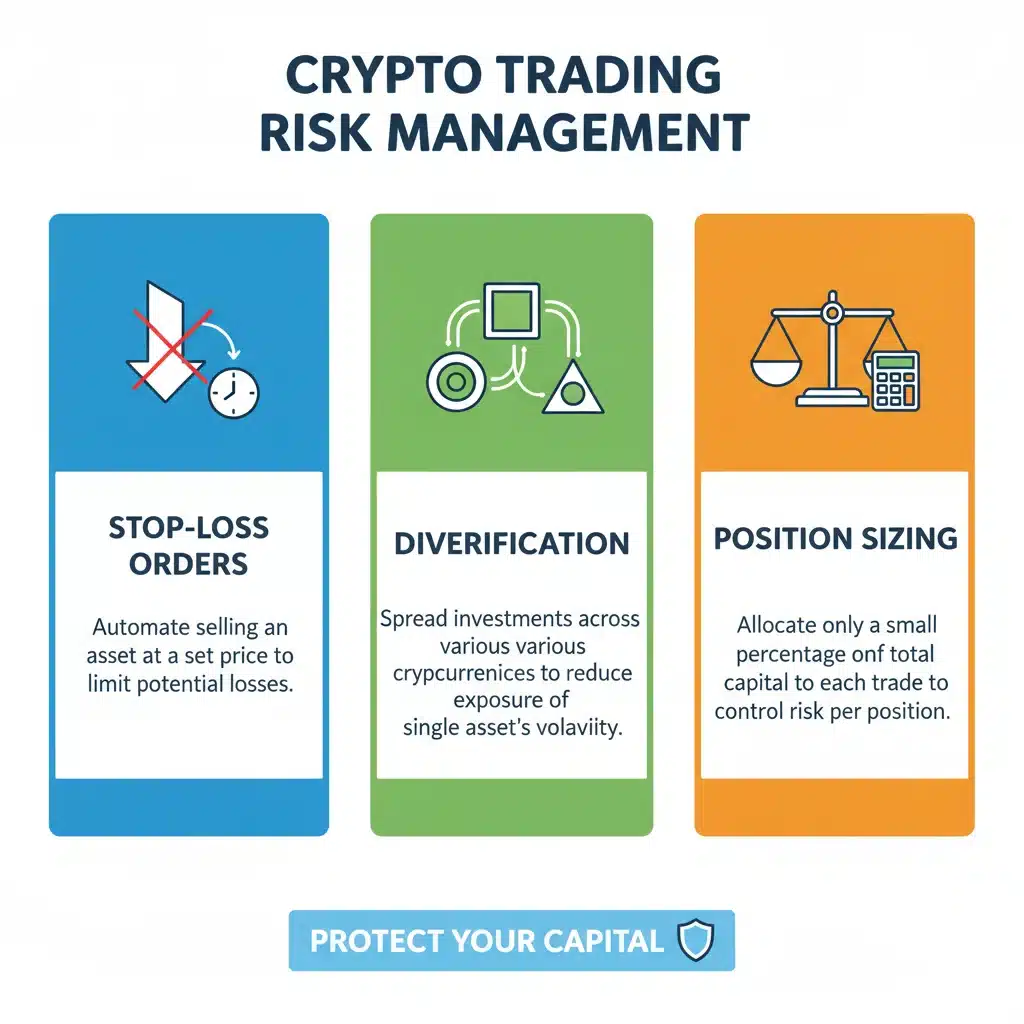
One of the most critical aspects of risk management is appropriate position sizing. Never allocate an outsized portion of your portfolio to a single altcoin, especially if it’s highly volatile or speculative. A common rule of thumb is to risk no more than 1-2% of your total trading capital on any single trade. This means if you have $10,000, your maximum loss on one trade should be $100-$200. This approach ensures that even if several trades go south, your overall capital remains largely intact, allowing you to stay in the game and recover.
Stop-Loss Orders: Your Safety Net
Implementing stop-loss orders is non-negotiable when trading volatile altcoins. A stop-loss order automatically sells your asset if its price drops to a predetermined level, limiting your potential losses. For altcoins prone to 10% swings, setting tight but reasonable stop-loss levels is crucial. For example, if you enter a trade, you might set your stop-loss at 5% below your entry price, ensuring that a sudden downturn doesn’t wipe out a significant portion of your capital. However, be mindful of ‘stop hunts’ where market makers might temporarily drive prices down to trigger stop losses before a rebound. Using mental stops or trailing stops can also be beneficial in certain scenarios.
Diversification: Spreading Your Bets
While diversification is a fundamental principle in traditional finance, it’s equally, if not more, important in the altcoin market. Instead of putting all your capital into one or two altcoins, spread your investments across a variety of projects with different use cases, technologies, and market caps. This strategy helps mitigate the impact of a single project’s failure or underperformance. However, avoid over-diversification, which can dilute your potential gains and make portfolio management unwieldy. A balanced approach might involve a mix of established large-cap altcoins, promising mid-cap projects, and a small allocation to higher-risk, higher-reward small-cap tokens.
Profit-Taking Strategies: Don’t Get Greedy
Many traders fall victim to greed, holding onto winners for too long in hopes of even greater gains, only to see profits evaporate during a market correction. Establishing clear profit-taking targets is essential. This could involve selling a portion of your holdings once an altcoin reaches a certain percentage gain (e.g., selling 25% at 20% profit, another 25% at 40% profit) or using trailing stop-losses to lock in gains as the price rises. Having a defined exit strategy, both for losses and gains, is a hallmark of disciplined trading.
Pillar 2: Technical Analysis and Charting for Altcoin Volatility
Technical analysis (TA) provides a framework for understanding price movements and predicting future trends by studying historical market data, primarily price and volume. For US traders navigating altcoin volatility, TA is an indispensable tool.
Identifying Support and Resistance Levels
Support and resistance levels are fundamental concepts in TA. Support is a price level where a downtrend is expected to pause due to a concentration of demand. Resistance is a price level where an uptrend is expected to pause due to a concentration of supply. Identifying these levels can help traders determine optimal entry and exit points. For example, buying near a strong support level and selling near a strong resistance level can help mitigate risk and maximize profit during altcoin price swings.
Using Candlestick Patterns and Chart Formations
Candlestick patterns (e.g., doji, hammer, engulfing patterns) and chart formations (e.g., head and shoulders, triangles, flags) provide visual cues about market sentiment and potential price reversals or continuations. Learning to recognize these patterns can give US traders an edge in anticipating significant moves. For instance, a bullish engulfing pattern after a downtrend might signal a potential reversal, offering a low-risk entry point.
Leveraging Technical Indicators
Numerous technical indicators can assist in analyzing altcoin volatility. Some of the most popular and effective include:
- Relative Strength Index (RSI): Measures the speed and change of price movements. It oscillates between 0 and 100, with readings above 70 indicating overbought conditions and below 30 indicating oversold conditions. This can signal potential reversals.
- Moving Averages (MAs): Smooth out price data to identify trend direction. Crossovers of short-term and long-term moving averages (e.g., 50-day and 200-day MA) are often used as buy or sell signals.
- Bollinger Bands: Consist of a middle band (simple moving average) and two outer bands (standard deviations from the middle band). They help measure volatility and identify overbought/oversold conditions relative to the average. Price touching the upper band might indicate an overbought condition, while touching the lower band might suggest an oversold condition.
- Volume: Often overlooked, volume provides crucial context to price movements. High volume accompanying a price breakout or breakdown adds conviction to the move, while low volume suggests a weaker trend.
Timeframe Analysis
It’s crucial to analyze altcoins across multiple timeframes (e.g., 1-hour, 4-hour, daily, weekly charts). What appears as a strong uptrend on a 1-hour chart might be just a minor bounce within a larger downtrend on a daily chart. This multi-timeframe analysis helps confirm trends and avoid false signals, providing a more holistic view of altcoin volatility.
Pillar 3: Fundamental Analysis in a Volatile Market
While technical analysis helps you understand when to trade, fundamental analysis (FA) helps you understand what to trade. In the altcoin space, FA focuses on the underlying value, technology, team, and potential of a project. This is especially vital for long-term holders and for filtering out speculative noise from genuinely promising ventures amidst altcoin volatility.
Project Utility and Use Case
Does the altcoin project solve a real-world problem? What is its unique value proposition? Projects with clear utility, a strong use case, and a demonstrable market need are more likely to sustain value over time. Examples include decentralized finance (DeFi) protocols offering lending/borrowing, layer-1 blockchains providing scalable infrastructure, or NFTs with tangible applications beyond art. Understanding the project’s utility helps gauge its long-term potential beyond short-term price fluctuations.
Team and Developers
The strength and experience of the development team are paramount. Research their backgrounds, previous successes, and commitment to the project. A transparent and active development team, frequently communicating updates and progress, instills confidence. Conversely, anonymous teams or those with a history of failed projects should raise red flags.
Tokenomics and Supply Distribution
Tokenomics refers to the economic model of a cryptocurrency. This includes the total supply, circulating supply, distribution schedule, vesting periods for founders and investors, and how the token is used within its ecosystem (e.g., for governance, staking, or gas fees). Projects with excessively large supplies, inflationary models without strong utility, or highly concentrated ownership can be more susceptible to significant price dumps. Understanding tokenomics helps US traders assess the long-term supply-demand dynamics and potential for sustained growth, mitigating impact from altcoin volatility caused by large token unlocks.
Community and Ecosystem Growth
A vibrant and engaged community is a strong indicator of a project’s health and potential. Look at the size and activity of their social media channels, developer forums, and online discussions. A growing ecosystem, with increasing partnerships, dApp deployments, and user adoption, suggests a project is gaining traction and building a sustainable future. A strong community can also provide a support base during periods of high altcoin volatility.
Competitive Landscape
How does the altcoin compare to its competitors? What are its advantages and disadvantages? Is it a first-mover, or does it offer a superior solution? Analyzing the competitive landscape helps determine if the project has a sustainable edge and can capture a significant market share. This includes evaluating the technology, adoption rates, and network effects of similar projects.
Pillar 4: Advanced Trading Techniques for Altcoin Volatility
Beyond basic strategies, several advanced techniques can help US traders capitalize on or protect against significant altcoin volatility in 2026.
Dollar-Cost Averaging (DCA)
DCA involves investing a fixed amount of money into an altcoin at regular intervals, regardless of its price. This strategy helps reduce the impact of volatility by averaging out your purchase price over time. When prices are high, your fixed investment buys fewer units, and when prices are low, it buys more. DCA is particularly effective for long-term investors who believe in a project’s fundamental value but want to smooth out their entry during periods of high altcoin volatility.
Grid Trading
Grid trading is an automated strategy that places a series of buy and sell orders at predetermined price intervals above and below a set price. The idea is to profit from small price fluctuations within a defined range. When the price drops to a buy order, it’s filled, and a corresponding sell order is placed at a higher grid level. When the price rises to a sell order, it’s filled, and a new buy order is placed at a lower grid level. This can be highly effective in choppy, range-bound markets characterized by altcoin volatility, allowing traders to accumulate profits on small movements.
Arbitrage Opportunities
Due to market inefficiencies and varying liquidity across exchanges, altcoins can sometimes trade at different prices on different platforms. Arbitrage involves simultaneously buying an altcoin on one exchange where it’s cheaper and selling it on another where it’s more expensive, pocketing the difference. While these opportunities can be fleeting and require fast execution, they can be a profitable strategy for experienced traders, especially during periods of high altcoin volatility where price discrepancies might occur more frequently.
Hedging with Derivatives
For sophisticated US traders, using derivatives like futures and options can be a way to hedge against altcoin volatility. For example, if you hold a significant amount of an altcoin and anticipate a short-term downturn, you could short a corresponding futures contract to offset potential losses in your spot holdings. Options can also be used to limit downside risk or speculate on price movements with defined risk. However, derivatives are complex instruments and carry significant risks, requiring a deep understanding of their mechanics.
Pillar 5: Psychological Resilience and Continuous Learning
Beyond strategies and technical tools, the mental aspect of trading altcoin volatility cannot be overstated. The emotional rollercoaster of crypto markets can lead to irrational decisions, making psychological resilience and continuous learning vital for long-term success for US traders.
Emotional Discipline: Avoiding FOMO and FUD
Fear Of Missing Out (FOMO) often leads traders to chase pumps, buying at the peak just before a correction. Fear, Uncertainty, and Doubt (FUD) can cause panic selling at the bottom. Both are detrimental. Developing emotional discipline means sticking to your trading plan, not letting emotions dictate your decisions, and understanding that not every opportunity needs to be seized. Patience is a virtue in volatile markets.
Continuous Learning and Adaptation
The crypto space evolves at a breakneck pace. New technologies, regulatory shifts, and market dynamics emerge constantly. Successful US traders must commit to continuous learning, staying updated on project developments, macro trends, and new trading strategies. What worked in 2023 might not be effective in 2026. Adaptability is key to navigating the ever-changing landscape of altcoin volatility.
Journaling Your Trades
Keeping a detailed trading journal is an invaluable practice. Document your entry and exit points, the reasons for your trades, your emotional state, and the outcomes. This allows you to identify patterns in your decision-making, learn from mistakes, and refine your strategies. A trade journal provides objective feedback that can significantly improve your performance amidst altcoin volatility.
Setting Realistic Expectations
While altcoins offer immense potential, it’s crucial to set realistic expectations. Not every trade will be a winner, and not every project will go to the moon. Understand that losses are a part of trading, and focus on consistent, sustainable growth rather than chasing overnight riches. A realistic mindset helps manage stress and prevents burnout in the face of significant price swings.
Regulatory Considerations for US Traders in 2026
For US traders, navigating altcoin volatility in 2026 also means staying abreast of the complex and evolving regulatory environment. Compliance is not just a legal necessity but can also impact market dynamics.
SEC and CFTC Oversight
The Securities and Exchange Commission (SEC) and the Commodity Futures Trading Commission (CFTC) are the primary regulators in the US crypto space. The classification of an altcoin as a security or a commodity has significant implications for how it can be traded, listed, and offered. US traders must be aware of projects facing regulatory scrutiny, as such events can trigger substantial altcoin volatility.
Tax Implications
The IRS treats cryptocurrencies as property for tax purposes, meaning every trade, sale, or use of crypto can be a taxable event. Understanding capital gains and losses, wash sale rules (if applicable to crypto in the future), and accurate record-keeping are crucial. Non-compliance can lead to severe penalties. Consulting with a tax professional specializing in crypto is highly recommended for US traders.
KYC/AML Regulations
Know Your Customer (KYC) and Anti-Money Laundering (AML) regulations are standard on most legitimate US-based crypto exchanges. While these measures aim to prevent illicit activities, they also mean that traders’ identities and transactions are tracked. US traders should always use regulated and compliant platforms to avoid legal issues and ensure the security of their assets.
State-Specific Regulations
Beyond federal regulations, some US states have their own specific rules regarding cryptocurrency. For instance, New York’s BitLicense imposes strict requirements on crypto businesses. Traders should be aware of any state-specific regulations that might affect their ability to trade certain altcoins or use particular platforms.
Conclusion: Thriving Amidst Altcoin Volatility in 2026
The altcoin market in 2026 will undoubtedly continue its trajectory of innovation and, inevitably, significant altcoin volatility. For US traders, this presents both unique challenges and unparalleled opportunities. By integrating a multi-faceted approach that combines robust risk management, insightful technical analysis, diligent fundamental research, advanced trading techniques, and unwavering psychological resilience, you can position yourself for success.
Remember, the goal is not to eliminate volatility – an impossible task – but to understand it, anticipate it, and devise strategies to profit from it while protecting your capital. Stay informed about regulatory changes, continuously adapt your strategies, and never stop learning. The crypto landscape is a marathon, not a sprint, and those who approach it with discipline, knowledge, and a long-term perspective will be the ones to truly thrive amidst the 10% price swings and beyond. Embrace the volatility, for within it lies the potential for extraordinary growth for the prepared US trader.