Chainlink Oracle Networks: Powering DeFi & Enterprise Growth
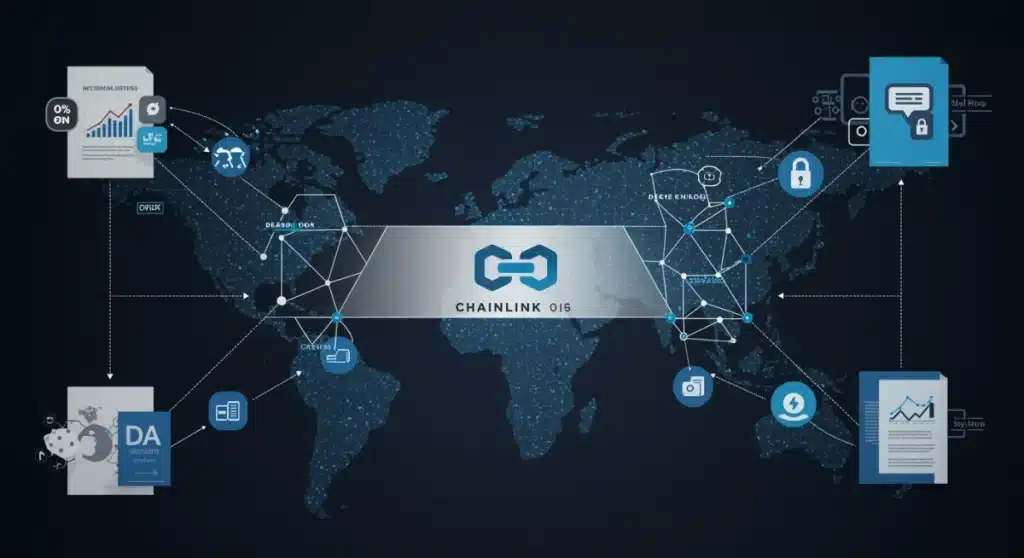
Chainlink’s oracle networks are the backbone of decentralized finance, delivering tamper-proof real-world data crucial for over 70% of DeFi protocols, with enterprise adoption projected to grow by 15% by 2025.
Deciphering Chainlink’s Oracle Networks: A Deep Dive into How Its Data Feeds Are Powering 70% of DeFi Protocols and Its Projected 15% Growth in Enterprise Adoption by 2025 is more than just a technical exploration; it’s an examination of the foundational technology enabling the next generation of financial innovation. Have you ever wondered how decentralized applications access real-world information securely? This article delves into the intricate mechanisms that make Chainlink indispensable, from its pivotal role in DeFi to its expanding footprint in traditional enterprise sectors.
The Fundamental Challenge of Blockchain Oracles
Blockchains, by design, are isolated systems. While this isolation is crucial for their security and immutability, it also creates a significant challenge: how do smart contracts access external data? Without reliable, tamper-proof information from the outside world, the utility of smart contracts is severely limited. This fundamental problem, often referred to as the ‘oracle problem,’ is precisely what Chainlink was built to solve.
The inherent determinism of blockchains means that any data input must be verified by all participating nodes, which is impractical for real-world information that changes constantly. Centralized oracles, while a potential solution, introduce a single point of failure and undermine the very decentralization ethos of blockchain. This leaves a critical gap in the ecosystem, one that Chainlink has effectively filled.
The ‘Oracle Problem’ Defined
- Data Isolation: Blockchains cannot natively connect to external data sources like stock prices, weather data, or real-world events.
- Trust Assumption: Relying on a single, centralized entity to provide data introduces a trust vulnerability and potential for manipulation.
- Security Concerns: If an oracle is compromised, the smart contracts relying on its data can be exploited, leading to significant financial losses.
The challenge extends beyond mere data retrieval; it encompasses ensuring the integrity, accuracy, and timeliness of that data. Any solution must be robust enough to withstand malicious attacks and provide a high degree of assurance to decentralized applications. Chainlink’s approach addresses these concerns head-on, creating a secure bridge between the on-chain and off-chain worlds.
In essence, the oracle problem highlights the need for a decentralized, secure, and reliable mechanism to feed external data into smart contracts. Without such a mechanism, the transformative potential of blockchain technology, particularly in areas like DeFi, would remain largely untapped. Chainlink’s architecture provides this essential link, enabling a vast array of use cases.
Chainlink’s Decentralized Oracle Network Architecture
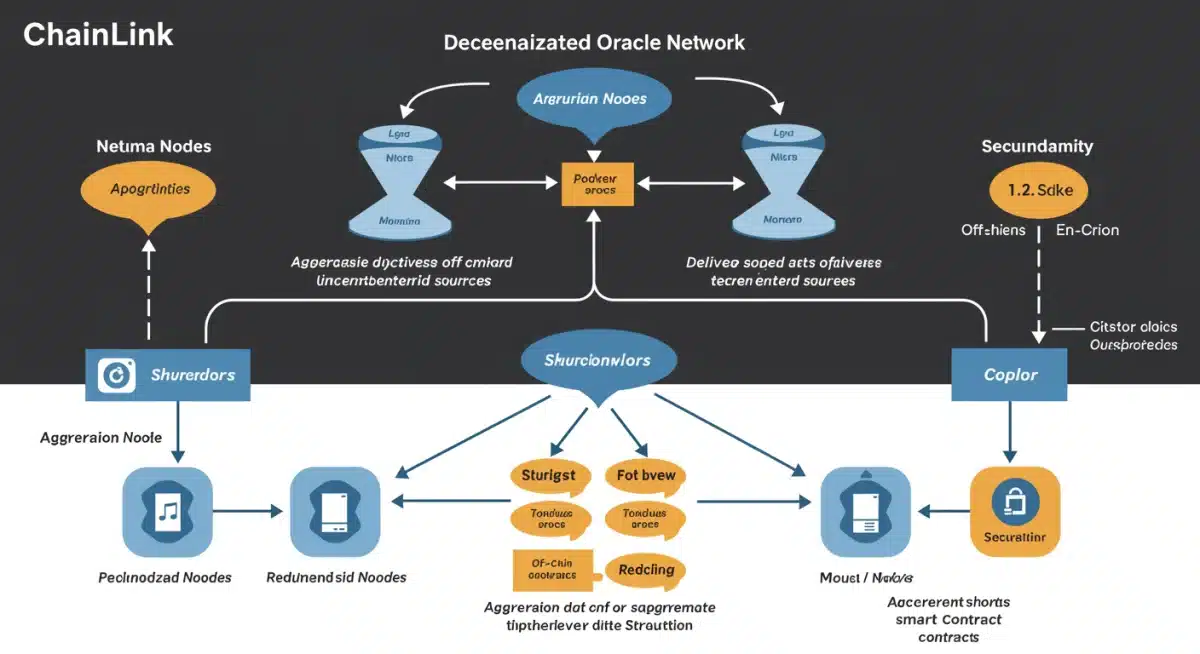
Chainlink doesn’t rely on a single data provider; instead, it utilizes a decentralized network of independent oracle nodes. These nodes collectively fetch, validate, and deliver data to smart contracts, significantly mitigating the risks associated with centralized data sources. This decentralized approach is fundamental to Chainlink’s security and reliability, ensuring data integrity even if individual nodes or data sources fail.
The architecture is designed to be highly resilient and tamper-proof. Each data request triggers a process involving multiple nodes, aggregation, and cryptographic proofs, guaranteeing that the data reaching a smart contract is accurate and consistent. This multi-layered security model is a cornerstone of Chainlink’s success and its widespread adoption across the DeFi landscape.
Key Components of the Network
- Oracle Nodes: Independent operators that run Chainlink software, connecting smart contracts to external data.
- Data Providers: Sources of real-world information, ranging from financial market data to weather APIs.
- Aggregating Contracts: On-chain contracts that collect data from multiple oracle nodes and compute a median or average value, filtering out outliers.
- LINK Token: The native cryptocurrency used to pay Chainlink node operators for their services, providing economic incentives for reliable data delivery.
This multi-faceted design ensures that data is not only delivered but also thoroughly vetted before being consumed by smart contracts. The use of multiple nodes and data sources prevents a single point of failure, while the aggregation process provides a robust defense against inaccurate or manipulated data. This robust architecture is a primary reason why Chainlink has become the industry standard for decentralized oracles.
The distributed nature of Chainlink’s oracle network ensures that no single entity controls the data flow, aligning perfectly with the decentralized principles of blockchain. This architectural strength underpins the security and trustworthiness of the data feeds that power a significant portion of the DeFi ecosystem.
How Chainlink Powers Over 70% of DeFi Protocols
The sheer number of decentralized finance (DeFi) protocols relying on Chainlink Oracle Networks is a testament to its critical role. From lending platforms to decentralized exchanges and prediction markets, secure and accurate real-world data is paramount. Chainlink provides the essential data feeds, such as crypto asset prices, that enable these protocols to function correctly and securely, preventing market manipulation and ensuring fair execution.
Without Chainlink, many DeFi applications would be unable to operate effectively, or would be exposed to significant risks. Imagine a lending protocol that cannot accurately determine the value of collateral, or a derivatives platform that relies on a single, easily manipulated price feed. Chainlink’s decentralized price feeds offer the reliability and security necessary for these complex financial instruments to thrive in a decentralized environment.
Impact on Key DeFi Sectors
- Lending & Borrowing: Provides accurate asset prices for collateral valuation and liquidation thresholds, crucial for platforms like Aave and Compound.
- Decentralized Exchanges (DEXs): Supplies reliable price data for stablecoin pegs and asset swaps, ensuring fair trading.
- Derivatives & Synthetics: Enables the creation and settlement of complex financial products by providing external market data.
- Prediction Markets: Delivers verifiable real-world outcomes to settle bets and predictions on platforms like Augur.
The integration of Chainlink’s data feeds has allowed DeFi to grow exponentially, providing developers with the tools to build sophisticated and robust applications. Its reliability has built trust among users and developers alike, solidifying its position as an indispensable piece of the DeFi infrastructure. The ability to access external data securely is not just a feature; it’s a fundamental requirement for the maturation and scaling of the decentralized financial system.
Chainlink’s widespread adoption in DeFi underscores its effectiveness in solving the oracle problem at scale. Its consistent performance and commitment to decentralization have made it the go-to solution for protocols seeking secure and reliable external data, thereby fostering innovation and stability in the rapidly evolving DeFi space.
Projected 15% Growth in Enterprise Adoption by 2025
Beyond the vibrant world of DeFi, Chainlink is making significant inroads into traditional enterprise sectors. The projection of a 15% growth in enterprise adoption by 2025 highlights a growing recognition among large corporations of the value Chainlink brings. Enterprises are increasingly exploring blockchain technology for various applications, but they, too, face the challenge of connecting their private systems and real-world data to public or private blockchains.
Chainlink’s proven track record in providing secure and reliable data feeds for DeFi makes it an attractive solution for enterprises seeking to leverage blockchain for supply chain management, insurance, trade finance, and other data-intensive operations. Its ability to support hybrid smart contracts, which combine on-chain logic with off-chain data and computation, is particularly appealing to companies navigating complex regulatory and operational environments.
Enterprise Use Cases and Benefits
- Supply Chain Transparency: Tracking goods with verifiable data from sensors and logistics providers.
- Insurance Automation: Automating payouts based on real-world events like weather data or flight delays.
- Trade Finance: Facilitating cross-border transactions with verified data on shipments and payments.
- Data Monetization: Allowing enterprises to securely sell their proprietary data to other blockchain applications.
The enterprise sector demands even higher levels of security, compliance, and customizability than many DeFi applications. Chainlink’s flexible framework allows for the creation of custom oracle networks tailored to specific enterprise needs, ensuring data privacy and integration with existing legacy systems. This adaptability is key to overcoming the hurdles traditional businesses face when adopting blockchain solutions.
The increasing interest from enterprises signals a broader understanding of blockchain’s potential beyond cryptocurrencies. Chainlink acts as a crucial enabler, allowing these large organizations to securely and efficiently integrate their operations with blockchain technology, unlocking new efficiencies and business models. This expansion into enterprise is a significant growth vector for Chainlink, validating its long-term vision.
The Role of Hybrid Smart Contracts in Future Innovation
The concept of hybrid smart contracts is central to Chainlink’s long-term vision and its ability to bridge the gap between traditional systems and blockchain. These contracts combine the immutability and security of on-chain logic with the rich data and computational power available off-chain. This blend allows for the creation of far more sophisticated and practical applications than purely on-chain smart contracts could ever achieve, addressing real-world complexities.
Chainlink provides the necessary middleware for these hybrid contracts, securely connecting them to external data sources, enterprise systems, and off-chain computation. This capability unlocks a new era of innovation, where smart contracts are no longer confined to the blockchain’s limited environment but can interact seamlessly with the vast digital and physical world. This paradigm shift is essential for mainstream adoption.
Components of Hybrid Smart Contracts
- On-Chain Smart Contract: Handles core logic, state changes, and transaction settlement on the blockchain.
- Chainlink Oracles: Securely bring external data and off-chain computation results to the smart contract.
- Off-Chain Computation: Enables complex calculations, privacy-preserving techniques, and integration with legacy systems.
The power of hybrid smart contracts lies in their ability to combine the best of both worlds: the trust and transparency of blockchain with the flexibility and scalability of off-chain resources. This makes them ideal for enterprise applications that require extensive data processing, privacy, and integration with existing infrastructure. Chainlink’s role as the enabler of these hybrid contracts positions it at the forefront of blockchain innovation.
By facilitating the creation of these advanced smart contracts, Chainlink is not just solving the oracle problem; it’s expanding the very definition of what smart contracts can do. This opens up a myriad of possibilities for decentralized applications that can respond dynamically to real-world events and integrate deeply with traditional business processes, paving the way for a more connected and automated future.
Security and Reliability: Cornerstones of Chainlink’s Success
In the world of decentralized systems, security and reliability are not just features; they are existential requirements. Chainlink’s continued success and widespread adoption, particularly in high-value DeFi protocols, are fundamentally rooted in its unwavering commitment to these principles. The network employs a multi-layered security model designed to protect against data manipulation, Sybil attacks, and single points of failure, ensuring the integrity of the data feeds it provides.
The decentralized nature of its oracle networks means that no single node or data source can compromise the system. Data is aggregated from multiple independent sources and validated by numerous nodes, with cryptographic proofs ensuring transparency and verifiability. This robust security framework is what instills confidence in developers and users, allowing them to build and interact with applications that rely on external data without fear of compromise.
Chainlink’s Security Mechanisms
- Decentralized Oracle Networks: Multiple independent nodes provide data, eliminating single points of failure.
- Data Aggregation: Responses from multiple nodes are aggregated to derive a robust and tamper-resistant data point.
- Cryptographic Proofs: On-chain proofs verify the integrity and origin of off-chain data.
- Reputation System: Node operators are incentivized to provide accurate data through a staking and reputation mechanism.
- Economic Incentives: The LINK token rewards honest behavior and penalizes malicious actors.
Beyond technical safeguards, Chainlink fosters a vibrant community of node operators who are economically incentivized to maintain high standards of performance and integrity. This combination of technical innovation and economic design creates a powerful defense against potential threats, making Chainlink one of the most secure and reliable oracle solutions available. The continuous development and auditing of its protocols further solidify its position as a trusted infrastructure provider.
The emphasis on security and reliability is not merely a technical detail; it is the foundation upon which the entire ecosystem built on Chainlink thrives. By providing assurances that data feeds are accurate and tamper-proof, Chainlink empowers developers to innovate with confidence, accelerating the adoption of decentralized applications in both crypto and traditional sectors.
The Future Landscape: Expansion and Integration
The trajectory of Chainlink Oracle Networks points towards continued expansion and deeper integration across various industries. As the blockchain space matures and enterprises increasingly recognize the value of decentralized technologies, Chainlink’s role as the secure bridge to real-world data will only grow in importance. The future landscape will likely see Chainlink powering not just more DeFi protocols, but also a wider array of enterprise solutions, government initiatives, and even consumer-facing applications.
Innovations like CCIP (Cross-Chain Interoperability Protocol) are set to further enhance Chainlink’s utility, enabling seamless communication and value transfer between different blockchain networks. This cross-chain capability is crucial for a multi-chain future, allowing applications to leverage the strengths of various blockchains while maintaining data integrity and security provided by Chainlink’s oracles. The network’s adaptability and ongoing development ensure its relevance in an ever-evolving technological landscape.
Upcoming Developments and Potential Areas of Growth
- Cross-Chain Interoperability: Facilitating secure communication and asset transfer between disparate blockchains.
- Data Monetization: Creating new opportunities for businesses to securely sell and access high-quality data.
- Web2.0 Integration: Bridging traditional web services and APIs directly with blockchain applications.
- Decentralized Science (DeSci): Providing verifiable data for scientific research and intellectual property management.
- Gaming & Metaverse: Enabling dynamic, data-driven experiences within virtual worlds.
The future of Chainlink is not just about providing data; it’s about enabling a truly interconnected digital economy where smart contracts can securely interact with any external resource. This vision extends to empowering developers to build more complex, responsive, and impactful decentralized applications that can address a broader range of real-world problems. The network’s continuous evolution, driven by a strong community and a clear roadmap, positions it as a cornerstone of the decentralized web.
As the digital frontier expands, Chainlink is poised to remain a vital piece of infrastructure, connecting the disparate elements of the decentralized ecosystem. Its commitment to security, reliability, and innovation will continue to drive its adoption and solidify its position as an essential catalyst for the next wave of blockchain-powered advancements across all sectors.
| Key Aspect | Brief Description |
|---|---|
| DeFi Dominance | Powers over 70% of DeFi protocols with secure and reliable data feeds. |
| Enterprise Growth | Projected 15% increase in enterprise adoption by 2025 across various sectors. |
| Hybrid Smart Contracts | Enables advanced applications by combining on-chain logic with off-chain data/computation. |
| Security & Reliability | Decentralized oracle networks and cryptographic proofs ensure data integrity. |
Frequently Asked Questions About Chainlink
Chainlink solves the ‘oracle problem’ by enabling smart contracts to securely and reliably access external, real-world data and off-chain computations. Blockchains are isolated by design, and without Chainlink, they cannot natively interact with information outside their network, limiting their utility for complex applications.
Chainlink uses decentralized oracle networks, where multiple independent nodes fetch and validate data from various sources. This aggregated approach, combined with cryptographic proofs and a reputation system, eliminates single points of failure and ensures the data delivered to smart contracts is tamper-proof and accurate.
Chainlink is crucial for DeFi because it provides the secure and reliable real-world data, such as asset prices, that these protocols need to function. Without accurate data feeds, DeFi applications like lending platforms, decentralized exchanges, and derivatives markets would be vulnerable to manipulation and unable to operate effectively.
Chainlink facilitates enterprise adoption by enabling hybrid smart contracts, which connect traditional business systems to blockchain. It provides the secure data feeds and off-chain computation necessary for enterprises to leverage blockchain in areas like supply chain management, insurance, and trade finance, ensuring privacy and scalability.
Hybrid smart contracts combine on-chain blockchain logic with off-chain data and computation, making them more versatile than purely on-chain contracts. They are important because they allow smart contracts to interact with the vast external world, enabling complex applications that respond to real-world events and integrate with legacy systems, crucial for broader adoption.
Conclusion
Chainlink Oracle Networks stand as an undeniable pillar of the decentralized web, providing the essential bridge between the isolated world of blockchains and the rich data of the real world. Its decentralized architecture and robust security mechanisms have not only enabled the explosive growth of DeFi, powering over 70% of its protocols, but are also rapidly paving the way for mainstream enterprise adoption. As blockchain technology continues to evolve and integrate into more facets of our digital and physical lives, Chainlink’s role in ensuring data integrity and fostering innovation will only become more pronounced. The projected 15% growth in enterprise adoption by 2025 underscores its foundational importance, making it a critical infrastructure for the future of finance and beyond.