DeFi Arbitrage in 2026: Cross-Chain Opportunities for 8% Daily Gains

DeFi arbitrage in 2026 involves exploiting price differences of digital assets across decentralized exchanges and blockchain networks, offering experienced traders the potential for significant daily returns by leveraging advanced tools and swift execution.
The decentralized finance (DeFi) landscape continues its rapid evolution, presenting sophisticated opportunities for those keen to navigate its complexities. In 2026, the potential for significant profits through DeFi arbitrage in 2026 remains a compelling prospect, particularly when focusing on cross-chain opportunities that promise daily gains upwards of 8% for the well-prepared.
Understanding DeFi Arbitrage in the Current Landscape
DeFi arbitrage, at its core, is the practice of simultaneously buying and selling an asset on different decentralized exchanges (DEXs) to profit from slight price discrepancies. This concept, while simple in theory, becomes incredibly complex and rewarding within the multi-chain universe of 2026. The proliferation of layer-2 solutions, sidechains, and entirely new blockchain ecosystems has created a rich tapestry of fragmented liquidity, leading to frequent and exploitable price imbalances.
The speed at which these opportunities emerge and vanish necessitates advanced technological solutions and a deep understanding of market dynamics. Manual execution is largely obsolete, replaced by automated bots capable of scanning multiple liquidity pools and executing trades in milliseconds. This technological arms race defines much of the arbitrage landscape today.
The Evolution of Arbitrage Beyond Single Chains
Historically, arbitrage was confined to single blockchain networks, primarily Ethereum. However, the scalability challenges and high gas fees on Ethereum pushed innovation towards cross-chain solutions. In 2026, cross-chain arbitrage is not just an advanced strategy; it is the dominant paradigm for maximizing returns.
- Interoperability Protocols: Bridges and atomic swaps have matured significantly, enabling seamless asset transfers between chains.
- Multi-chain DEX Aggregators: Tools that scan prices across numerous chains and DEXs are indispensable for identifying the best entry and exit points.
- Flash Loans: These uncollateralized loans, often executed within a single transaction block, remain a powerful tool for financing large arbitrage trades without upfront capital.
Successfully executing DeFi arbitrage now requires a holistic view of the entire crypto ecosystem, not just isolated pockets. The ability to move capital efficiently and cheaply between different chains is paramount.
Identifying Cross-Chain Opportunities with Precision
Identifying profitable cross-chain arbitrage opportunities in 2026 is a blend of sophisticated data analysis, real-time monitoring, and predictive modeling. The sheer volume of transactions and the number of active chains mean that manual scanning is simply not feasible. Instead, traders rely on highly specialized software and algorithms.
These systems constantly monitor price feeds from hundreds of DEXs across dozens of blockchain networks. They look for specific patterns: a token listed at a lower price on one chain’s DEX and a higher price on another, after accounting for all transaction fees and slippage. The challenge lies in the ephemeral nature of these discrepancies, which often last only fractions of a second.
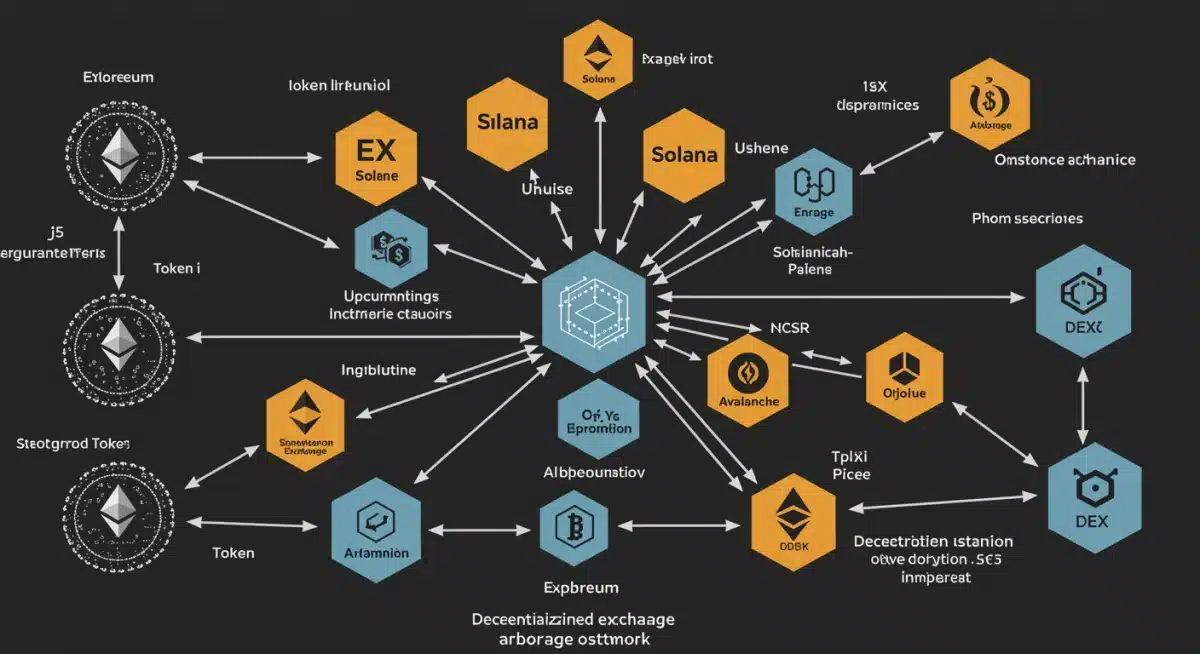
One critical aspect is understanding liquidity depth on each exchange. A large price difference is meaningless if there isn’t enough liquidity to execute the trade without significantly moving the price against the arbitrageur. Therefore, advanced tools also factor in liquidity pools and potential price impact before flagging an opportunity.
Key Data Points for Opportunity Detection
- Real-time Price Feeds: Aggregated data from all relevant DEXs and chains.
- Transaction Cost Analysis: Gas fees on source and destination chains, bridge fees, and potential slippage.
- Liquidity Depth: Assessing the size of liquidity pools to ensure trades can be executed without adverse price impact.
- Latency and Network Congestion: Critical for timely execution, especially during peak network usage.
The continuous refinement of these data points and the algorithms that process them is what separates consistently profitable arbitrageurs from those struggling to keep pace. It’s an ongoing battle against market efficiency and other sophisticated bots.
Strategies for Capitalizing on 8% Daily Gains
Achieving consistent 8% daily gains through DeFi arbitrage in 2026 is ambitious but attainable for those employing advanced strategies and robust risk management. This level of return typically requires high-frequency trading, significant capital deployment (often facilitated by flash loans), and an edge in execution speed.
One primary strategy involves utilizing flash loans to execute multi-leg arbitrage. An arbitrageur borrows a large sum of capital, uses it to buy an asset on one chain, bridges it to another, sells it for a profit, and repays the flash loan, all within a single atomic transaction. If any part of the transaction fails, the entire operation is reverted, mitigating capital risk.
Another strategy focuses on identifying newly listed tokens or tokens undergoing significant volatility. These assets often exhibit wider price disparities across chains as liquidity providers adjust, creating larger windows for arbitrage. However, this also comes with increased smart contract risk and potential for impermanent loss if not managed carefully.
Advanced Execution Techniques
- Optimized Smart Contracts: Arbitrage bots are built using highly optimized smart contracts designed for minimal gas consumption and maximum execution speed.
- MEV (Maximal Extractable Value) Strategies: Arbitrageurs often work with or become validators to ensure their transactions are included in blocks ahead of others, guaranteeing execution.
- Low-Latency Infrastructure: Hosting arbitrage bots on servers physically close to blockchain nodes can shave off precious milliseconds, providing a competitive advantage.
The pursuit of these high daily gains transforms arbitrage into a technological race, where infrastructure, code efficiency, and strategic partnerships play as crucial a role as market insight.
The Role of Automation and AI in 2026 Arbitrage
In 2026, automation and artificial intelligence (AI) are not just tools; they are the backbone of any successful DeFi arbitrage operation. The speed and complexity of cross-chain environments make manual trading utterly impractical. AI-driven algorithms are now capable of far more than just identifying price discrepancies; they can predict them, optimize transaction routes, and even dynamically adjust strategies based on real-time network conditions.
AI models are trained on vast datasets of historical market data, network congestion patterns, and order book movements to identify subtle signals that precede arbitrage opportunities. This predictive capability allows bots to pre-position assets or prepare transactions, giving them a crucial edge in a highly competitive field. Furthermore, AI can manage risk by dynamically adjusting trade sizes and exit points.
The sophistication extends to managing complex multi-chain transactions. AI can determine the most efficient bridging protocols, estimate gas fees across different networks in real-time, and even re-route transactions if a particular chain experiences unexpected congestion or price spikes. This adaptability is key to maintaining profitability in a volatile environment.
Key Automation and AI Features
- Predictive Analytics: Forecasting potential price discrepancies based on market sentiment and historical data.
- Dynamic Route Optimization: Intelligent selection of the fastest and cheapest paths for cross-chain asset transfers.
- Automated Risk Management: Setting stop-loss limits, adjusting position sizes, and managing exposure to impermanent loss.
- Self-Learning Algorithms: Continuously improving performance by analyzing past trades and market outcomes.
The synergy between human oversight and advanced AI systems defines the cutting edge of DeFi arbitrage in 2026, allowing for unparalleled efficiency and potential returns.
Risk Management in High-Stakes DeFi Arbitrage
While the prospect of 8% daily gains is enticing, DeFi arbitrage, especially cross-chain, is fraught with significant risks. Effective risk management is not merely a suggestion; it’s a prerequisite for long-term survival and profitability. The volatile nature of crypto assets, coupled with the inherent complexities of blockchain technology, introduces multiple points of failure.
Smart contract risk remains a primary concern. Bugs or vulnerabilities in the smart contracts underpinning DEXs, bridging protocols, or even the arbitrage bots themselves can lead to catastrophic losses. Thorough auditing and continuous monitoring of these contracts are essential. Furthermore, network congestion or unexpected gas fee spikes can render a profitable arbitrage opportunity unprofitable, or worse, lead to stuck transactions and potential losses.
Another crucial risk is impermanent loss in liquidity pools, especially if an arbitrage strategy involves providing liquidity or if the price action moves unexpectedly against the arbitrageur during a multi-leg trade. Market manipulation, front-running by other bots, and regulatory changes also pose significant threats that must be constantly weighed and mitigated.
Mitigating Arbitrage Risks
- Robust Smart Contract Audits: Regular, independent audits of all deployed contracts.
- Real-time Monitoring Systems: Alerts for sudden gas fee changes, network outages, or significant price volatility.
- Diversification of Strategies: Not relying on a single arbitrage method or asset pair.
- Capital Management: Only deploying capital that one can afford to lose, and setting strict stop-loss parameters.
- Understanding Slippage: Accounting for potential price impact on large trades.
A disciplined approach to risk, combining technical safeguards with conservative financial practices, is the bedrock upon which consistent arbitrage profits are built.
The Future Outlook for Cross-Chain Arbitrage in 2026 and Beyond
The landscape of DeFi arbitrage in 2026 is dynamic and ever-evolving, driven by continuous innovation in blockchain technology and increasing market efficiency. While the 8% daily gains might seem aggressive, they reflect the current opportunities available to highly sophisticated players. Looking ahead, several trends will shape the future of cross-chain arbitrage.
Firstly, the further development of interoperability solutions will continue to reduce friction and costs associated with moving assets between chains. This will likely lead to even faster execution times and potentially narrower arbitrage windows, demanding even greater technological prowess. Zero-knowledge proofs and other advanced cryptographic techniques could also play a significant role in securing and expediting cross-chain transactions.
Secondly, regulatory clarity, or lack thereof, will impact how arbitrageurs operate. As governments worldwide grapple with how to classify and regulate DeFi activities, compliance will become an increasingly important factor. Adaptability to new legal frameworks will be crucial. Finally, the ongoing competition among arbitrage bots will push the boundaries of AI and machine learning, making the field even more competitive and requiring constant innovation to maintain an edge.
Emerging Trends and Challenges
- Enhanced Interoperability: More seamless and secure cross-chain communication.
- Regulatory Scrutiny: Increased oversight potentially impacting operational models.
- AI Advancement: Even more sophisticated algorithms for prediction and execution.
- Market Efficiency: Arbitrage opportunities may become smaller and shorter-lived, demanding higher frequency.
The future of DeFi arbitrage promises to be a fascinating blend of technological race, strategic foresight, and careful risk management, continuously rewarding those who stay at the forefront of innovation.
| Key Aspect | Brief Description |
|---|---|
| Cross-Chain Focus | Exploiting price differences across multiple blockchain networks and DEXs. |
| Automation & AI | Essential for identifying, executing, and optimizing high-frequency arbitrage trades. |
| Risk Management | Crucial for mitigating smart contract risks, network issues, and market volatility. |
| Potential Gains | Opportunities for 8% daily returns, demanding advanced strategies and swift execution. |
Frequently Asked Questions About DeFi Arbitrage in 2026
DeFi arbitrage in 2026 involves profiting from price differences of digital assets across various decentralized exchanges (DEXs) and blockchain networks. It leverages sophisticated bots to execute rapid buy and sell orders, capitalizing on fleeting market inefficiencies, particularly across different chains.
Cross-chain opportunities emerge due to fragmented liquidity across different blockchain networks and DEXs. Price discrepancies occur because assets might be valued differently on one chain versus another, and these imbalances are created by varying supply-demand dynamics and transaction costs.
Achieving 8% daily gains is ambitious but possible for highly skilled and well-resourced arbitrageurs in 2026. This requires advanced automated systems, significant capital, ultra-low latency infrastructure, and robust risk management strategies to continuously exploit numerous small, short-lived opportunities.
Key risks include smart contract vulnerabilities, high gas fees, network congestion, impermanent loss, and front-running by other bots. Regulatory changes and market volatility also pose significant threats. Thorough technical audits and stringent risk management protocols are essential.
AI is crucial in 2026, enabling predictive analytics to identify opportunities, optimize transaction routes across chains, and automate complex execution. It enhances speed, efficiency, and risk management, making it indispensable for competitive arbitrage strategies in the fast-paced DeFi environment.
Conclusion
DeFi arbitrage in 2026, particularly focusing on cross-chain opportunities, stands as a testament to the relentless innovation within the decentralized finance sector. While the allure of 8% daily gains is significant, it is a domain reserved for those equipped with advanced technological tools, a deep understanding of market dynamics, and a rigorous approach to risk management. The continuous evolution of interoperability, the increasing sophistication of AI-driven automation, and the ever-present competitive landscape demand constant adaptation and expertise. For the diligent and well-prepared, DeFi arbitrage offers a powerful avenue for capital growth in the dynamic world of digital assets.