Advanced DeFi Staking 2026: 20%+ Returns with LSDs on Ethereum 2.0

Advanced DeFi staking in 2026, leveraging Liquid Staking Derivatives (LSDs) on Ethereum 2.0, provides investors with sophisticated mechanisms to achieve annualized returns exceeding 20% by enhancing capital efficiency and enabling layered yield generation across multiple decentralized finance protocols.
The landscape of decentralized finance (DeFi) is perpetually evolving, and by 2026, advanced strategies like Advanced DeFi Staking 2026 are poised to redefine how investors generate substantial returns. With Ethereum 2.0 reaching full maturity and the widespread adoption of Liquid Staking Derivatives (LSDs), unlocking 20%+ annual returns is no longer a distant dream but a tangible reality for those who understand the intricacies of this burgeoning ecosystem. This article delves into the cutting-edge techniques and innovations driving these unprecedented opportunities.
The Evolution of Staking: From Basic to Advanced DeFi
Staking has come a long way since its inception, moving from simple token locking to complex, multi-layered strategies. Initially, staking involved holding cryptocurrencies in a wallet to support network operations and earn rewards. While effective, this often meant illiquid assets. The advent of Ethereum 2.0 (now fully implemented) transformed this, enabling more robust and secure network validation, but still posing challenges for capital efficiency.
In 2026, the focus has shifted dramatically towards advanced DeFi staking, where liquidity and composability are paramount. Investors are no longer content with single-digit percentage yields from basic staking. Instead, they seek to maximize their capital by engaging in strategies that allow their staked assets to be utilized across various DeFi protocols simultaneously, generating multiple streams of income.
Understanding Liquid Staking Derivatives (LSDs)
Liquid Staking Derivatives (LSDs) are at the core of this advanced evolution. These tokens represent staked assets, but unlike traditional staking, they remain liquid and tradable. For example, when you stake ETH through a liquid staking protocol, you receive an equivalent amount of an LSD token (e.g., stETH, rETH). This LSD token can then be used in other DeFi applications.
- Enhanced Capital Efficiency: LSDs allow staked assets to be used in lending, borrowing, and yield farming protocols, preventing capital from being locked away.
- Increased Flexibility: Investors can exit their staked position instantly by selling their LSDs on a secondary market, rather than waiting for unbonding periods.
- Compounding Returns: The ability to re-invest LSDs in other protocols creates a compounding effect, significantly boosting overall yields.
The rise of LSDs has fundamentally reshaped the staking paradigm, transforming illiquid assets into dynamic, yield-generating instruments within the broader DeFi ecosystem. This innovation is a cornerstone for achieving the ambitious 20%+ returns discussed.
Ethereum 2.0 and Its Impact on Advanced Staking
The full transition of Ethereum to its Proof-of-Stake (PoS) consensus mechanism, commonly referred to as Ethereum 2.0, has been a game-changer for staking. This upgrade brought significant improvements in scalability, security, and energy efficiency, but more importantly for DeFi, it solidified the foundation for advanced staking protocols.
With a stable and efficient Ethereum network, staking rewards became more predictable and reliable, attracting a larger pool of participants. The underlying security and decentralization of Ethereum provide a trusted environment for LSD protocols to thrive, assuring users of the integrity of their staked assets.
Key Features of Ethereum 2.0 Supporting Advanced DeFi Staking
Several aspects of Ethereum 2.0 directly contribute to the viability and profitability of advanced staking strategies:
- Finality and Security: The enhanced security model of PoS Ethereum reduces risks associated with staking, making it safer for larger capital deployments.
- Predictable Rewards: Stable and transparent staking rewards from the network itself form the base layer of profitability, upon which LSDs build additional yields.
- Developer Ecosystem: Ethereum’s robust developer community continues to build innovative DeFi applications, creating more avenues for LSD utility and yield generation.
The maturity of Ethereum 2.0 by 2026 means that the infrastructure is robust enough to handle the complexities of layered DeFi strategies, minimizing smart contract risks and network congestion that plagued earlier iterations. This stability is crucial for investors seeking high, yet sustainable, returns.
Strategies for Unlocking 20%+ Returns with LSDs
Achieving 20%+ returns in advanced DeFi staking requires a multi-pronged approach that leverages the composability of LSDs across various protocols. It’s not just about staking ETH; it’s about what you do with the resulting liquid staking tokens.
A common strategy involves staking ETH with a major liquid staking provider (e.g., Lido, Rocket Pool) to receive stETH or rETH. These LSDs then become the foundation for subsequent yield-generating activities. This could involve depositing them into a lending protocol to earn interest, using them as collateral for borrowing stablecoins to farm other yields, or providing liquidity in decentralized exchanges (DEXs) for trading fees and additional farming rewards.
Layering Yields: A Practical Example
Consider a scenario where an investor stakes 10 ETH, receiving 10 stETH. The initial ETH staking provides a base yield (e.g., 4-5%). The 10 stETH can then be deposited into a lending platform like Aave or Compound, earning an additional 2-3% interest. Simultaneously, these stETH can be used as collateral to borrow stablecoins, which are then paired with another asset to provide liquidity on a DEX, generating further trading fees and farming incentives (e.g., 10-15%).
- Base Staking Yield: Direct rewards from staking ETH on Ethereum 2.0.
- Lending/Borrowing Yield: Earning interest by lending LSDs or leveraging them as collateral.
- Liquidity Provision (LP) Yield: Providing liquidity to DEXs with LSDs or assets borrowed against them.
- Yield Aggregation: Utilizing platforms that automatically optimize these layered strategies for maximum returns.
The key is to carefully select protocols with robust security audits and a proven track record, ensuring that the combined yields outweigh the inherent risks. This layered approach is what propels returns beyond traditional staking percentages.
Risks and Mitigation in Advanced DeFi Staking
While the allure of 20%+ returns is strong, advanced DeFi staking is not without its risks. Understanding and mitigating these risks is crucial for long-term success. The complexity of layered strategies introduces multiple points of failure, from smart contract vulnerabilities to market volatility and de-pegging risks for LSDs.
Smart contract risk remains a primary concern. Every protocol an LSD interacts with introduces a potential vulnerability. Audits by reputable firms are essential, but even audited contracts can have undiscovered bugs. Market risk, particularly the de-pegging of LSDs from their underlying asset (e.g., stETH losing its 1:1 peg with ETH), can lead to significant losses.
Mitigating Common Risks
Effective risk management in advanced DeFi staking involves several key practices:
- Diversification: Spreading capital across multiple LSD protocols and DeFi strategies reduces exposure to any single point of failure.
- Due Diligence: Thorough research into the security audits, team reputation, and track record of all protocols involved is paramount.
- Monitoring: Actively monitoring market conditions, protocol health, and LSD peg stability allows for timely adjustments to strategies.
- Insurance: Utilizing DeFi insurance protocols can provide a safety net against smart contract exploits or de-pegging events, albeit at a cost.
By consciously addressing these risks through diversification, diligent research, continuous monitoring, and strategic insurance, investors can navigate the advanced DeFi staking landscape more securely and sustainably achieve their desired returns.
The Role of Decentralized Autonomous Organizations (DAOs) and Governance
In 2026, Decentralized Autonomous Organizations (DAOs) play an increasingly vital role in governing the protocols that facilitate advanced DeFi staking. Many liquid staking providers and DeFi platforms are controlled by DAOs, where token holders vote on key decisions, such as fee structures, protocol upgrades, and risk parameters.
Participation in DAO governance is not just about having a say; it’s about protecting one’s investment and shaping the future of the protocols that underpin advanced staking strategies. Active governance can help ensure that protocols remain secure, efficient, and aligned with the interests of their users, thereby contributing to the stability and profitability of LSD-based yields.
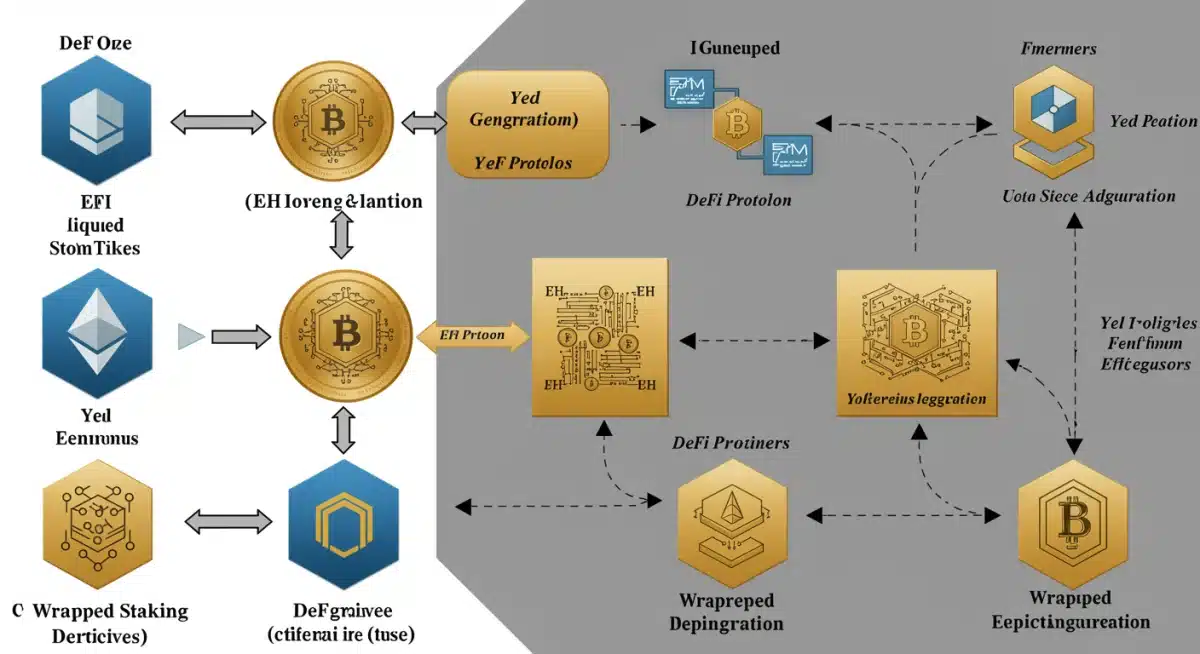
Impact of DAO Governance on Staking Returns
DAO decisions can directly influence the profitability and risk profile of advanced DeFi staking. For instance, votes on adjusting staking reward distribution or implementing new security measures can impact overall returns and capital safety. Furthermore, the transparency inherent in DAO governance fosters trust, which is crucial for attracting and retaining capital in the DeFi space.
- Protocol Upgrades: DAOs vote on improvements that enhance security or introduce new yield opportunities.
- Fee Structures: Governance can adjust fees charged by liquid staking protocols, directly affecting net returns.
- Risk Management: Community-led decisions on collateral ratios and liquidation thresholds help manage systemic risk.
Engaging with DAO governance empowers investors to be proactive participants rather than passive observers, allowing them to influence the very environment in which they seek to generate high returns from advanced DeFi staking.
Future Outlook: Advanced DeFi Staking Beyond 2026
Looking beyond 2026, the trajectory for advanced DeFi staking is one of continued innovation and integration. We can anticipate even more sophisticated LSDs and a higher degree of composability across an expanded array of Layer 2 solutions and interconnected blockchains. Cross-chain liquid staking, where assets staked on one chain can be utilized on another, is likely to become a dominant theme.
The regulatory landscape will also play a significant role. As DeFi matures, clearer regulations may emerge, potentially standardizing certain practices and offering greater protection to investors. This could attract institutional capital, further legitimizing and scaling the advanced staking ecosystem.
Emerging Trends and Technologies
Several key trends and technologies are expected to shape the future of advanced DeFi staking:
- Interoperability: Seamless movement of LSDs across different blockchain networks will unlock new yield opportunities and increase capital efficiency.
- Modular Blockchains: The rise of modular blockchain architectures will allow for highly specialized and optimized staking environments.
- AI-Driven Strategies: Artificial intelligence could be used to optimize yield farming and risk management in real-time, automating complex layered strategies.
The future of advanced DeFi staking promises a landscape where capital is incredibly fluid, yields are highly optimized, and the barriers between different blockchain ecosystems are increasingly blurred, making 20%+ returns potentially more accessible and sustainable for informed investors.
| Key Point | Brief Description |
|---|---|
| Liquid Staking Derivatives (LSDs) | Tokens representing staked assets that remain liquid, enabling their use across various DeFi protocols for additional yield. |
| Ethereum 2.0 Foundation | The fully implemented Proof-of-Stake Ethereum network provides a secure and stable base layer for advanced staking strategies. |
| Layered Yield Strategies | Combining base staking yields with lending, borrowing, and liquidity provision using LSDs to achieve compounded returns. |
| Risk Management | Crucial practices like diversification, due diligence, monitoring, and insurance to mitigate smart contract and market risks. |
Frequently Asked Questions About Advanced DeFi Staking in 2026
LSDs are tokens representing staked cryptocurrencies, like ETH, but unlike traditional staking, they remain liquid. This liquidity allows investors to use these tokens in other DeFi protocols, such as lending or yield farming, effectively earning multiple layers of rewards simultaneously and boosting overall returns.
Yes, achieving 20%+ returns is realistic in 2026 for informed investors leveraging advanced DeFi staking with LSDs. By combining base staking yields with additional returns from lending, liquidity provision, and other DeFi strategies, compounded gains can significantly exceed traditional staking percentages.
Primary risks include smart contract vulnerabilities, de-pegging of LSDs, and market volatility. Mitigation strategies involve thorough due diligence on protocols, diversifying investments, continuous market monitoring, and considering DeFi insurance to protect against potential exploits.
Ethereum 2.0’s full transition to Proof-of-Stake provides a secure, stable, and efficient foundation for staking. Its predictable rewards and robust infrastructure minimize underlying network risks, creating a reliable environment for liquid staking protocols and the complex DeFi strategies built upon them.
DAOs govern many liquid staking and DeFi protocols, allowing token holders to vote on key decisions like fee structures, protocol upgrades, and risk parameters. Active participation in DAO governance helps ensure protocols remain secure, efficient, and aligned with user interests, indirectly safeguarding and enhancing staking returns.
Conclusion
In 2026, the landscape of DeFi staking has matured significantly, offering unprecedented opportunities for investors to achieve substantial returns. Advanced DeFi Staking 2026, particularly through the clever utilization of Liquid Staking Derivatives on a fully realized Ethereum 2.0, provides a powerful pathway to unlocking 20%+ annual yields. By understanding the mechanisms of LSDs, layering yield-generating strategies, diligently managing risks, and engaging with decentralized governance, individuals can navigate this dynamic space effectively. The future promises even greater innovation, with cross-chain capabilities and AI-driven optimizations potentially making these high returns more accessible and sustainable, cementing DeFi’s role as a cornerstone of modern digital finance.