DeFi Insurance 2026: Nexus Mutual & InsurAce for Under 1% Annual Premium

The decentralized finance (DeFi) landscape has evolved at an unprecedented pace, transforming traditional financial paradigms and offering innovative opportunities for wealth creation. However, with great innovation comes inherent risks. The nascent nature of blockchain technology, coupled with the complexity of smart contracts and potential for exploits, has highlighted a critical need for robust security measures. This is where DeFi insurance steps in, acting as a crucial safeguard for participants in this dynamic ecosystem. As we look towards 2026, the question isn’t whether DeFi insurance will be relevant, but how it will continue to mature and become an indispensable component of any serious DeFi strategy. This article delves into the future of DeFi Insurance 2026, focusing on how leading protocols like Nexus Mutual and InsurAce are set to offer comprehensive protection for your digital assets, potentially for annual premiums under 1%.
The Imperative for DeFi Insurance in a Maturing Ecosystem
The journey of DeFi from niche interest to a significant financial force has been marked by both incredible growth and significant setbacks. High-profile hacks, smart contract vulnerabilities, and economic exploits have underscored the fragility of unprotected assets. While the underlying blockchain technology is often secure, the applications built on top of it can be prone to flaws. This reality has driven the development and adoption of specialized insurance solutions tailored for the unique risks of decentralized finance.
Understanding the Risks in DeFi
Before diving into how insurance protocols mitigate these risks, it’s essential to understand what they are. The primary risks in DeFi can be categorized as:
- Smart Contract Risk: Bugs or vulnerabilities in the code of a smart contract that can lead to loss of funds. This is arguably the most prevalent risk in DeFi.
- Oracle Failure Risk: Oracles provide external data to smart contracts. If an oracle feeds incorrect or manipulated data, it can lead to catastrophic losses.
- Liquidation Risk: In lending protocols, volatile asset prices can lead to rapid liquidations if collateral falls below a certain threshold. While not directly covered by traditional DeFi insurance, understanding market risk is crucial.
- Governance Attack Risk: Malicious actors gaining control over a protocol’s governance mechanism to exploit it.
- Centralization Risk: Although DeFi aims for decentralization, some projects still have centralized components that can be single points of failure or attack vectors.
- Stablecoin De-peg Risk: Stablecoins, designed to maintain a peg to fiat currencies, can sometimes lose their peg due to market events or systemic issues, leading to significant losses for holders.
- Exchange/Platform Risk: While less common for pure DeFi, centralized exchanges that interact with DeFi protocols can be targets for hacks.
These risks are complex and often interconnected, making a robust insurance solution not just a luxury, but a necessity for informed participants. As DeFi Insurance 2026 continues to evolve, these protocols are becoming more sophisticated in their ability to assess and cover a wider array of these specific risks.
Nexus Mutual: The Pioneer of Decentralized Insurance
Nexus Mutual stands as one of the oldest and most established players in the DeFi insurance space. Launched in 2019, it pioneered the concept of a decentralized, member-owned alternative to traditional insurance. Its model is built on a collective risk-sharing pool, governed by its members, who decide on coverage terms and claims. This community-driven approach is a cornerstone of its strength and aligns perfectly with the ethos of decentralization.
How Nexus Mutual Works
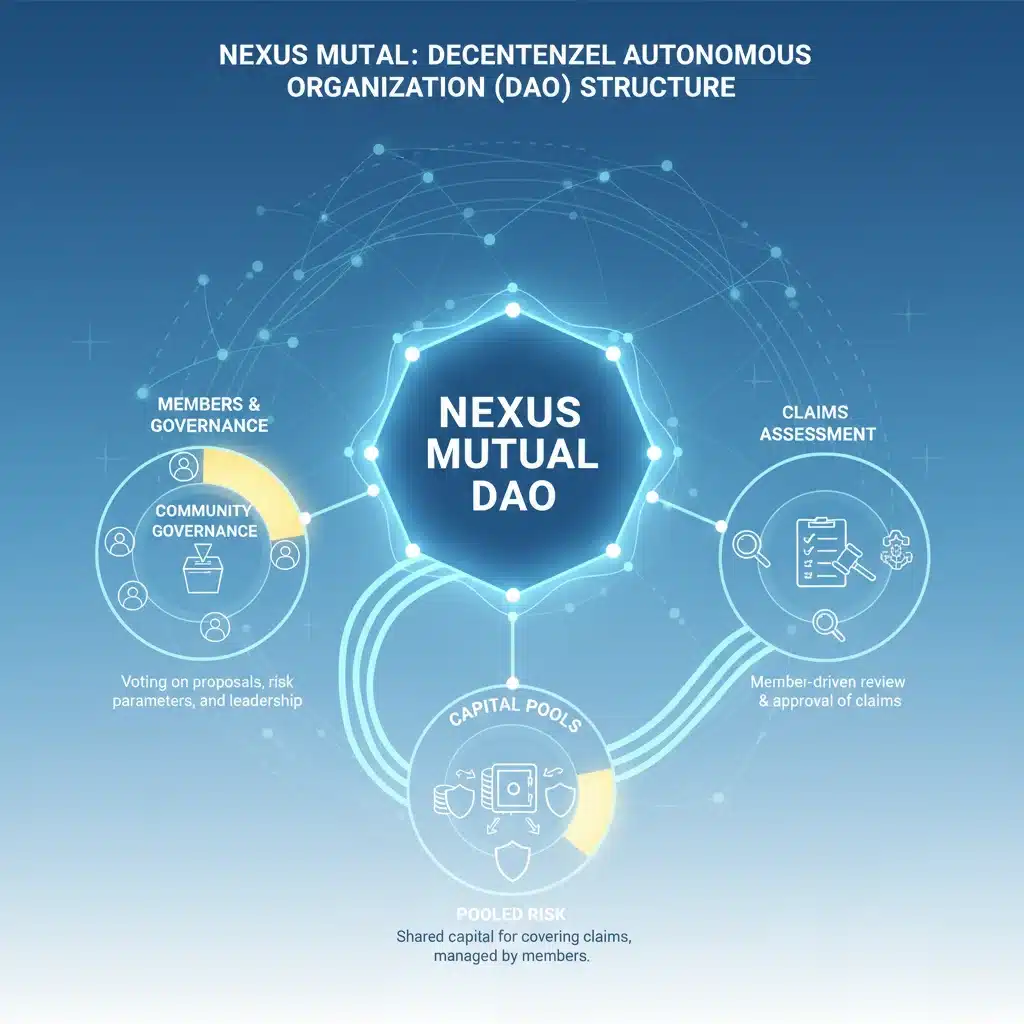
At its core, Nexus Mutual operates as a discretionary mutual. This means that claims are assessed and approved by its members through a voting process, rather than by a centralized entity. Key components include:
- Capital Pool: Members contribute capital (in ETH or DAI) to a shared pool, which is used to pay out claims. This pool is managed by the members.
- Cover Products: Nexus Mutual primarily offers smart contract cover, protecting against technical vulnerabilities and hacks. It also offers custodian cover (for centralized exchanges) and, increasingly, other types of cover as the market demands.
- Claims Assessment: When a claim is filed, Nexus Mutual members (specifically, Claims Assessors who stake NXM tokens) vote on its validity. A majority vote determines whether the claim is paid out from the capital pool. This peer-to-peer assessment adds a layer of trust and transparency.
- Staking and Risk Assessment: Members can stake NXM tokens on specific protocols or smart contracts, signaling their confidence in the security of those projects. This staking mechanism helps determine the pricing of cover and provides an incentive for members to accurately assess risk.
- Tokenomics (NXM): The native token, NXM, plays a crucial role in governance, capital provision, and claims assessment. Its value is intrinsically linked to the capital pool and the overall health of the mutual.
Nexus Mutual in 2026: Enhancements and Future Prospects
By 2026, Nexus Mutual is expected to have further solidified its position as a leading provider of DeFi Insurance 2026. Anticipated developments include:
- Expanded Cover Offerings: Beyond smart contract risk, Nexus Mutual will likely offer more nuanced cover for oracle failures, stablecoin de-pegs, and potentially even certain types of economic exploits, as its risk modeling capabilities become more sophisticated.
- Improved User Experience: While powerful, the current user interface can be complex for newcomers. Significant improvements in UX/UI are expected, making it easier for a broader audience to purchase cover.
- Cross-Chain Capabilities: As DeFi expands to multiple blockchain networks, Nexus Mutual will need to adapt. We can expect increased integration and cover options for protocols on chains beyond Ethereum, through bridges or native deployments.
- Dynamic Pricing Models: Leveraging advanced data analytics and machine learning, premium pricing will become even more dynamic, reflecting real-time risk assessments of protocols based on audits, TVL, and historical exploit data. This could contribute to the sub-1% annual premium target.
- Increased Capital Efficiency: Optimizations in capital deployment and underwriting will allow the mutual to offer more cover with less capital, leading to more competitive pricing.
The community-driven nature of Nexus Mutual ensures its adaptability and resilience, making it a cornerstone of DeFi Insurance 2026.
InsurAce: Multi-Chain and User-Friendly DeFi Coverage
InsurAce.io is another prominent player in the DeFi insurance sector, distinguishing itself with a focus on multi-chain compatibility and a user-friendly experience. Launched in 2021, InsurAce has rapidly gained traction by offering a wide range of cover products across various blockchain networks, aiming to make DeFi insurance accessible to more users.
How InsurAce Works
InsurAce operates a more traditional insurance model compared to Nexus Mutual’s discretionary mutual, yet it retains a decentralized governance structure. Key features include:
- Multi-Chain Coverage: One of InsurAce’s strongest selling points is its ability to provide cover for protocols on multiple chains, including Ethereum, Binance Smart Chain, Polygon, Avalanche, Fantom, and more. This broad reach is crucial in a fragmented DeFi landscape.
- Diverse Cover Products: InsurAce offers a comprehensive suite of cover options, including smart contract vulnerability cover, stablecoin de-peg cover, IDO event risk cover, and even rug pull cover (though this is a more complex risk to underwrite).
- Underwriting Pool: Users can stake stablecoins (USDC) into underwriting pools for specific chains or protocols, earning rewards from premiums. This acts as the capital base for claims.
- Claims Assessment Committee: While decentralized, InsurAce has a structured claims assessment process involving a committee (elected by token holders) that reviews and votes on claims based on predefined criteria.
- INSR Token: The native INSR token is used for governance, staking, and as an incentive for participation in the ecosystem.
- Portfolio-Based Insurance: InsurAce has introduced innovative features like portfolio-based insurance, allowing users to cover multiple assets or protocols under a single policy, streamlining the process.

InsurAce in 2026: Accessibility and Expansion
By 2026, InsurAce is poised to be a dominant force in DeFi Insurance 2026, particularly for users seeking broad, multi-chain coverage and ease of use. Expected advancements include:
- Broader Multi-Chain Integration: Expect InsurAce to expand its coverage to virtually all major and emerging Layer 1 and Layer 2 solutions, becoming a truly universal insurance provider.
- AI-Driven Risk Assessment: Integration of AI and machine learning for real-time risk assessment and automated underwriting, leading to highly accurate and competitive premium pricing, potentially below 1% for many common cover types.
- Parametric Insurance Products: Development of more parametric insurance products, where payouts are triggered automatically upon the occurrence of a predefined event (e.g., a stablecoin de-peg reaching a certain threshold), reducing the need for manual claims assessment.
- Institutional Adoption: As DeFi matures, institutions will demand robust insurance solutions. InsurAce’s structured approach and multi-chain capabilities make it well-suited for institutional clients.
- Enhanced User Interfaces and APIs: Even more intuitive front-ends and robust APIs for seamless integration into other DeFi platforms, making insurance a native feature rather than an afterthought.
InsurAce’s strategy of broad coverage and user-centric design positions it uniquely for significant growth in the future of DeFi Insurance 2026.
Achieving Sub-1% Annual Premiums: A Realistic Outlook for 2026
The prospect of securing your DeFi assets for an annual premium under 1% might seem ambitious, but it is a realistic goal for DeFi Insurance 2026. Several factors contribute to this optimistic outlook:
Maturing Risk Assessment Models
As the DeFi space gathers more data on exploits, vulnerabilities, and protocol stability, insurance protocols can build more sophisticated and accurate risk assessment models. This data-driven approach allows for more precise pricing, moving away from broad estimates to granular, protocol-specific premiums. Machine learning algorithms will play a crucial role here, identifying patterns and predicting potential risks with higher accuracy.
Increased Capital Efficiency and Underwriting Capacity
Both Nexus Mutual and InsurAce are continuously working on optimizing their capital utilization. As their capital pools grow and their underwriting models improve, they can cover more risk with fewer reserves, leading to lower premiums. Furthermore, the ability to re-insure risks within the DeFi ecosystem or with traditional insurers (via bridges) could further enhance capacity and reduce costs.
Competition and Market Dynamics
The DeFi insurance market is becoming increasingly competitive. As more protocols enter the space and existing ones innovate, the pressure to offer attractive pricing will intensify. This competition will naturally drive down premiums, benefiting users. Protocols that can offer the most comprehensive cover at the lowest cost will likely capture significant market share.
Reduced Protocol Risk Over Time
While exploits will never be entirely eliminated, the overall security posture of the DeFi ecosystem is improving. Protocols are undergoing more rigorous audits, implementing bug bounty programs, and adopting best practices in smart contract development. As the inherent risks of DeFi projects decrease, so too will the cost of insuring them.
User Adoption and Network Effects
As more users embrace DeFi insurance, the capital pools of these protocols will grow, further enhancing their capacity to cover risks. This network effect leads to a virtuous cycle: more users mean larger pools, which means more competitive pricing, which in turn attracts more users. This scalability is a key advantage of decentralized insurance models.
Integrating DeFi Insurance into Your Portfolio Strategy
For any serious DeFi participant, integrating insurance into their portfolio strategy should be a priority, especially looking towards DeFi Insurance 2026. Here’s how to approach it:
Assess Your Risk Exposure
Understand which protocols you are interacting with and the specific risks associated with them. Are you providing liquidity to a new, unaudited project? Are you staking on a well-established but complex protocol? Your risk exposure will dictate the type and amount of cover you need.
Compare Coverage Options
Don’t just look at the price. Compare the scope of coverage offered by Nexus Mutual, InsurAce, and other providers. Does it cover smart contract risk, oracle attacks, stablecoin de-pegs, or a combination? Understand the claims assessment process and payout history of each provider.
Consider Policy Duration and Cost
Premiums are typically quoted annually, but you can often purchase cover for shorter durations. Calculate the annual percentage cost to ensure it aligns with your budget and risk tolerance. Aim for those sub-1% annual premiums where possible.
Stay Informed
The DeFi landscape is dynamic. Protocols evolve, new risks emerge, and insurance offerings change. Regularly review your insurance policies and stay updated on the security posture of the protocols you use and the latest developments in DeFi Insurance 2026.
Diversify Your Insurance
Just as you diversify your investments, consider diversifying your insurance providers if you have significant assets across multiple protocols or chains. This can reduce counterparty risk associated with a single insurance provider.
Challenges and Future Outlook for DeFi Insurance
While the future of DeFi Insurance 2026 appears bright, there are still challenges to address:
- Regulatory Scrutiny: As DeFi grows, regulators will inevitably take a closer look at decentralized insurance. Navigating these evolving regulatory landscapes will be crucial for long-term sustainability.
- Complexity of Claims: While improving, the claims assessment process for highly complex exploits can still be challenging and time-consuming. Streamlining this while maintaining decentralization is key.
- Underwriting Sophisticated Risks: Covering highly complex or novel risks (e.g., flash loan attacks, economic exploits that don’t involve smart contract bugs) remains a frontier for DeFi insurance.
- Scalability: Ensuring that insurance protocols can scale their capital pools and underwriting capacity to meet the growing demand of a multi-trillion-dollar DeFi ecosystem.
However, the innovative spirit of the DeFi community, coupled with the relentless pursuit of robust security solutions, suggests that these challenges will be met head-on. The collaboration between security auditors, protocol developers, and insurance providers will be instrumental in building a safer and more resilient DeFi future.
Conclusion: Securing Your Assets in the Era of DeFi Insurance 2026
As we march towards 2026, DeFi insurance is transitioning from an optional safeguard to an essential component of responsible participation in the decentralized economy. Protocols like Nexus Mutual and InsurAce are at the forefront of this evolution, offering sophisticated, community-driven, and multi-chain solutions designed to protect your digital assets. The vision of securing your DeFi investments for an annual premium potentially under 1% is not a distant dream but a tangible reality, driven by maturing risk models, increased capital efficiency, and fierce competition.
By understanding the risks, evaluating the robust offerings from leading providers, and strategically integrating DeFi insurance into your portfolio, you can navigate the exciting yet volatile world of decentralized finance with greater confidence and peace of mind. The era of unprotected DeFi assets is drawing to a close; the era of comprehensive, affordable DeFi Insurance 2026 is here.