SEC Guidance & Altcoins: Q3 2026 Valuation Impact
The recent SEC guidance in Q3 2026 profoundly influences altcoin valuations by redefining regulatory classifications and enhancing compliance demands, directly affecting investor sentiment and market liquidity.
The cryptocurrency landscape is perpetually shifting, driven by technological innovation, market sentiment, and perhaps most significantly, regulatory clarity. In Q3 2026, the United States Securities and Exchange Commission (SEC) released updated guidance that has sent ripples throughout the digital asset ecosystem. For anyone involved in the altcoin market, understanding how this guidance impacts SEC guidance altcoin valuation is not just important; it’s absolutely critical for navigating the complexities of this evolving space. This comprehensive analysis delves into the nuances of the SEC’s latest directives, examining their immediate and long-term implications for altcoins, investor strategies, and the broader market.
Understanding the Latest SEC Directives
The SEC’s role in the digital asset market has steadily expanded, reflecting a growing recognition of cryptocurrencies’ financial significance. The Q3 2026 guidance is not merely an incremental update; it represents a more refined and assertive stance on how digital assets are classified and regulated. This clarity, while often sought by the industry, invariably brings new challenges and opportunities, especially for the diverse and often volatile altcoin sector.
Previously, the SEC’s approach was characterized by a series of enforcement actions and general statements. However, the latest directives aim to provide a more structured framework for distinguishing between securities and non-securities, offering specific criteria that projects and investors must consider. This renewed focus on classification directly influences how altcoins are perceived and traded, particularly concerning initial offerings and secondary market liquidity.
Key Components of the Q3 2026 Guidance
- Enhanced Howey Test Application: The SEC has detailed specific scenarios and factors for applying the Howey Test to digital assets, making it more challenging for certain altcoins to avoid security classification.
- Disclosure Requirements: New, stringent disclosure requirements for projects deemed securities, including financial statements, risk factors, and governance structures.
- Intermediary Responsibilities: Clearer expectations for exchanges, brokers, and custodians dealing with digital assets classified as securities, emphasizing registration and compliance.
These components collectively paint a picture of a more regulated environment, one where the onus of compliance falls heavily on both issuers and market participants. The implications for altcoin projects that have previously operated in regulatory gray areas are particularly profound, necessitating a strategic pivot towards greater transparency and adherence to established securities laws.
Reclassifying Altcoins: Securities vs. Commodities
One of the most significant aspects of the Q3 2026 SEC guidance is its impact on the classification of altcoins. The distinction between a security and a commodity dictates the regulatory body overseeing it – the SEC for securities and the CFTC for commodities. The latest guidance provides more granular detail on the characteristics that tip an altcoin into the ‘security’ category, primarily focusing on the decentralization continuum and the reasonable expectation of profit derived from the efforts of others.
Many altcoins, especially those with smaller market caps or those closely tied to a founding team’s ongoing development efforts, now face increased scrutiny. This reclassification isn’t just a legal formality; it has tangible consequences for how these assets are traded, marketed, and even developed. Projects that fall under the security umbrella must comply with comprehensive registration and reporting obligations, a significant burden for many nascent ventures.
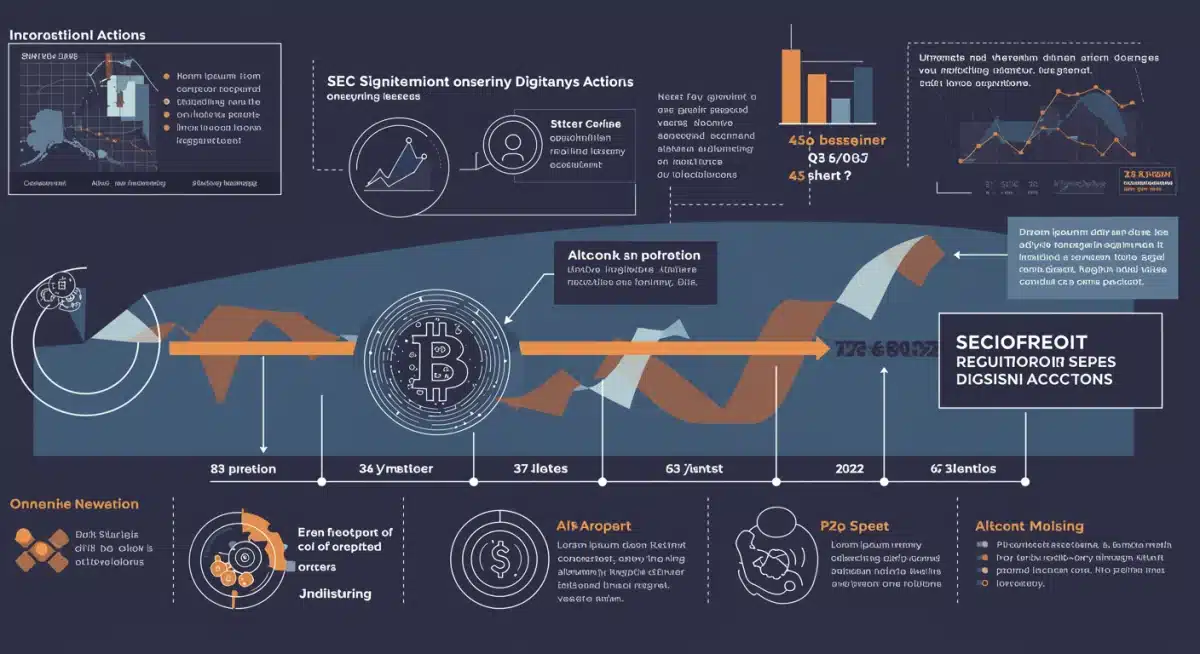
The market has already begun to react to these reclassification pressures. Investors are increasingly wary of altcoins that lack clear regulatory status, leading to capital flight from projects perceived as high-risk. This shift in investor behavior is a direct consequence of the SEC’s enhanced clarity, forcing a re-evaluation of portfolio allocations and due diligence processes.
Impact on Project Development and Funding
- Reduced ICO/IEO Activity: The stricter security classification makes traditional Initial Coin Offerings (ICOs) or Initial Exchange Offerings (IEOs) far more challenging due to heightened legal risks.
- Shift to Decentralized Autonomous Organizations (DAOs): Many projects are accelerating decentralization efforts to distance themselves from a central entity, aiming for commodity status.
- Increased Legal and Compliance Costs: Projects must allocate significant resources to legal counsel and compliance infrastructure, impacting development budgets.
Ultimately, the guidance is pushing the altcoin ecosystem towards greater maturity and compliance. While this may stifle some innovative but non-compliant projects in the short term, it aims to foster a more secure and transparent environment for investors, potentially paving the way for broader institutional adoption in the long run.
Market Response and Investor Sentiment Shifts
The immediate market response to the Q3 2026 SEC guidance has been a mixed bag, characterized by volatility and a noticeable shift in investor sentiment. While some established altcoins with clearer utility and decentralized governance have shown resilience, others, particularly those with less defined use cases or centralized control, have experienced significant price corrections.
Investor sentiment has gravitated towards assets with perceived regulatory clarity or those actively pursuing compliance. This flight to quality indicates a growing preference for projects that can demonstrate a robust legal framework, minimizing the risk of future enforcement actions. The market is increasingly valuing regulatory certainty as a premium, influencing trading volumes and market capitalization across the altcoin spectrum.
Furthermore, institutional investors, who have historically been cautious due to regulatory ambiguities, are now scrutinizing altcoins with an even sharper focus. Their participation is contingent on clear regulatory pathways, and the SEC’s guidance, despite its initial disruptive impact, is seen by some as a necessary step towards enabling greater institutional involvement in the digital asset space.
Key Market Indicators
- Increased Volatility: Altcoins facing reclassification uncertainty have seen heightened price swings.
- Divergent Performance: A growing divergence between compliant/decentralized altcoins and those with regulatory overhang.
- Due Diligence Emphasis: Investors are conducting more thorough legal and compliance due diligence before allocating capital.
The guidance is effectively segmenting the altcoin market, rewarding those that adapt to the new regulatory realities and challenging those that do not. This dynamic is reshaping investment strategies, compelling both retail and institutional investors to prioritize regulatory compliance alongside technological innovation.
Compliance Strategies for Altcoin Projects
In the wake of the Q3 2026 SEC guidance, altcoin projects are facing an imperative to re-evaluate and often overhaul their compliance strategies. Ignoring the new directives is not an option, as the SEC has demonstrated a willingness to pursue enforcement actions against non-compliant entities. The focus has shifted from merely avoiding regulatory attention to proactively building robust compliance frameworks.
For many projects, this means engaging specialized legal counsel to assess their current classification under the enhanced Howey Test. Depending on the outcome, projects may need to undertake significant structural changes, such as further decentralizing their governance, modifying their tokenomics, or even registering as securities with the SEC. Each path presents its own set of challenges and opportunities.
Beyond classification, the guidance also emphasizes transparency and disclosure. Projects now need to consider comprehensive reporting mechanisms, ensuring that investors have access to accurate and timely information. This includes financial audits, technical whitepaper updates, and clear communication regarding development milestones and team activities. The goal is to build trust through verifiable compliance.
Essential Compliance Steps
- Legal Classification Review: Obtain expert legal opinion on the altcoin’s security status under the new guidance.
- Decentralization Roadmap: Develop and implement strategies to increase decentralization, if aiming for commodity status.
- Enhanced Disclosure: Prepare for comprehensive disclosures, potentially including SEC registration, if classified as a security.
The landscape demands a proactive and adaptable approach to compliance. Projects that can successfully navigate these regulatory waters will not only mitigate legal risks but also enhance their appeal to a broader base of safety-conscious investors, ultimately strengthening their market position.
The Role of Decentralization in Regulatory Avoidance
Decentralization has emerged as a critical factor in how altcoins navigate the SEC’s regulatory framework, particularly following the Q3 2026 guidance. The SEC has repeatedly indicated that truly decentralized networks, where no single entity controls the project or profits from its efforts, are less likely to be classified as securities. This has spurred a renewed focus on achieving genuine decentralization among altcoin projects.
However, achieving genuine decentralization is a complex and often gradual process. It involves distributing control over protocol development, governance, and treasury management among a wide array of independent participants. Many projects that initially started with centralized teams are now actively working towards progressive decentralization, transferring power to community-driven DAOs and open-source contributors.
The guidance has also highlighted the distinction between technical decentralization (e.g., distributed nodes) and economic/governance decentralization (e.g., token holder voting, independent development). Projects must demonstrate both to effectively argue against security classification. This often requires significant architectural redesigns and community engagement initiatives.
Decentralization Strategies
- Progressive Governance: Implementing phased decentralization of governance mechanisms, moving from core team control to community voting.
- Open-Source Development: Fostering a robust open-source community to reduce reliance on a single development entity.
- Distributed Ownership: Ensuring broad distribution of tokens to prevent concentrated control by a few entities or the founding team.
Ultimately, the pursuit of decentralization is not just a technical or philosophical ideal; it has become a strategic imperative for altcoin projects seeking regulatory clarity and market stability in the wake of the SEC’s updated guidance. Projects that successfully achieve and demonstrate true decentralization are likely to see a positive impact on their long-term valuation prospects.
Future Outlook: Altcoin Valuations Beyond Q3 2026
Looking beyond Q3 2026, the implications of the SEC’s guidance for altcoin valuations are likely to be profound and enduring. While the immediate aftermath has brought some uncertainty and volatility, the long-term outlook suggests a more mature, compliant, and potentially more stable altcoin market. The regulatory clarity, though stringent, is a foundational step toward broader adoption and integration into traditional finance.
We can anticipate a continued bifurcation in the altcoin market. Projects that successfully adapt to the new regulatory environment, whether by achieving decentralization or by embracing security registration, are likely to gain investor confidence and see their valuations stabilize or grow. Conversely, projects that fail to address regulatory concerns may face delisting, enforcement actions, and a decline in investor interest.
Furthermore, the guidance is expected to spur innovation in compliance solutions, legal frameworks, and decentralized technologies. Service providers specializing in crypto legal compliance, regulatory tech (RegTech), and decentralized governance models will likely see increased demand. This regulatory pressure, while challenging, can foster a more robust and resilient ecosystem.
Long-Term Trends to Watch
- Institutional Influx: Increased regulatory clarity could unlock significant institutional capital flows into compliant altcoins.
- Consolidation: The market may see consolidation, with stronger, compliant projects absorbing or outcompeting non-compliant ones.
- Innovation in Compliance: Development of new technologies and services to help projects meet regulatory demands more efficiently.
The journey for altcoins in the post-Q3 2026 regulatory landscape will be dynamic, but the overarching trend points towards a future where regulatory adherence is paramount. This will redefine how altcoins are valued, traded, and developed, ultimately shaping the next era of digital finance.
| Key Point | Brief Description |
|---|---|
| Reclassification Pressure | SEC’s enhanced Howey Test application forces many altcoins to re-evaluate their security status. |
| Investor Sentiment Shift | Preference for compliant/decentralized assets, leading to capital reallocation and increased due diligence. |
| Decentralization Imperative | Projects actively pursue decentralization to mitigate security classification and regulatory risks. |
| Long-Term Market Maturation | Guidance fosters a more compliant, stable, and trusted altcoin market, attracting institutional interest. |
Frequently Asked Questions About SEC Guidance and Altcoins
The primary impact is a re-evaluation of altcoin classifications, with stricter application of the Howey Test. This pushes many altcoins towards being deemed securities, necessitating enhanced compliance and disclosure, directly affecting their market valuation and investor appeal.
Genuine decentralization, where no single entity controls the project or profits from its efforts, reduces the likelihood of an altcoin being classified as a security. The SEC views truly decentralized networks as commodities, which fall under different regulatory oversight, primarily the CFTC.
Projects should undertake a legal classification review, potentially implement strategies to increase decentralization, and prepare for enhanced disclosure requirements. This might include registering as a security if necessary, or significantly modifying tokenomics and governance structures.
While initially disruptive, the increased regulatory clarity is likely to attract more institutional investment in the long term. Institutions often require clear regulatory frameworks to operate, and compliant altcoins will become more appealing as the market matures under these new guidelines.
Investor sentiment is shifting towards prioritizing regulatory clarity and compliance. Investors are increasingly favoring altcoins that demonstrate strong legal frameworks or a clear path to decentralization, leading to a flight to quality and more cautious capital allocation decisions.
Conclusion
The Q3 2026 SEC guidance marks a pivotal moment for the altcoin market. While it introduces significant challenges and demands a strategic reorientation for many projects, its ultimate aim is to foster a more transparent, secure, and compliant digital asset ecosystem. Projects that embrace decentralization, enhance their disclosure practices, and proactively navigate the regulatory landscape will not only mitigate risks but also position themselves for sustained growth and increased investor confidence. The path ahead requires adaptability and a deep understanding of the evolving regulatory framework, but the long-term benefits of a more mature market could be substantial for the future of altcoin valuations.