Top DeFi Lending Protocols for US Investors: 10%+ Returns in 2026

The 3 Best Lending Protocols for US DeFi Investors in 2026: Achieving 10%+ Returns with Enhanced Security Features
The world of decentralized finance (DeFi) is constantly evolving, presenting unprecedented opportunities for investors seeking substantial returns. For US DeFi investors looking beyond traditional financial instruments, the promise of 10%+ annual percentage yields (APYs) from DeFi lending protocols is incredibly attractive. As we look towards 2026, the landscape of these protocols is maturing, with a heightened focus on security, regulatory compliance, and sustainable growth. This comprehensive guide will delve into the top 3 DeFi Lending Protocols poised to offer not only impressive returns but also robust security features for US investors.
Navigating the DeFi space requires a keen understanding of its intricacies, from smart contract risks to liquidity considerations and the ever-present regulatory uncertainty. However, for those who do their due diligence, the rewards can be significant. Our focus today is on identifying DeFi Lending Protocols that have demonstrated resilience, innovation, and a commitment to user safety, making them ideal candidates for your investment portfolio in 2026.
Before we dive into the specifics of each protocol, it’s crucial to understand what makes a DeFi lending platform stand out, especially for US investors. Factors such as Total Value Locked (TVL), audit history, community governance, insurance mechanisms, and potential for future growth all play a pivotal role. Moreover, given the evolving regulatory environment in the United States, protocols that show a proactive approach to compliance or offer features that cater to US market specificities will be prioritized.
Understanding DeFi Lending: The Basics for US Investors
At its core, DeFi lending allows users to lend their cryptocurrency holdings to others in exchange for interest. This process is facilitated by smart contracts on a blockchain, eliminating the need for traditional intermediaries like banks. Borrowers, in turn, can access capital by providing collateral, typically in the form of other cryptocurrencies. The transparent and immutable nature of blockchain technology underpins these operations, offering a new paradigm for financial interactions.
How Do DeFi Lending Protocols Generate 10%+ Returns?
The high returns often associated with DeFi Lending Protocols stem from several factors:
- Demand for Capital: There’s a strong demand for capital within the crypto ecosystem, driven by trading, arbitrage, and other DeFi activities.
- Efficiency: The absence of intermediaries reduces operational costs, allowing a larger share of the profits to be distributed to lenders.
- Dynamic Interest Rates: Many protocols employ algorithmic interest rate models that adjust based on supply and demand, often leading to competitive rates.
- Token Incentives: Some protocols offer additional rewards in their native governance tokens, effectively boosting the overall yield.
Key Considerations for US DeFi Investors
For US investors, several specific considerations come into play when evaluating DeFi Lending Protocols:
- Regulatory Landscape: The regulatory environment for cryptocurrencies in the US is complex and dynamic. Protocols that have a clear strategy for navigating these waters, or those that offer features like KYC/AML compliance for specific pools, might be more appealing.
- Tax Implications: Understanding the tax implications of DeFi earnings is paramount. US investors need to track interest earned, capital gains, and other taxable events.
- Security Audits: Regular and thorough security audits by reputable firms are non-negotiable. Smart contract vulnerabilities can lead to significant losses.
- Insurance & Safeguards: While not universally available, some protocols offer insurance funds or partnerships with decentralized insurance providers to mitigate risks.
- Liquidity: Adequate liquidity is vital to ensure that lenders can withdraw their funds when needed without significant price impact.
The Top 3 DeFi Lending Protocols for US Investors in 2026
Based on their current trajectory, commitment to security, innovation, and potential for sustainable high yields, the following three DeFi Lending Protocols are poised to be leaders for US investors by 2026.
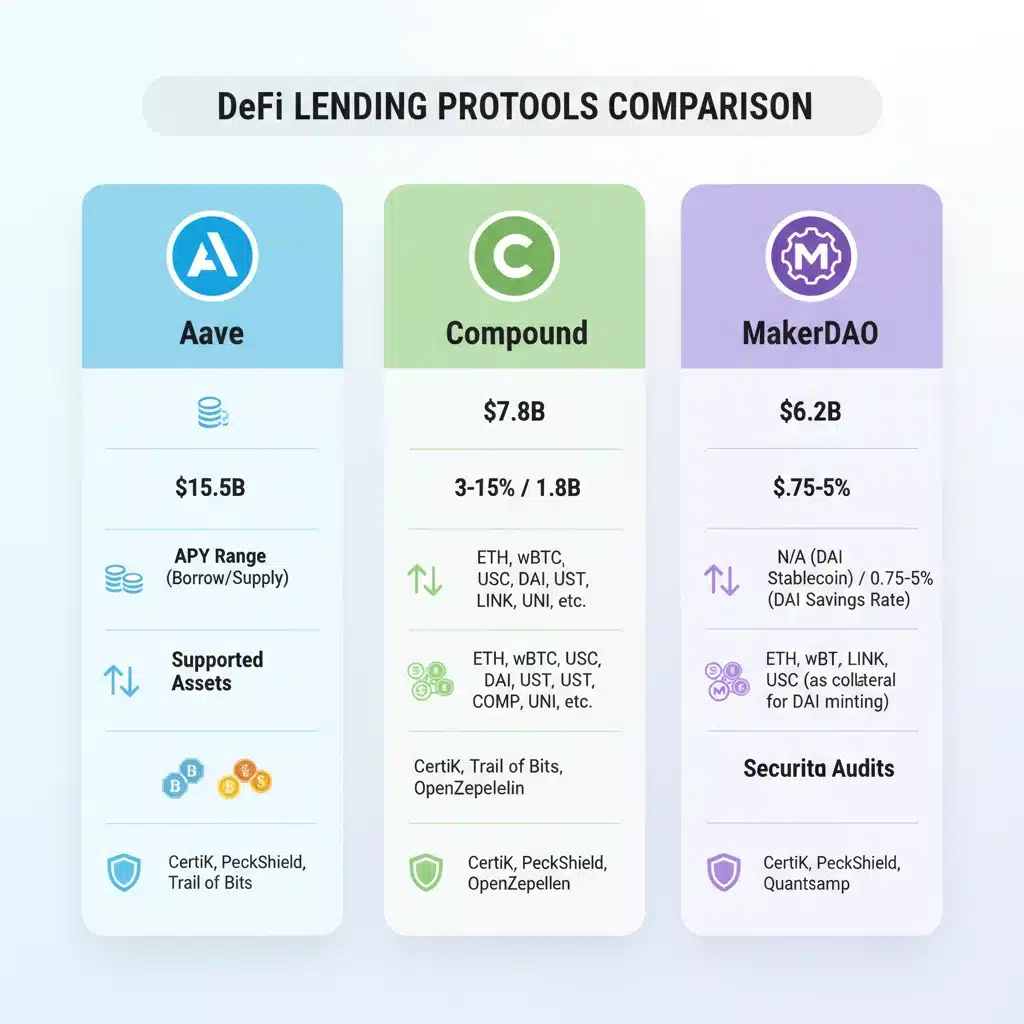
Protocol 1: Aave – The Established Powerhouse with Evolving Features
Aave has long been a cornerstone of the DeFi lending landscape, renowned for its robust architecture and continuous innovation. By 2026, Aave is expected to further solidify its position as a go-to platform for US investors seeking reliable and diverse lending opportunities. Its strength lies in its battle-tested smart contracts, extensive liquidity, and a wide array of supported assets.
Why Aave Stands Out for US Investors:
- Multi-Chain Expansion: Aave’s expansion across multiple blockchains (Ethereum, Polygon, Avalanche, Optimism, Arbitrum, etc.) offers users greater flexibility, lower transaction costs, and access to a broader range of assets. This is particularly beneficial for US investors looking to optimize gas fees.
- Flash Loans: Aave pioneered flash loans, a unique uncollateralized lending option for developers and advanced users to execute arbitrage strategies and other complex DeFi operations within a single transaction block. While not directly generating passive income for lenders, it showcases Aave’s innovative spirit and strengthens its ecosystem.
- Aave V3 Enhancements: Aave V3 introduced significant improvements such as ‘Portal’ for seamless asset transfers between networks, ‘High Efficiency Mode’ for optimized capital utilization, and ‘Isolation Mode’ to limit risk exposure from newly listed assets. These features collectively enhance capital efficiency and security, directly benefiting lenders.
- Safety Module (Staking AAVE): The Aave Safety Module allows users to stake AAVE tokens to provide security for the protocol, earning staking rewards and a share of protocol fees. This acts as a decentralized insurance mechanism, providing a layer of protection against unexpected events, which is a major draw for security-conscious US investors.
- Strong Governance and Community: Aave boasts a highly active and engaged decentralized autonomous organization (DAO). Token holders participate in critical decisions, ensuring the protocol evolves in a transparent and community-driven manner. This level of decentralization and community oversight builds significant trust.
- Regulatory Preparedness: While DeFi is inherently permissionless, Aave has shown a willingness to engage with regulatory discussions, and its architecture can support permissioned pools or other features if required by evolving US regulations, providing a potential pathway for institutional adoption.
Expected Returns and Security in 2026:
Aave’s lending APYs are dynamic, but with stablecoin lending often hovering around 3-8% (and occasionally spiking higher during periods of high demand), the inclusion of AAVE token incentives and strategic liquidity provision could push effective returns well into the 10%+ range for savvy US investors. Its security is paramount, with numerous audits, a bug bounty program, and the robust Safety Module providing significant peace of mind. As Aave continues to innovate and adapt, it remains a top contender for secure and profitable DeFi lending.
Protocol 2: Compound Finance – Reliable Yields with Institutional Appeal
Compound Finance is another pillar of the DeFi lending space, known for its elegant design and consistent performance. By 2026, Compound is expected to enhance its appeal to US investors, particularly those with a more conservative approach but still seeking competitive DeFi yields. Its emphasis on transparent, algorithmic interest rates and a clear path to decentralization makes it a strong candidate.
Why Compound Finance Stands Out for US Investors:
- Algorithmic Interest Rates: Compound’s interest rates are determined algorithmically based on supply and demand for each asset, ensuring transparency and fairness. This predictable model helps lenders understand their potential earnings.
- Robust Oracle System: Compound relies on a robust and decentralized oracle system to fetch price data, crucial for accurate collateral valuation and liquidation processes. This minimizes manipulation risks.
- COMP Token Rewards: Lenders and borrowers on Compound earn COMP tokens, the protocol’s governance token. These rewards significantly boost the overall APY, often pushing it into the double digits, making it attractive for US investors looking for higher effective returns.
- Battle-Tested Smart Contracts: Compound’s smart contracts have undergone extensive scrutiny and have a strong track record of security, a vital factor for any US investor.
- Decentralized Governance: The Compound protocol is governed by COMP token holders, allowing for community-led upgrades and parameter adjustments. This decentralized control fosters trust and resilience.
- Institutional Engagement: Compound has actively engaged with institutional players and explored pathways for compliant DeFi. This foresight positions it well for potential future regulatory frameworks in the US, making it more accessible and appealing to a broader range of investors, including those from traditional finance.
- Clear and User-Friendly Interface: Compound offers a straightforward user experience, making it relatively easy for new US DeFi investors to get started with lending and borrowing.
Expected Returns and Security in 2026:
Compound’s core lending APYs for stablecoins typically range from 2-6%. However, when factoring in the distribution of COMP tokens, the effective APY can frequently exceed 10%, especially for strategic positions. The protocol’s commitment to security is evident in its rigorous auditing process and the stability of its underlying code. As the DeFi space matures, Compound’s reputation for reliability and its potential for institutional integration will continue to attract US investors seeking consistent and secure DeFi Lending Protocols.
Protocol 3: MakerDAO (Dai Savings Rate) – Stable, Secure, and Sovereign
While primarily known for creating the decentralized stablecoin Dai, MakerDAO also offers a powerful lending mechanism through its Dai Savings Rate (DSR). By 2026, the DSR is expected to remain a highly attractive option for US investors prioritizing stability and robust security, offering competitive yields on the most decentralized stablecoin.
Why MakerDAO’s DSR Stands Out for US Investors:
- Stability of Dai: Dai is a decentralized, collateral-backed stablecoin pegged to the US dollar. Investing in the DSR means earning yield on an asset designed for price stability, significantly reducing volatility risk compared to lending volatile cryptocurrencies. This stability is a huge advantage for risk-averse US investors.
- Consistent Yield with Governance Control: The Dai Savings Rate is managed by MakerDAO governance, allowing MKR token holders to adjust the rate based on market conditions. This means the DSR can be responsive to demand, aiming to offer competitive yields while maintaining Dai’s peg. While it might not always hit 10%+ directly from DSR, combined strategies (e.g., DSR + other yield farming opportunities with Dai) can achieve this.
- Overcollateralization and Robust Risk Management: MakerDAO’s system is built on a foundation of overcollateralization, meaning every Dai is backed by more than its value in other cryptocurrencies. This robust risk management framework provides an exceptional level of security for Dai holders.
- Decentralization and Transparency: MakerDAO is one of the most decentralized protocols in DeFi. Its operations are transparent on the Ethereum blockchain, and its governance is entirely in the hands of MKR token holders. This level of decentralization offers significant censorship resistance and trust.
- Audited and Battle-Tested: The Maker Protocol has been operational for years and has undergone numerous audits, proving its resilience and security through various market cycles. This long track record is a critical factor for US investors concerned about platform reliability.
- Integration with Other DeFi Protocols: Dai is a foundational asset in the DeFi ecosystem. Holding Dai in the DSR doesn’t preclude its use in other DeFi strategies, allowing for composability and potentially higher blended yields if investors choose to explore beyond the DSR itself.
Expected Returns and Security in 2026:
The DSR’s APY fluctuates based on governance decisions and market dynamics, but it consistently offers a solid, stable yield for Dai holders. While historically it might not always sit above 10% on its own, its role as a bedrock of stable, secure yield makes it an indispensable component of a diversified DeFi portfolio. For US investors, the unparalleled stability and security of Dai, combined with the potential for competitive yields, make the DSR a compelling choice for conservative yet yield-seeking strategies. The security of the Maker Protocol against hacks and systemic failures is among the highest in DeFi, making it an excellent option for preserving capital while earning interest.
Key Security Features to Prioritize for US DeFi Investors
For US investors, security is not just a feature; it’s a prerequisite. As DeFi Lending Protocols evolve, so do their security measures. Here are the paramount security features to look for:
1. Smart Contract Audits and Formal Verification
Reputable protocols undergo regular security audits by independent third-party firms. These audits scrutinize the smart contract code for vulnerabilities, bugs, and potential exploits. Formal verification takes this a step further, using mathematical methods to prove that the code behaves exactly as intended. Always check for recent audit reports and the reputation of the auditing firm.
2. Decentralized Governance and Multisig Wallets
Protocols governed by a Decentralized Autonomous Organization (DAO) where token holders vote on critical upgrades and parameters are generally more secure. This decentralization prevents a single point of failure or malicious control. Furthermore, critical protocol funds and upgrade mechanisms should ideally be controlled by multi-signature (multisig) wallets, requiring multiple independent parties to approve transactions.
3. Insurance Funds and Cover Options
Some DeFi Lending Protocols, like Aave with its Safety Module, have built-in insurance funds to cover potential losses from smart contract exploits or liquidations. Additionally, decentralized insurance platforms (e.g., Nexus Mutual, InsurAce) offer coverage for specific protocols, allowing investors to purchase protection against certain risks. While not always 100% comprehensive, these options add a crucial layer of security.
4. Oracle Security
DeFi lending relies heavily on accurate price feeds from external sources (oracles) to determine collateralization ratios and trigger liquidations. Secure protocols use decentralized and robust oracle networks (like Chainlink) to prevent price manipulation, which could otherwise lead to unfair liquidations or bad debt.
5. Progressive Decentralization and Open Source Code
Protocols that are progressively decentralizing their operations and have fully open-source code allow for community scrutiny and foster transparency. This open development model contributes to identifying and mitigating risks more effectively.
Navigating Regulatory Compliance for US DeFi Investors in 2026
The regulatory landscape for DeFi in the US is a significant factor. While the exact contours of future regulations are still being shaped, US investors should be aware of potential developments:
- KYC/AML Requirements: While most DeFi protocols are permissionless, some may introduce permissioned pools or front-ends that incorporate Know Your Customer (KYC) and Anti-Money Laundering (AML) checks, particularly for institutional participants or to comply with specific jurisdictions.
- Tax Reporting: The IRS views cryptocurrency as property, and DeFi activities generate taxable events. US investors must meticulously track all transactions, interest earned, and capital gains/losses. Tools and services designed for crypto tax reporting will become even more essential.
- Stablecoin Regulation: Potential regulation of stablecoins could impact protocols that heavily rely on them. Protocols using decentralized, overcollateralized stablecoins like Dai might prove more resilient to certain regulatory pressures.
- SEC Scrutiny: The SEC continues to examine whether certain crypto assets or DeFi services constitute securities. Investors should stay informed about any regulatory actions or guidance that could affect the protocols they use.
Choosing DeFi Lending Protocols that are either inherently designed for resilience against regulatory changes (e.g., highly decentralized) or those that are proactively engaging with regulatory bodies might offer an added layer of peace of mind for US investors.
Strategies for Maximizing Returns and Managing Risk
Achieving 10%+ returns in DeFi lending requires a strategic approach beyond simply picking a protocol. Here are some advanced strategies and risk management tips:
Yield Aggregators and Optimizers
Platforms like Yearn Finance or Convex Finance automatically move your funds between different DeFi Lending Protocols and yield farms to find the best available APY. These aggregators can significantly boost returns by leveraging complex strategies, but they also introduce additional smart contract risk.
Leveraged Lending
Some advanced users borrow stablecoins against their crypto collateral and then lend those stablecoins back out, essentially leveraging their position to amplify returns. This strategy significantly increases both potential gains and liquidation risk. It should only be attempted by experienced investors with a deep understanding of market dynamics.
Diversification
Never put all your capital into a single protocol or asset. Diversify your investments across multiple reputable DeFi Lending Protocols, different stablecoins, and even different blockchains to spread risk.
Monitoring and Rebalancing
The DeFi market is highly dynamic. Interest rates, collateral values, and liquidity can change rapidly. Regularly monitor your positions, rebalance your portfolio, and adjust your strategies as market conditions evolve.
Understanding Impermanent Loss (If Applicable)
While less direct in simple lending, if you combine lending with liquidity provision in a pool, be aware of impermanent loss. This occurs when the price ratio of your deposited assets changes, potentially leading to a loss compared to simply holding the assets.
Start Small and Learn
For those new to DeFi, it’s always advisable to start with a small amount of capital, understand how the protocols work firsthand, and gradually increase your investment as your knowledge and comfort level grow.
The Future of DeFi Lending for US Investors
By 2026, DeFi Lending Protocols are expected to become even more sophisticated and integrated. We anticipate:
- Enhanced User Experience: Simpler interfaces, fiat on-ramps, and integrated tax reporting tools will make DeFi more accessible to mainstream US investors.
- Increased Institutional Participation: Dedicated institutional DeFi products and regulatory clarity will attract more large-scale capital, further legitimizing the space.
- Cross-Chain Interoperability: Seamless asset transfers and lending across different blockchains will become the norm, unlocking greater liquidity and efficiency.
- Zero-Knowledge Proofs for Privacy: Advanced cryptographic techniques could offer enhanced privacy features while maintaining regulatory compliance where necessary.
- Real-World Assets (RWAs): The tokenization of real-world assets and their integration into DeFi lending will open up new collateral options and potentially more stable, predictable yields.
The journey of DeFi is one of continuous innovation and adaptation. For US investors, staying informed and adopting a cautious yet open-minded approach will be key to harnessing the immense potential of DeFi Lending Protocols.
Conclusion: Positioning for Success in 2026
The prospect of achieving 10%+ returns from DeFi Lending Protocols in 2026 is not merely a dream; it’s a tangible goal for informed and strategic US investors. Protocols like Aave, Compound Finance, and MakerDAO (through its DSR) stand out for their proven track records, commitment to security, and innovative roadmaps. They offer a blend of high yield potential, robust security features, and a proactive stance towards the evolving regulatory landscape.
While the allure of high APYs is strong, it’s imperative for US investors to approach DeFi with a clear understanding of the associated risks – primarily smart contract vulnerabilities, market volatility, and regulatory uncertainty. By prioritizing protocols with extensive audits, strong governance, and built-in safeguards, and by implementing sound risk management strategies such as diversification and continuous monitoring, you can position yourself to thrive in the exciting world of decentralized finance.
As 2026 approaches, the DeFi ecosystem will undoubtedly continue its rapid evolution. By focusing on these top DeFi Lending Protocols and maintaining a vigilant eye on industry developments, US investors can confidently pursue attractive returns while navigating the space with enhanced security and strategic foresight. The future of finance is decentralized, and the opportunities for those prepared to engage are boundless.