Bitcoin Dominance 2026: What 55% Market Share Means for U.S. Crypto Portfolios

Bitcoin Dominance 2026: What 55% Market Share Means for U.S. Crypto Portfolios
The cryptocurrency landscape is constantly evolving, a dynamic ecosystem where innovation and market sentiment converge to shape the future of finance. As we look towards 2026, one projection stands out: Bitcoin’s potential resurgence to a 55% market dominance. This isn’t just a number; it’s a critical indicator that could profoundly influence investment strategies, regulatory frameworks, and the overall health of U.S. crypto portfolios. Understanding what a 55% Bitcoin dominance by 2026 truly entails requires a deep dive into historical trends, current market dynamics, and future forecasts. For U.S. investors, especially, this insight is not merely academic; it’s essential for strategic planning in a rapidly maturing asset class.
The Concept of Bitcoin Dominance: A Historical Perspective
Before we project forward, it’s crucial to grasp what Bitcoin dominance means. Bitcoin dominance, often referred to as ‘BTC Dominance,’ is a metric that measures Bitcoin’s market capitalization relative to the total market capitalization of all cryptocurrencies. When Bitcoin’s dominance is high, it suggests that a larger portion of the total crypto market value is concentrated in Bitcoin. Conversely, a lower dominance indicates a more diversified market, with altcoins (alternative cryptocurrencies) capturing a larger share. This metric serves as a barometer for market sentiment and investor preference.
Historically, Bitcoin’s dominance has seen significant fluctuations. In the early days of crypto, Bitcoin was virtually the only game in town, naturally holding near 100% dominance. As altcoins emerged and gained traction, particularly during the ICO (Initial Coin Offering) boom of 2017 and the DeFi (Decentralized Finance) and NFT (Non-Fungible Token) surges of 2020-2021, Bitcoin’s dominance dipped significantly. These periods were often characterized by ‘altcoin seasons,’ where smaller cap assets experienced exponential growth, sometimes outpacing Bitcoin’s returns. However, Bitcoin has consistently demonstrated resilience, often regaining dominance during bear markets or periods of uncertainty, as investors flock to its perceived stability and liquidity as a ‘safe haven’ within the crypto space.
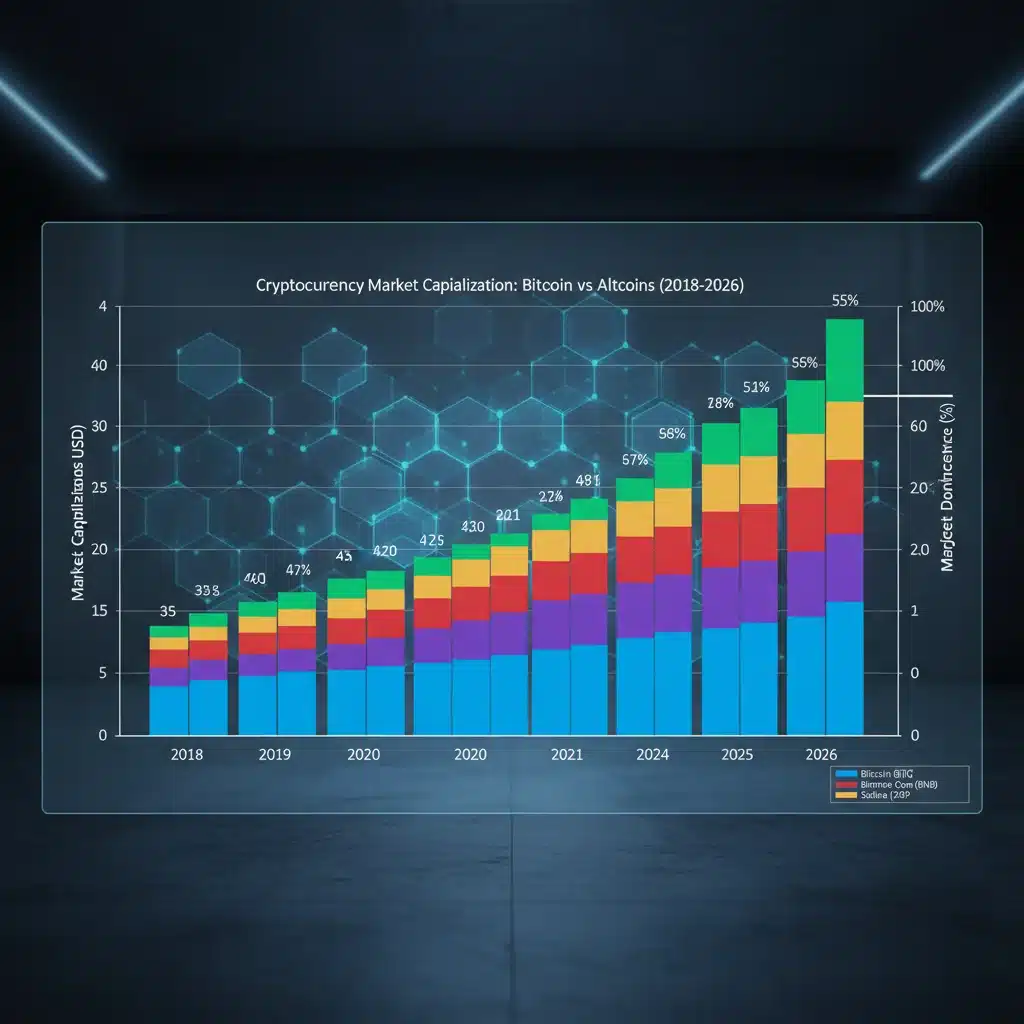
The journey of Bitcoin dominance is a narrative of market cycles. From its peak in 2017, dipping to around 35-40% during subsequent altcoin rallies, and then recovering. Each cycle provides valuable lessons about investor behavior, technological innovation, and market maturity. The projected 55% Bitcoin dominance by 2026 suggests a potential shift back towards a Bitcoin-centric market, or at least a market where Bitcoin reasserts its foundational role more strongly than it has in recent years. This level of dominance would represent a significant consolidation of value, signaling a mature phase for the pioneer cryptocurrency.
Factors Driving Bitcoin Dominance Towards 55% by 2026
Several converging factors could contribute to Bitcoin reaching a 55% market dominance by 2026. Understanding these drivers is key to anticipating market movements and adjusting investment strategies accordingly.
Institutional Adoption and Regulatory Clarity
One of the most significant catalysts for increased Bitcoin dominance is the accelerating pace of institutional adoption. The approval of spot Bitcoin ETFs in the U.S. marked a watershed moment, opening the floodgates for traditional finance to access Bitcoin more easily. As more institutions, including pension funds, endowments, and sovereign wealth funds, allocate portions of their portfolios to Bitcoin, its market capitalization will naturally swell. These large-scale investments bring with them not only capital but also a stamp of legitimacy that can attract retail investors who were previously hesitant.
Coupled with institutional adoption is the ongoing development of regulatory clarity, particularly in the United States. While the regulatory landscape remains somewhat fragmented, there’s a growing consensus on how Bitcoin should be treated from a legal and taxation perspective. Clearer regulations reduce uncertainty, making Bitcoin a more attractive and less risky asset for both institutional and retail investors. This clarity can also differentiate Bitcoin from the vast array of altcoins, many of which face greater regulatory scrutiny or are still navigating their legal classifications.
Bitcoin’s Halving Cycles and Scarcity Narrative
Bitcoin’s programmed halving events, which reduce the supply of new Bitcoins entering circulation every four years, have historically been precursors to significant price appreciation. The next halving is anticipated around 2024. These events reinforce Bitcoin’s fundamental scarcity narrative, making it an increasingly valuable asset as demand potentially outstrips supply. The cumulative effect of these halvings, combined with growing demand, could propel Bitcoin’s price to new highs, thereby increasing its market dominance.
Technological Advancements and Network Security
While altcoins often boast about novel technological features, Bitcoin continues to evolve. Developments like the Lightning Network for faster and cheaper transactions, and ongoing improvements in its core protocol, enhance Bitcoin’s utility and scalability. Its unparalleled network security, buttressed by the immense computational power of its mining network, remains a critical advantage. In a world increasingly concerned with digital security, Bitcoin’s robust architecture provides a level of trust and immutability that few other cryptocurrencies can match, making it a preferred choice for storing significant value.
Macroeconomic Conditions and Safe-Haven Appeal
Global macroeconomic conditions can also play a crucial role. In times of economic uncertainty, currency debasement, or geopolitical instability, Bitcoin has often been touted as ‘digital gold’ – a hedge against inflation and a store of value independent of traditional financial systems. If global economic volatility persists or escalates towards 2026, Bitcoin’s appeal as a decentralized, censorship-resistant asset could strengthen, driving more capital into it and boosting its dominance. U.S. investors, keenly aware of inflation and market fluctuations, may increasingly view Bitcoin as a necessary component of a diversified portfolio.
Implications of 55% Bitcoin Dominance for U.S. Crypto Portfolios
A 55% Bitcoin dominance by 2026 would have profound implications for U.S. crypto investors, necessitating a re-evaluation of current portfolio allocations and strategies.
Increased Stability and Lower Volatility (Relative to Altcoins)
If Bitcoin reclaims a significant portion of the market, it could lead to a period of relative stability for the crypto market as a whole. While Bitcoin itself is volatile compared to traditional assets, its larger market cap and institutional backing tend to make it less volatile than most altcoins. A higher dominance could mean that Bitcoin acts as a stronger anchor for the overall market, potentially reducing extreme price swings across the board, though altcoins would still experience higher beta.
Altcoin Performance: A Differentiated Landscape
A higher Bitcoin dominance doesn’t necessarily spell doom for all altcoins, but it does suggest a more selective market. Investors might see a ‘flight to quality’ within the altcoin space, where only projects with strong fundamentals, clear utility, and robust development teams continue to thrive. ‘Meme coins’ or projects with speculative hype but little substance might struggle to gain traction against a dominant Bitcoin. U.S. investors would need to be more discerning, focusing on altcoins that offer genuine innovation, solve real-world problems, and have a clear path to adoption. This could lead to a ‘decoupling’ of high-quality altcoins from the broader altcoin market, where their performance is less tied to Bitcoin’s movements.
Portfolio Rebalancing and Risk Management
For many U.S. investors, a 55% Bitcoin dominance would likely necessitate a rebalancing of their portfolios. Those heavily invested in a wide array of altcoins might consider increasing their Bitcoin allocation to align with market trends and potentially reduce overall portfolio risk. Risk management would become even more critical, with a greater emphasis on understanding the specific use cases and competitive advantages of each altcoin investment. Diversification within altcoins would still be important, but perhaps with a greater focus on established projects in key sectors like DeFi, Web3 infrastructure, or enterprise blockchain solutions.
The ‘Bitcoin Standard’ for Valuations
A strong Bitcoin dominance could further solidify Bitcoin’s role as the primary benchmark for the crypto market. Altcoins are often valued in terms of their Bitcoin equivalent (e.g., how many satoshis an altcoin is worth). If Bitcoin’s dominance strengthens, this ‘Bitcoin standard’ could become even more pronounced, influencing how investors perceive the value and potential of other digital assets. This means that even if an altcoin’s USD value increases, its performance relative to Bitcoin would be a key metric for many investors.
Navigating the Market: Strategies for U.S. Investors
Given the projection of 55% Bitcoin dominance by 2026, U.S. crypto investors should consider adopting strategies that align with this potential market shift.
Core Bitcoin Allocation
For many, a foundational allocation to Bitcoin will be paramount. Bitcoin’s role as a store of value, its increasing institutional acceptance, and its potential for continued appreciation make it a cornerstone asset. Investors who have previously shied away from a significant Bitcoin holding might find it prudent to review their positions and consider increasing their exposure, especially through regulated avenues like spot ETFs.
Strategic Altcoin Selection
Instead of broad altcoin exposure, a more strategic approach to altcoin selection will be crucial. Focus on projects with strong utility, proven technology, active development, and a clear market fit. Research projects that solve specific problems, have growing user bases, and possess sustainable tokenomics. Consider sectors that are likely to see continued growth, such as decentralized finance (DeFi), layer-2 scaling solutions, privacy coins, or specific industry-focused blockchain applications. This approach helps to filter out speculative projects that may not withstand a Bitcoin-dominant market.
Dollar-Cost Averaging (DCA)
Regardless of market conditions, dollar-cost averaging (DCA) remains a robust strategy. By investing a fixed amount of money at regular intervals, investors can mitigate the impact of market volatility and avoid trying to ‘time the market.’ This strategy is particularly effective in a market where Bitcoin is expected to maintain strong upward momentum over the long term.
Staying Informed on Regulatory Developments
The U.S. regulatory landscape for cryptocurrencies is still evolving. Staying informed about new legislation, SEC rulings, and IRS guidance is vital. Regulatory clarity can significantly impact the viability and growth potential of various crypto assets, and understanding these changes can help investors make informed decisions and remain compliant.
Understanding Market Cycles and Sentiment
Crypto markets are cyclical. Recognizing the patterns of Bitcoin dominance – how it tends to rise during bear markets and consolidate during bull runs – can provide valuable insights. A 55% Bitcoin dominance by 2026 could signal a mature phase of the current cycle, where capital flows are more concentrated in established assets. Monitoring market sentiment, both for Bitcoin and altcoins, through various indicators and news sources, can help investors gauge opportune times for entry and exit.

Potential Challenges and Counterarguments
While the projection of 55% Bitcoin dominance by 2026 is based on strong indicators, it’s also important to consider potential challenges and counterarguments that could alter this trajectory.
Emergence of ‘Bitcoin Killers’ or Disruptive Technologies
The crypto space is renowned for its rapid innovation. While Bitcoin’s network effect and security are formidable, a truly disruptive technology could emerge that challenges its fundamental value proposition. A new blockchain that offers significantly superior scalability, privacy, or functionality without compromising decentralization could potentially chip away at Bitcoin’s market share. However, the bar for such a ‘Bitcoin killer’ is incredibly high, and none have successfully done so to date.Unexpected Regulatory Crackdowns
Despite the trend towards clarity, unforeseen or overly restrictive regulatory actions, particularly in the U.S., could negatively impact the entire crypto market, including Bitcoin. While Bitcoin is considered more resilient to regulatory pressures than many altcoins, extreme measures could dampen investor enthusiasm and capital inflows, affecting its dominance.
Macroeconomic Shocks and Black Swan Events
A severe global economic downturn, an unprecedented financial crisis, or a major geopolitical conflict could lead to a ‘risk-off’ environment where even Bitcoin, as a nascent asset class, faces significant selling pressure. While it might still outperform altcoins in such scenarios, its overall market cap and dominance could be affected if investors retreat en masse from all speculative assets.
Sustained Altcoin Innovation and Ecosystem Growth
The altcoin market is not static. Continuous innovation in areas like decentralized AI, gaming, social media, and new Layer 1 or Layer 2 solutions could lead to a renewed ‘altcoin season’ that challenges Bitcoin’s dominance. If these ecosystems mature rapidly and attract significant user bases and capital, they could collectively grow faster than Bitcoin, preventing it from reaching the 55% mark. The continued growth of stablecoins, while not directly competing with Bitcoin, also represents a significant portion of the total crypto market cap that can influence dominance metrics.
The Long-Term Outlook for Bitcoin and U.S. Investors
Regardless of whether Bitcoin precisely hits 55% dominance by 2026, the underlying trends suggest a continued maturation of the cryptocurrency market with Bitcoin playing a central, foundational role. For U.S. investors, this means that understanding Bitcoin’s position is not optional; it’s fundamental to navigating the digital asset space.
The future of finance is increasingly digital, and Bitcoin is at the forefront of this transformation. Its predictable supply, growing institutional acceptance, and increasing utility position it as a long-term store of value and a hedge against traditional financial instabilities. As the market evolves, U.S. investors who strategically incorporate Bitcoin into their portfolios, alongside a carefully curated selection of high-potential altcoins, will be best positioned to capitalize on the opportunities that the digital economy presents.
The journey to 2026 will undoubtedly bring its share of volatility and surprises. However, by focusing on fundamental analysis, maintaining a long-term perspective, and adapting to market shifts, U.S. crypto investors can build resilient portfolios designed to thrive in a world where Bitcoin’s influence is likely to remain paramount. The 55% dominance projection serves as a powerful reminder of Bitcoin’s enduring strength and its critical role in shaping the future of digital wealth.
Conclusion: Preparing for a Bitcoin-Dominant Future
The prospect of Bitcoin achieving 55% market dominance by 2026 is more than just a statistical forecast; it’s a potential blueprint for the evolving cryptocurrency market. This scenario underscores Bitcoin’s growing maturity, its strengthening position as a digital store of value, and its increasing integration into the traditional financial landscape, especially within the United States. For U.S. crypto investors, this projection signals a need for thoughtful consideration of portfolio construction, risk management, and strategic asset allocation.
While altcoins will continue to offer innovative opportunities and potentially higher returns, a market with higher Bitcoin dominance suggests that a strong foundational holding in Bitcoin will likely be a prudent strategy. The factors driving this dominance – institutional adoption, regulatory clarity, halving cycles, and technological resilience – paint a picture of a more stable, yet still dynamic, crypto ecosystem. As we move towards 2026, staying informed, maintaining a long-term investment horizon, and adapting to these macro trends will be crucial for success in the ever-exciting world of digital assets.