Altcoin Valuation 2026: Advanced Metrics for U.S. Investors
The cryptocurrency landscape is in constant flux, evolving at a remarkable pace that often leaves traditional investment strategies struggling to keep up. For U.S. investors looking to navigate the burgeoning altcoin market in 2026, relying solely on historical price charts or superficial hype is a recipe for disaster. As the market matures and regulatory frameworks begin to solidify, a deeper, more analytical approach to altcoin valuation becomes not just advantageous, but absolutely essential. This article delves into three advanced metrics that sophisticated U.S. investors must integrate into their due diligence process to uncover true value and mitigate risk in the dynamic world of altcoins.
Understanding these advanced altcoin valuation metrics will empower you to move beyond speculative trading and towards informed, strategic investing. We’re talking about a paradigm shift from ‘what’s hot’ to ‘what’s fundamentally sound.’ The year 2026 promises a more refined crypto ecosystem, where projects with robust fundamentals and sustainable models are more likely to thrive. Therefore, our focus will be on tangible, quantifiable, and qualitative factors that contribute to an altcoin’s long-term viability and potential for appreciation.
The sheer volume of altcoins available can be overwhelming, with thousands of projects vying for attention and capital. Distinguishing between fleeting trends and genuine innovation requires a keen eye and a structured methodology. This is where advanced altcoin valuation metrics come into play. They provide a framework for dissecting a project’s core components, allowing investors to make decisions based on data and logic, rather than emotion or herd mentality. For U.S. investors, who are increasingly facing stricter compliance and reporting requirements, a verifiable and defensible valuation process is paramount.
The Evolving Altcoin Landscape: Why Traditional Metrics Fall Short
For many years, the cryptocurrency market, especially the altcoin sector, was characterized by high volatility and a strong correlation to Bitcoin’s price movements. Valuation often hinged on market capitalization, trading volume, and community sentiment. While these metrics still hold some relevance, they are insufficient for a comprehensive analysis in 2026. The market has matured, and projects are now expected to demonstrate real-world utility, sustainable economic models, and active development.
Traditional financial metrics like Price-to-Earnings (P/E) ratios or Discounted Cash Flow (DCF) models, while foundational in equity markets, often struggle to translate directly to the unique characteristics of decentralized digital assets. Cryptocurrencies don’t typically generate traditional earnings, and their value propositions are often tied to network effects, technological innovation, and community governance. This necessitates a bespoke set of altcoin valuation metrics that can capture these nuances effectively.
Furthermore, the regulatory environment in the U.S. is becoming increasingly defined. Securities laws, tax implications, and consumer protection measures are all shaping how altcoins are perceived and traded. Investors must not only understand the intrinsic value of an altcoin but also its regulatory compliance posture. While this article focuses on fundamental valuation, it’s a critical underlying factor that influences the long-term prospects of any project operating within the U.S. legal framework.
The rise of decentralized finance (DeFi), Non-Fungible Tokens (NFTs), and Web3 applications has also introduced new layers of complexity. An altcoin might be the native token of a DeFi protocol, a governance token for a DAO, or a utility token within a metaverse. Each of these use cases demands a tailored approach to valuation, moving beyond simple supply and demand dynamics to evaluate the underlying ecosystem’s health and growth potential. This brings us to our first advanced metric: Tokenomics.
Advanced Metric 1: In-depth Tokenomics Analysis
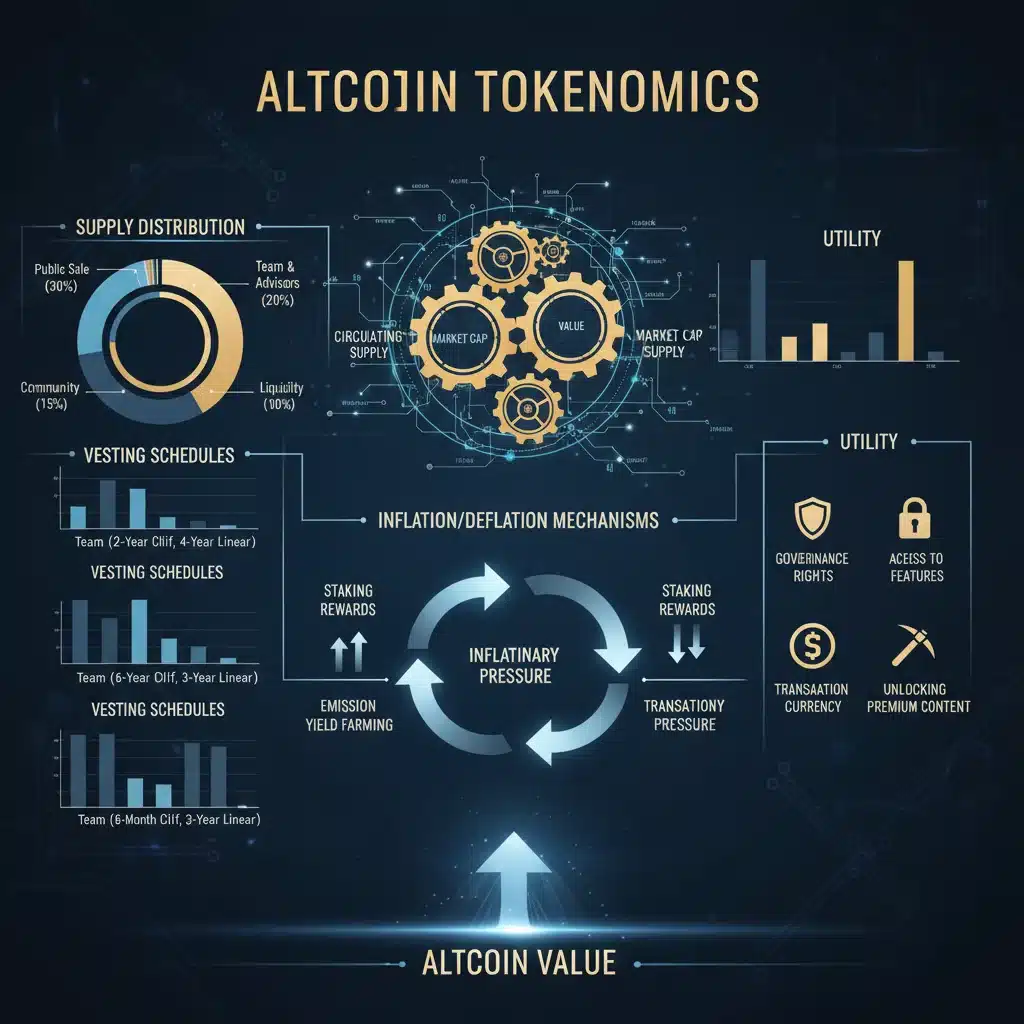
Tokenomics, a portmanteau of ‘token’ and ‘economics,’ refers to the economic principles governing a cryptocurrency. It encompasses everything from how a token is created, distributed, and used, to its supply schedule, incentive mechanisms, and utility within its ecosystem. For altcoin valuation, a thorough understanding of tokenomics is paramount, as it directly impacts the token’s scarcity, demand, and long-term value proposition. For U.S. investors, scrutinizing tokenomics helps identify projects with sustainable economic models versus those designed for short-term speculation.
Supply and Distribution Mechanics
The total supply and circulating supply of an altcoin are fundamental. Projects with an uncapped supply or an overly inflationary issuance schedule can see their value diluted over time. Conversely, projects with a fixed or deflationary supply, especially those with burning mechanisms or staking rewards, might exhibit stronger long-term value retention. Key questions to ask include:
- What is the maximum supply of the token? Is it fixed or dynamic?
- What is the current circulating supply, and what is the future emission schedule?
- How were tokens initially distributed (e.g., ICO, IEO, airdrop, fair launch)?
- Are there significant allocations to founders, teams, or venture capitalists? What are their vesting schedules? Long vesting periods can indicate long-term commitment, but large unlocks can also create selling pressure.
U.S. investors should pay close attention to vesting schedules. A project with a large percentage of its supply held by early investors or the team, with short vesting periods, poses a higher risk of significant sell-offs once those tokens unlock. Transparency in these areas is a strong indicator of a project’s legitimacy and commitment to its community.
Utility and Value Accrual Mechanisms
Beyond mere speculation, a token’s intrinsic value is often derived from its utility within its native ecosystem. What can users actually do with the token? Does it grant governance rights, pay for network fees, serve as collateral, or provide access to exclusive features? The stronger and more diverse the utility, the higher the fundamental demand for the token is likely to be.
- Does the token have a clear and compelling use case within its ecosystem?
- Does holding the token entitle users to a share of protocol revenue or fees?
- Is the token required for staking, providing liquidity, or participating in governance?
- How does the token capture value from the growth and adoption of the underlying protocol or application?
For example, a governance token that allows holders to vote on critical protocol parameters and receive a share of transaction fees has a stronger value accrual mechanism than a simple payment token with no additional utility. U.S. investors should seek out tokens where the success of the underlying project directly translates into increased demand or value for the token itself.
Incentive Structures and Game Theory
Well-designed tokenomics incorporate game theory to align the incentives of all participants – users, developers, validators, and investors. This ensures the network’s security, efficiency, and growth. Poorly designed incentives can lead to centralization, exploitation, or a ‘tragedy of the commons’ scenario.
- Are there effective staking mechanisms that incentivize long-term holding and network security?
- Do liquidity mining or yield farming programs encourage participation without creating unsustainable inflation?
- How does the protocol prevent malicious behavior or Sybil attacks?
- Are there mechanisms for burning tokens or distributing fees that benefit holders?
Analyzing these incentive structures helps U.S. investors understand the long-term sustainability and robustness of an altcoin project. A tokenomic model that encourages active participation and discourages predatory behavior is a strong positive signal.
Advanced Metric 2: Developer Activity and Code Quality
In the world of technology, particularly open-source software like most cryptocurrencies, the health and activity of the development team and community are critical indicators of a project’s long-term viability. For altcoin valuation, U.S. investors should look beyond marketing hype and delve into the actual code and the people building it. A project with a vibrant, active, and skilled developer community is far more likely to innovate, adapt, and secure its network than one with stagnant or centralized development.
Codebase Activity and GitHub Metrics
GitHub (or similar code repositories) serves as the open ledger of a project’s development. Analyzing metrics here can provide invaluable insights into the progress, security, and future potential of an altcoin. For U.S. investors, these are objective, verifiable data points.
- Commits: How frequently are developers committing new code or changes? Consistent, regular commits indicate ongoing development.
- Contributors: How many unique developers are contributing to the codebase? A higher number suggests a decentralized and robust development effort.
- Forks and Stars: While not direct indicators of quality, a high number of forks (copies of the repository) and stars (bookmarks) can indicate interest and potential for community development.
- Pull Requests (PRs) and Issues: Active PRs and resolved issues demonstrate engagement and responsiveness to bugs or improvements.
- Code Quality: Look for well-documented code, adherence to best practices, and security audits. Tools like static code analyzers can offer some insights.
A project with a flurry of commits from a single developer might raise red flags regarding centralization and bus factor risk. Conversely, a project with a diverse group of contributors making regular, meaningful updates suggests a healthy and resilient development ecosystem. U.S. investors should prioritize projects that demonstrate continuous improvement and active maintenance.
Developer Community and Ecosystem Growth
Beyond the core codebase, the broader developer community around an altcoin is crucial. A strong community attracts more talent, fosters innovation, and ensures the protocol’s long-term evolution. This often includes:
- Documentation: Is the project’s documentation comprehensive, up-to-date, and easy for new developers to understand? Good documentation lowers the barrier to entry for external contributors.
- Developer Tools & SDKs: Does the project offer robust Software Development Kits (SDKs), APIs, and other tools that make it easy for developers to build decentralized applications (dApps) on its platform?
- Grants and Funding: Are there active grant programs or other initiatives to fund external developers building on the protocol? This indicates a commitment to ecosystem growth.
- Hackathons and Conferences: Participation in or hosting of developer events signals an active and engaged community.
For U.S. investors, a thriving developer ecosystem translates to a higher likelihood of new applications, increased utility, and ultimately, greater adoption for the altcoin. This organic growth is a powerful driver of long-term value.
Audits and Security Posture
Given the immutable nature of blockchain and the significant financial stakes involved, security is paramount. Rigorous security audits are non-negotiable for any serious altcoin project. U.S. investors must verify that projects have undergone independent security audits by reputable firms.
- Are there recent, independent security audits available for the protocol’s smart contracts?
- What were the findings of these audits, and how were critical vulnerabilities addressed?
- Does the project have a bug bounty program to incentivize white-hat hackers to find and report vulnerabilities?
- What is the project’s track record regarding security incidents or exploits?
A proactive approach to security, including regular audits and a responsive team, significantly de-risks an altcoin investment. Neglecting security can lead to catastrophic losses, as evidenced by numerous hacks and exploits in the crypto space. U.S. investors should exercise extreme caution with projects that lack transparent security measures.
Advanced Metric 3: Network Effect and Adoption Metrics
The concept of a network effect, where a product or service becomes more valuable as more people use it, is profoundly relevant to altcoin valuation. For cryptocurrencies, this translates into increased utility, liquidity, and security as the user base and interconnected applications grow. For U.S. investors, understanding the strength and trajectory of an altcoin’s network effect is crucial for assessing its long-term potential.
User Adoption and Transactional Activity
The ultimate measure of a blockchain’s success is its real-world usage. High user adoption and consistent transactional activity indicate a healthy and valuable network. These are vital altcoin valuation indicators.
- Active Addresses: How many unique active addresses interact with the network daily, weekly, or monthly? Consistent growth here signals increasing adoption.
- Transaction Count and Volume: A high number of transactions and significant transaction volume indicate real utility and economic activity on the chain.
- Fees Generated: For protocols that accrue fees, the amount of fees generated can be a direct measure of economic value being captured by the network.
- Distinct Users of dApps: For smart contract platforms, how many unique users are interacting with decentralized applications built on that chain?
It’s important to distinguish between speculative transactions and genuine utility-driven usage. A project with consistently high transaction volume driven by actual use cases (e.g., DeFi transactions, NFT minting, payment processing) is far more robust than one whose volume is primarily driven by exchange trading. U.S. investors should look for organic, sustained growth in these metrics, rather than sudden spikes that might indicate manipulation.
Interoperability and Ecosystem Integration
In a multi-chain future, an altcoin’s ability to interact with other blockchains and integrate into the broader crypto ecosystem significantly enhances its network effect. Isolated projects, no matter how technologically advanced, risk becoming irrelevant.
- Bridge Activity: Is the altcoin’s network connected to other major blockchains via bridges? High bridge activity indicates demand for assets or services on that chain.
- Wrapped Assets: Are assets from other chains being wrapped and utilized within the altcoin’s ecosystem, or vice versa?
- Partnerships and Integrations: Does the project have strategic partnerships with other reputable projects, traditional companies, or institutions?
- Standard Compliance: Does the project adhere to industry standards (e.g., ERC-20, ERC-721, IBC) that facilitate interoperability?
A project that acts as a hub, connecting various parts of the crypto world, naturally accrues more value due to its central role. U.S. investors should consider the project’s position within the larger Web3 ecosystem and its potential to become a foundational layer or a critical connector.
Community Engagement and Governance Participation
While often seen as a softer metric, a strong, engaged community is a powerful network effect driver. It contributes to decentralization, resilience, and collective innovation. For U.S. investors, a vibrant community can be a strong signal of long-term commitment and support for the project.
- Social Media Presence: Active and growing communities on platforms like Twitter, Discord, Telegram, and Reddit.
- Governance Participation: For projects with decentralized autonomous organizations (DAOs), what is the voter turnout for proposals? Active participation indicates an engaged community invested in the project’s future.
- Forum Activity: Are there active discussions, problem-solving, and idea generation happening in project forums or community calls?
- Developer and User Forums: Beyond general social media, dedicated forums for developers and users indicate a healthy ecosystem.
A project with a passionate and active community is more likely to weather market downturns, attract new talent, and adapt to changing conditions. This collective intelligence and support are invaluable assets for any altcoin. U.S. investors should look for communities that are not just large, but also genuinely engaged and contributing to the project’s development and adoption.

Integrating Advanced Metrics for Comprehensive Due Diligence
Successfully navigating the altcoin market in 2026 as a U.S. investor requires a holistic approach that integrates these advanced altcoin valuation metrics. No single metric provides the full picture; rather, it’s the interplay and confluence of strong signals across all three categories that indicate a truly promising project. Think of it as constructing a multi-faceted investment thesis. Each metric serves as a pillar supporting your decision-making process.
A Synergistic Approach
Consider a hypothetical altcoin project. If its tokenomics reveal a well-designed deflationary model with clear utility and strong incentive alignment, that’s a positive. If, in addition, its GitHub shows consistent commits from a diverse group of talented developers, and it has recently undergone a successful security audit, the picture becomes even stronger. Finally, if on-chain data demonstrates growing active addresses, increasing transaction volume, and robust interoperability with other major chains, you have a compelling case for a deep dive.
Conversely, red flags in any one area should prompt further investigation. Poorly designed tokenomics, stagnant development, or a lack of real-world adoption are significant warning signs, even if other aspects appear favorable. For U.S. investors, regulatory scrutiny means that projects with clear, defensible fundamentals are less likely to face legal challenges or be deemed unregistered securities.
The Importance of Qualitative Analysis
While these metrics provide a quantitative framework, don’t underestimate the power of qualitative analysis. Who is the team behind the project? What is their experience and track record? What is their vision for the future, and how well do they communicate it? Is their roadmap realistic and achievable? A strong team with a clear vision and transparent communication can overcome many hurdles, while a brilliant technical idea can falter without effective leadership and execution.
Furthermore, assessing the competitive landscape is crucial. What other projects are attempting to solve similar problems? Does the altcoin have a sustainable competitive advantage – a unique technology, a first-mover advantage, or a superior network effect? Understanding its niche and its potential for market dominance adds another layer to your altcoin valuation.
Risk Management and Portfolio Diversification
Even with the most rigorous due diligence using advanced altcoin valuation metrics, the cryptocurrency market remains speculative and volatile. Therefore, prudent risk management is essential for U.S. investors. Never invest more than you can afford to lose, and consider diversifying your portfolio across multiple altcoins and different sectors of the crypto market (e.g., DeFi, L1s, NFTs, Web3 infrastructure).
Regularly review your investment thesis for each altcoin. Has the tokenomics model changed? Is developer activity slowing down? Are adoption metrics stagnating? The crypto space moves quickly, and what was a strong investment today might not be tomorrow. Continuous monitoring and adaptation are key to long-term success.
Conclusion: Mastering Altcoin Valuation for 2026 and Beyond
The year 2026 presents both immense opportunities and significant challenges for U.S. investors in the altcoin market. Moving beyond superficial analysis and embracing advanced altcoin valuation metrics is no longer optional; it’s a prerequisite for success. By meticulously examining a project’s tokenomics, scrutinizing its developer activity and code quality, and assessing its network effect and adoption, you can build a robust framework for making informed investment decisions.
These three advanced metrics – Tokenomics Analysis, Developer Activity and Code Quality, and Network Effect and Adoption Metrics – provide a comprehensive lens through which to evaluate the intrinsic value and long-term potential of altcoins. They empower U.S. investors to cut through the noise, identify truly innovative and sustainable projects, and navigate the complexities of the crypto market with greater confidence and strategic foresight.
Remember, investing in altcoins is a marathon, not a sprint. Patience, continuous learning, and a disciplined approach to due diligence using these advanced altcoin valuation metrics will be your most valuable assets in the years to come. As the digital asset space continues to mature, those who master these analytical tools will be best positioned to capitalize on the transformative potential of altcoins.